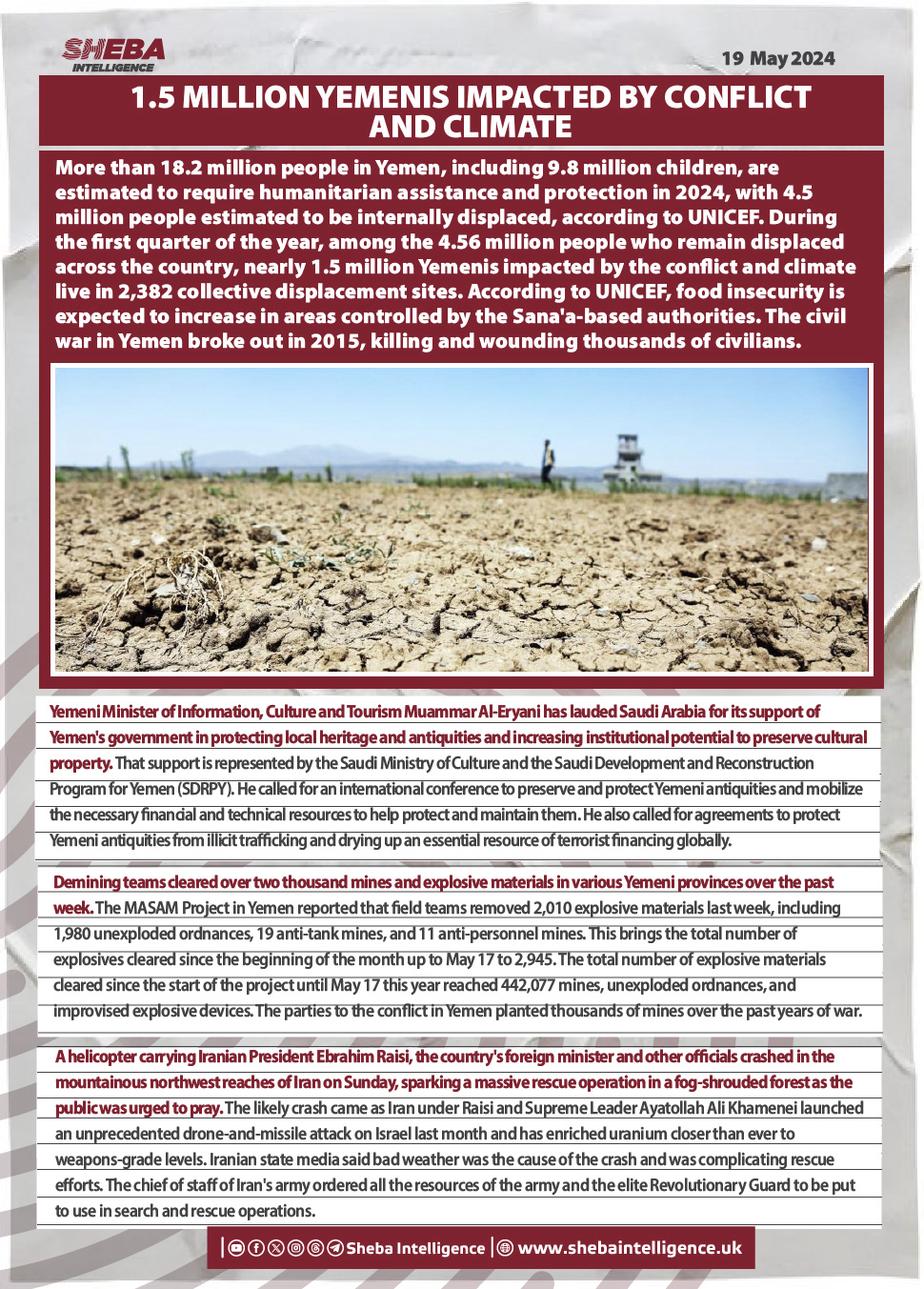
More than 18.2 million people in Yemen, including 9.8 million children, are estimated to require humanitarian assistance and protection in 2024, with 4.5 million people estimated to be internally displaced, according to UNICEF. During the first quarter of the year, among the 4.56 million people who remain displaced across the country, nearly 1.5 million Yemenis impacted by the conflict and climate live in 2,382 collective displacement sites. According to UNICEF, food insecurity is expected to increase in areas controlled by the Sana'a-based authorities. The civil war in Yemen broke out in 2015, killing and wounding thousands of civilians.
Yemeni Minister of Information, Culture and Tourism Muammar Al-Eryani has lauded Saudi Arabia for its support of Yemen's government in protecting local heritage and antiquities and increasing institutional potential to preserve cultural property. That support is represented by the Saudi Ministry of Culture and the Saudi Development and Reconstruction Program for Yemen (SDRPY). He called for an international conference to preserve and protect Yemeni antiquities and mobilize the necessary financial and technical resources to help protect and maintain them. He also called for agreements to protect Yemeni antiquities from illicit trafficking and drying up an essential resource of terrorist financing globally.
Demining teams cleared over two thousand mines and explosive materials in various Yemeni provinces over the past week. The MASAM Project in Yemen reported that field teams removed 2,010 explosive materials last week, including 1,980 unexploded ordnances, 19 anti-tank mines, and 11 anti-personnel mines. This brings the total number of explosives cleared since the beginning of the month up to May 17 to 2,945. The total number of explosive materials cleared since the start of the project until May 17 this year reached 442,077 mines, unexploded ordnances, and improvised explosive devices. The parties to the conflict in Yemen planted thousands of mines over the past years of war.
A helicopter carrying Iranian President Ebrahim Raisi, the country's foreign minister and other officials crashed in the mountainous northwest reaches of Iran on Sunday, sparking a massive rescue operation in a fog-shrouded forest as the public was urged to pray. The likely crash came as Iran under Raisi and Supreme Leader Ayatollah Ali Khamenei launched an unprecedented drone-and-missile attack on Israel last month and has enriched uranium closer than ever to weapons-grade levels. Iranian state media said bad weather was the cause of the crash and was complicating rescue efforts. The chief of staff of Iran's army ordered all the resources of the army and the elite Revolutionary Guard to be put to use in search and rescue operations.