Al-Alimi Confirms Strike on Sana’a Airport Runway, Says Yemen Avoided Wider Escalation
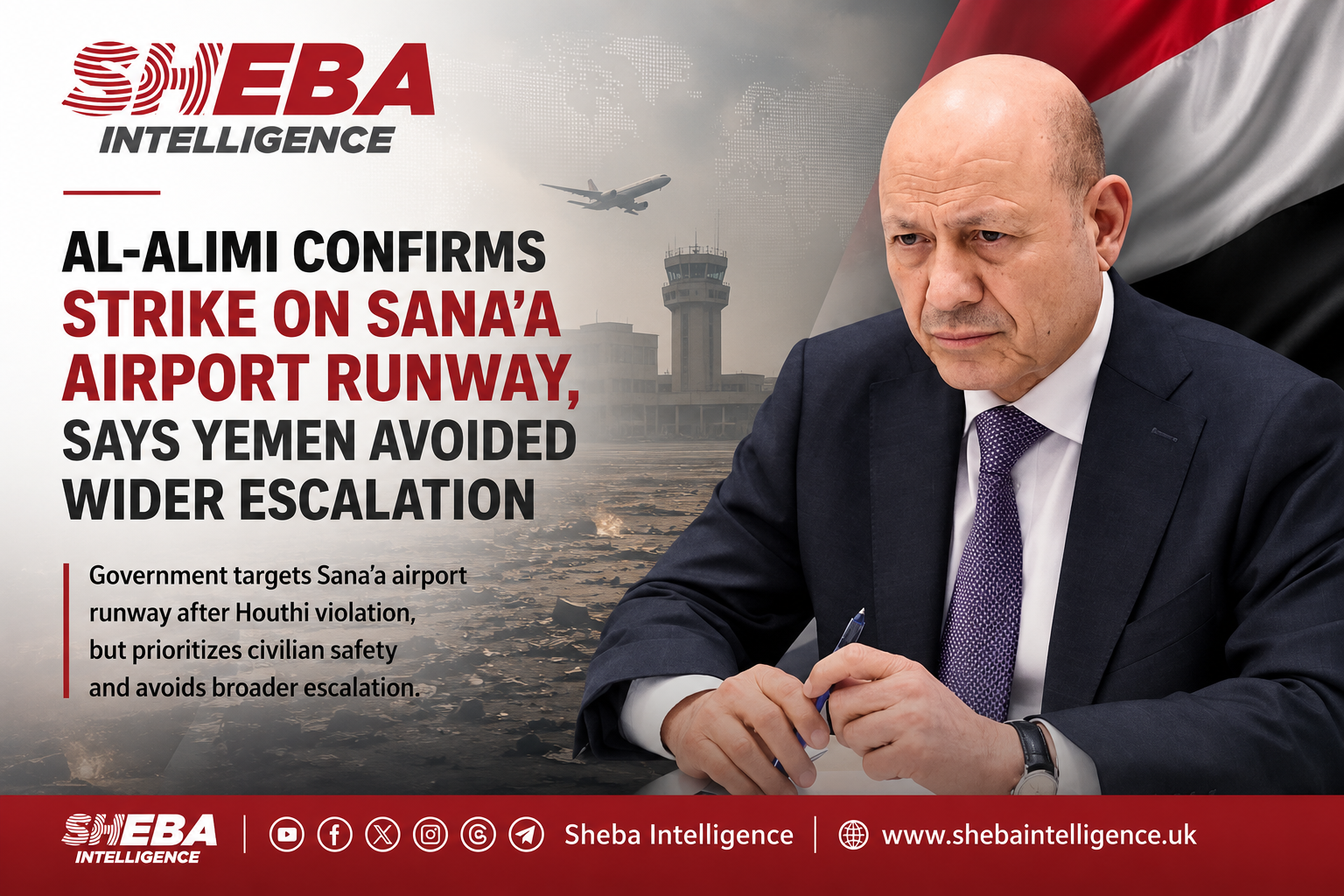
Yemen’s Presidential Leadership Council Chairman, Rashad al-Alimi, confirmed that government forces targeted the runway at Sana’a International Airport in what he described as a defensive action aimed at preventing a new unlawful flight from imposing a fait accompli over Yemeni airspace.
The statement marks the first direct official confirmation that the explosions reported at Sana’a airport were caused by an operation carried out by forces aligned with the internationally recognized government.
Al-Alimi said the armed forces and security agencies had been placed on the highest level of readiness and had taken the necessary measures to protect national sovereignty and prevent the Houthis from establishing unauthorized air routes outside the authority of the state.
However, the most significant development in the statement was his confirmation that he ordered the military not to expand the confrontation. He said the decision was taken after completing military, security and political assessments, with priority given to protecting civilian lives and public infrastructure.
Al-Alimi accused Iran of attempting to drag Yemen into a broader regional conflict that serves Tehran’s interests, while using Yemeni territory and civilians as instruments in that confrontation.
The statement therefore outlines a policy of limited deterrence rather than open escalation. The government sought to demonstrate that it has the ability to disrupt unauthorized flights, while deliberately avoiding a wider military confrontation that could endanger civilians or expand to other airports and facilities.
Al-Alimi also warned that the government would not allow any aircraft to violate Yemeni airspace in the future, whether through Sana’a airport or any other airport. The warning appears to include Hodeidah airport and other Houthi-controlled airfields that could be used as alternatives if Sana’a becomes unavailable.
He also called for an emergency meeting of the Presidential Leadership Council to review the latest developments and adopt further political, legal, security and military measures. Government institutions and security forces were instructed to maintain maximum readiness and prevent similar violations at Yemen’s airports, ports and border crossings.
The statement further stressed that the government remains prepared to keep Sana’a airport operating through legal commercial flights conducted by Yemenia Airways, the country’s officially authorized national carrier. Al-Alimi said the Houthis had rejected proposals intended to facilitate civilian travel and the movement of their delegation through an aircraft chartered by the airline.
Sheba Intelligence Background
The latest developments follow a series of warnings by Sheba Intelligence that Iran was seeking to reopen an air bridge to Houthi-controlled territory and test the Yemeni government’s willingness and ability to enforce sovereignty over national airspace.
Previous Sheba Intelligence reporting indicated that Iranian flights may have purposes extending beyond political messaging, including the possible transfer of technical experts or sensitive military equipment.
The platform had also warned that Hodeidah airport or other Houthi-controlled military airfields could be used as alternative destinations if operations at Sana’a airport were disrupted.
The latest statement indicates that the government has now moved from political warnings to a limited military response, while still seeking to contain the crisis and prevent it from developing into a broader air confrontation.
The dispute is therefore no longer limited to a single flight. It has become a wider test of the Yemeni state’s ability to control its airspace and of whether the Houthis and Iran can establish unauthorized aviation routes outside internationally recognized government authority.