Exclusive Investigation: Sheba Intelligence Uncovers Two Possible Sources of Houthi Cruise Missiles Used in Riyadh Attacks
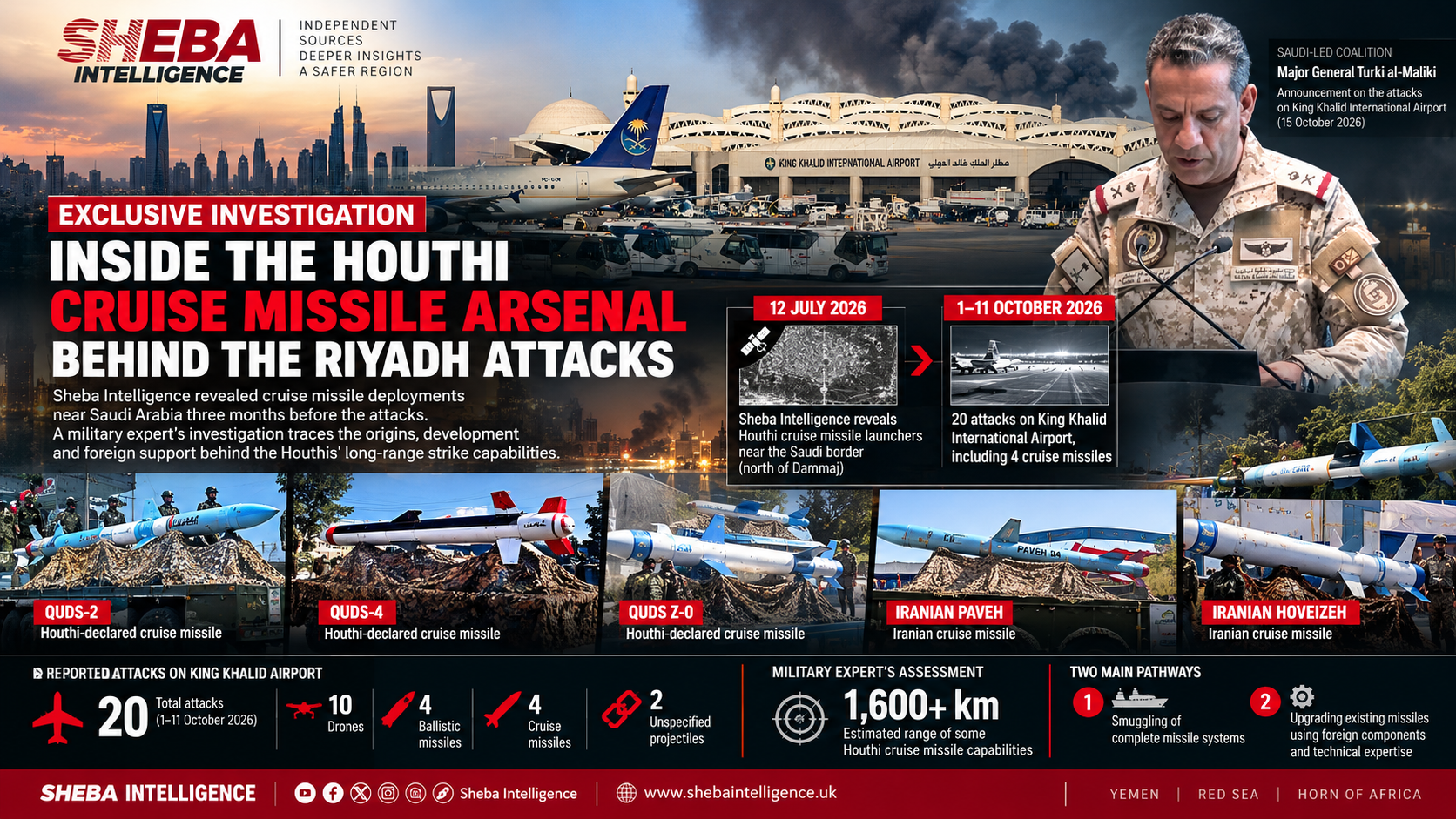
Three months before the attacks on King Khalid International Airport, Sheba Intelligence revealed the deployment of Houthi cruise missile launchers near the Saudi border. A new investigation conducted by a military expert for the platform traces the origins of the group's long-range missile capabilities, examining two scenarios: the smuggling of complete missile systems or the upgrading of existing weapons with foreign technical assistance. The investigation estimates that some of these capabilities may have ranges exceeding 1,600 kilometres.
Sheba Intelligence | Exclusive Investigation | October 20, 2026
Nearly three months before the attacks on King Khalid International Airport in Riyadh, Sheba Intelligence revealed that the Houthi group had deployed cruise missile launchers north of Dammaj in Yemen's Saada governorate, near the Saudi border, while missile specialists and technical and logistical support teams were being moved into border areas.
The disclosure came on July 12, 2026, when the platform published exclusive information about the redeployment of Houthi missile capabilities across northern and western Yemen, including positions in Saada, Hodeidah and along the western coast, amid intensifying military preparations.
Three months later, the Saudi-led coalition announced that King Khalid International Airport had been targeted in a series of missile and drone attacks, including strikes involving cruise missiles, resulting in casualties and damage to airport facilities.
The sequence of events has renewed attention to Sheba Intelligence's earlier findings and raised a broader question about the origins of the Houthis' land-attack cruise missiles, how their capabilities have evolved, and which actors have helped provide the technology, components and expertise sustaining the group's missile programme.
In an exclusive investigation conducted by a military expert for Sheba Intelligence, the technical characteristics of land-attack cruise missiles were examined alongside the missile types publicly displayed by the Houthis, Iranian missile systems, components intercepted in maritime arms shipments, and the group's long-range attacks against Saudi Arabia and Israel.
The investigation identifies two principal scenarios behind the development of these capabilities: the acquisition of complete cruise missile systems through international smuggling networks, or the modification of missiles already held by the Houthis using additional components, systems and foreign technical expertise.
The military expert also assesses that the group may possess cruise missiles with ranges exceeding 1,600 kilometres. The investigation further raises the possibility that Russian, Chinese and Indian specialists have contributed to the development of certain systems, alongside Iran's documented role in supporting Houthi missile capabilities.
These findings draw on technical analysis, previous Sheba Intelligence investigations, reports by the United Nations Panel of Experts on Yemen, maritime weapons seizures and international investigations into the evolution of Houthi arms supply networks.
Sheba Intelligence's Early Disclosure: Cruise Missile Launchers Near the Saudi Border
On July 12, 2026, Sheba Intelligence published an exclusive investigation titled:
“Houthis Deploy Missiles Along Saudi Border as Preparations Grow to Close Bab al-Mandab.”
The investigation revealed the deployment of cruise missile launchers north of Dammaj in Saada governorate, accompanied by the movement of missile specialists and technical and logistical support teams into border areas.
Sheba Intelligence also documented additional missile-related movements in western Yemen, including the deployment of long-range ballistic missiles in the Al-Shaghaf and Al-Ammariyah areas of Hodeidah governorate, near the administrative boundary with Al-Mahwit.
The information pointed to instructions to deploy additional launchers in Al-Jah, Al-Salif and Al-Tuhayta, as part of broader Houthi military preparations extending towards the western coast, the Red Sea and the Bab al-Mandab Strait.
According to the information obtained by Sheba Intelligence at the time, these movements were associated with the redistribution of missile and drone capabilities, the establishment of additional deployment positions and the assignment of specialised teams to support military operations.
The disclosure has acquired renewed significance following the Riyadh attacks because it documented the reinforcement of Houthi missile deployments near Saudi Arabia before cruise missiles were used in attacks on King Khalid International Airport.
Its importance also lies in the fact that Sheba Intelligence identified not only the deployment of launchers but also the movement of technical personnel, a detail directly relevant to the central question of the present investigation: how the Houthis acquire, operate and develop their missile capabilities.
The July disclosure therefore provides an important chronological and military reference point for understanding subsequent developments, without establishing that the launchers identified at the time were necessarily used in the October attacks.
King Khalid International Airport: Cruise Missiles Among 20 Attacks
On October 15, 2026, Saudi-led coalition spokesperson Major General Turki al-Maliki announced that King Khalid International Airport had been subjected to 20 attacks between October 1 and October 11.
According to the coalition's classification, the attacks involved ten drones, four ballistic missiles, four cruise missiles and two projectiles whose types had not been identified.
The coalition also reported fatalities and injuries and displayed images of cruise missile fragments it said were associated with the attacks on the airport.
During one wave of attacks, the coalition announced that it had intercepted a cruise missile near the airport. A projectile also fell on Terminal 4, causing a fire and casualties.
The reported use of cruise missiles is particularly significant because these weapons differ from ballistic missiles in their flight profiles, propulsion and guidance systems, as well as the challenges they present to air defence networks.
The continuation of long-range attacks despite operations targeting Houthi weapons depots and missile launchers also raises questions about the size of the group's remaining stockpiles and its ability to replenish losses.
The Technical Characteristics of Land-Attack Cruise Missiles
The investigation focuses on medium-range land-attack cruise missiles, a class of weapons capable of travelling considerable distances through sustained propulsion while following relatively low-altitude flight paths.
The military expert identifies the following representative technical characteristics:
| Characteristic | Technical specifications |
|---|---|
| Range | 300–1,300 kilometres for the medium-range category |
| Speed | Mach 0.7–0.9 |
| Flight altitude | 30–150 metres in low-altitude flight |
| Potential accuracy | 3–10 metres |
| Warhead weight | 200–500 kilograms |
| Guidance systems | GPS, INS, terrain matching and image-based navigation |
| Launch platforms | Fixed or mobile ground-based launchers |
These specifications vary between missile systems, while some modern cruise missiles have ranges considerably beyond the medium-range category.
The expert explains that a defining feature of cruise missiles is their ability to fly at relatively low altitudes, manoeuvre and alter their direction during flight, unlike ballistic missiles, which follow substantially different trajectories.
Some cruise missiles employ integrated navigation systems combining satellite positioning, inertial navigation, terrain contour matching and image-based guidance, enabling them to strike designated targets with considerable precision.
These characteristics can complicate early detection and interception, particularly when missiles fly at low altitude and have relatively small radar signatures.
Conversely, their subsonic speeds may provide air defence systems with greater opportunities to engage them once detected. Some guidance systems may also be affected by environmental conditions, while development and production costs influence the size and sustainability of available missile inventories.
The Houthi Arsenal: From Quds-1 to Later Generations
A review of the Houthi missile programme shows that the group possessed cruise missile capabilities years before the October 2026 attacks.
The Houthis previously announced systems belonging to the Quds family and subsequently displayed additional variants during military parades and in statements concerning long-range attacks.
The investigation examines the Quds-1 missile, which featured in UN investigations into earlier attacks against Saudi Arabia, alongside the Quds-2, Quds-3, Quds-4 and Quds-5, as well as imagery of a system identified as Quds Z-0.
It also refers to the Qadeer missile, which the expert's technical assessment describes as having a range of approximately 1,350 kilometres and associates with Houthi claims of attacks against Israel.
These systems illustrate the expanding range of missile types publicly claimed by the group, although their precise specifications must be distinguished from independently verified performance data.
In November 2023, Sheba Intelligence published an extensive investigation titled “Yemen's Houthi Missile Capabilities,”examining the evolution and origins of the Houthi missile arsenal.
That investigation identified three major sources: former Yemeni military stockpiles seized by the Houthis, Iranian weapons and technology, and older foreign-origin systems subsequently modified or upgraded.
It also examined the roles of former Yemeni missile specialists, Iranian experts and personnel associated with Hezbollah in operating, maintaining and developing certain weapons systems.
This historical background is essential to determining whether the latest attacks represent an extension of existing capabilities or a further stage in the development of Houthi cruise missiles.
United Nations Investigations: Quds-1 Components Reveal Foreign Technological Links
Investigations by the United Nations Panel of Experts on Yemen provide some of the most important documentary evidence concerning the origins of Houthi cruise missile capabilities.
In its 2020 report, the Panel examined cruise missile debris recovered from previous attacks and assessed components associated with the Quds family.
The investigation identified technical characteristics and foreign-origin components, including parts associated with propulsion systems, highlighting the programme's dependence on technology and materials that could not be explained solely by Yemen's domestic industrial capabilities at the time.
The Panel also documented maritime weapons seizures containing components associated with land-attack cruise missiles and anti-ship missile systems.
One notable case involved an intercepted shipment in the Arabian Sea in November 2019, which contained components associated with the Quds-1 missile, alongside parts linked to a C-802 anti-ship missile and another cruise missile system.
The significance of this shipment lies in the presence of components for weapons designed for different operational roles, demonstrating the breadth of military equipment being transported through illicit supply networks.
In its 2022 reporting, the Panel examined the Houthis' ability to obtain foreign components that could support the continued local assembly and production of certain weapons, while more sophisticated systems remained dependent on external technological sources.
These findings suggest that the Houthi missile programme cannot be understood either as a wholly independent domestic manufacturing effort or as a system reliant exclusively on importing complete weapons.
Instead, it combines foreign procurement, local assembly and technical adaptation.
Al-Dhabba Port Debris: UN Evidence of the Quds Family's Continued Evolution
In November 2022, the Al-Dhabba oil terminal in Yemen's Hadramout governorate was attacked with a cruise missile.
In June 2023, the UN Panel of Experts examined debris from the attack and compared its technical characteristics and markings with previously documented Quds missiles.
The examination identified technical similarities with the cruise missile family previously associated with attacks in Saudi Arabia, the United Arab Emirates and Yemen.
The Panel also examined variants of the Quds-1, Quds-2 and Quds-3, providing further evidence of the evolution of this missile family during the conflict.
These findings offer an important basis for comparing earlier generations of Houthi cruise missiles with the capabilities demonstrated in the October 2026 attacks.
They also underscore the value of examining the missile debris displayed by the Saudi-led coalition.
Comparisons involving propulsion components, airframe sections, guidance equipment and manufacturing markings could help determine whether the missiles used against Riyadh belong to an established family or represent a different system.
First Scenario: Complete Cruise Missiles Smuggled into Yemen
The investigation considers the possibility that the Houthis obtained complete land-attack cruise missiles from foreign suppliers and transported them into Yemen through international smuggling networks.
This scenario is supported by a long record of weapons shipments intercepted while allegedly destined for Houthi-controlled areas.
In January 2024, Sheba Intelligence reported details of a US maritime interception in the Arabian Sea involving components for cruise and ballistic missiles, alongside other military equipment.
Read Sheba Intelligence's coverage of the intercepted shipment.
Subsequent seizures involved additional weapons and equipment, including missiles, guidance components, warheads and materials associated with multiple weapons systems.
The acquisition of complete missiles would enable the Houthis to expand their capabilities without having to manufacture every major component domestically.
However, the composition of intercepted shipments also points to another important route: the procurement of individual components required for assembly, maintenance and modification.
This leads to the investigation's second major scenario.
Second Scenario: Upgrading Missiles Already in the Houthi Arsenal
The investigation examines whether the Houthis have upgraded cruise missiles already in their possession rather than relying entirely on newly imported systems.
The military expert focuses on the possibility that existing cruise missile systems, including missiles associated with maritime roles, have been modified to provide enhanced land-attack capabilities through the incorporation of additional components, subsystems and specialised technical expertise.
The investigation identifies the Quds-2, Quds-3, Quds-4 and Quds-5 as systems warranting technical comparison, alongside Iranian missiles such as the Paveh and Hoveyzeh.
This scenario is particularly relevant given the Houthis' history of modifying weapons inherited from former Yemeni military stockpiles and adapting foreign-origin systems.
The military expert identifies four possible motivations for developing these capabilities: expanding the arsenal with additional missile types, diversifying offensive options, acquiring further means of striking distant strategic targets, and compensating for the possible depletion of ballistic missile stocks.
On September 27, 2026, Sheba Intelligence published an investigation titled “Tracing Iran's Technology: New Houthi Anti-Aircraft Weapon May Be a Hybrid Loitering System.”
That investigation examined the possibility of integrating technologies from different weapons systems to produce a platform with new operational characteristics.
Although the weapons involved are different, both investigations address a common question: how far has the Houthi movement progressed in using foreign components and technology to modify existing military systems?
Earlier investigations into Houthi procurement networks suggest that access to components and expertise has become an important element of the group's military infrastructure, alongside the smuggling of complete weapons.
International Supply Networks: From Complete Weapons to Commercial Components
On July 11, 2026, Sheba Intelligence published “From Trade to Firepower: How the Houthis Became Iran's Regional Military Operator.”
The investigation traced the evolution of Houthi procurement networks from dependence on shipments of complete weapons towards a more complex system involving dual-use components, commercial intermediaries and local assembly.
This assessment overlaps with international research, including a February 2026 study by Century International examining the development of Houthi procurement networks into diversified supply chains.
International journalistic investigations have also examined the roles of commercial companies and intermediaries in supplying electronics, engines, navigation equipment and communications technology.
On September 2, 2026, Sheba Intelligence published an investigation into statements by a smuggling cell describing three supply routes to the Houthis through Iran, Somalia and Djibouti.
Those statements described the movement of shipments through maritime and commercial routes towards Houthi-controlled areas, including the port of Al-Salif.
Taken together, these findings indicate that the development of Houthi missile capabilities cannot be explained solely by the transfer of complete weapons from a single manufacturing country.
Components may originate from multiple suppliers, while assembly, maintenance and upgrading may take place at different locations.
This makes the military expert's second scenario particularly significant in explaining the resilience of the group's long-range strike capabilities.
Foreign Expertise: Iran's Role and Possible Russian, Chinese and Indian Involvement
The investigation raises the possibility that foreign specialists have contributed to the development of Houthi cruise missiles, with the military expert specifically identifying potential Russian, Chinese and Indian technical involvement.
The significance of this scenario extends beyond the nationality of individual specialists to the expertise required to develop sophisticated missile systems.
Cruise missiles incorporate propulsion, navigation, flight control, guidance and manufacturing technologies, and their development requires specialised technical knowledge.
International investigations have documented Iran's central role in strengthening Houthi military capabilities through technology transfers, components, training and technical assistance.
Reuters and other international reporting have also examined the contribution of personnel associated with Iran's Islamic Revolutionary Guard Corps and Lebanon's Hezbollah to the development of Houthi military capabilities.
In March 2024, Sheba Intelligence published “What Is the Link Between Houthis' Claim of Possessing Hypersonic Missiles and Russian Involvement in the Red Sea Battle?”
The investigation explored possible connections between Houthi claims of advanced missile technology and Russian involvement in the wider geopolitical confrontation surrounding the Red Sea.
Other investigations have highlighted the diverse industrial and technological origins of weapons and components reaching Yemen.
Together, these findings provide grounds for examining whether additional foreign expertise has contributed to the development of Houthi cruise missile systems.
Iran's role remains the most extensively documented in international investigations into Houthi military support. The possible involvement of Russian, Chinese and Indian specialists in the specific programme examined here remains a technical hypothesis raised by the military expert, rather than a conclusion supported by identified personnel or direct operational documentation.
The Iranian Comparison: Paveh, Hoveyzeh and the Quds Family
The investigation examines imagery and technical comparisons involving Houthi Quds missiles and Iranian systems, including the Paveh and Hoveyzeh.
This comparison is particularly relevant given the development of Iran's long-range cruise missile programme.
In February 2023, Iran announced the Paveh cruise missile, claiming a range of 1,650 kilometres, close to the range estimated by the military expert for some Houthi capabilities.
Iran had previously unveiled other land-attack cruise missiles, including the Soumar and Hoveyzeh.
These systems demonstrate that Iran possesses medium- and long-range land-attack cruise missile technology, making technical comparisons with Houthi-declared systems particularly relevant.
Such comparisons must distinguish similarities in external design from actual correspondence in engines, guidance systems and internal components.
Different designations used in military displays do not necessarily indicate entirely different technologies or manufacturing processes.
The examination of debris from the Riyadh attacks could therefore help clarify whether the missiles used share components or design characteristics with Iranian systems or with cruise missiles previously documented by UN investigators.
Why Cruise Missiles Challenge Saudi Air Defences
The investigation examines the technical characteristics that can make cruise missile interception more difficult under certain operational conditions.
The military expert reviews several air defence systems capable of engaging cruise missiles, including the Patriot PAC-3 and PAC-3 MSE, the European SAMP/T, and systems such as MEADS, MRIC and S-400.
Saudi Arabia operates a layered air defence network supported by early-warning capabilities and combat aircraft, including E-3 airborne early-warning aircraft and F-15SA fighters.
The investigation notes that Saudi air defences have announced cruise missile interceptions on multiple occasions, including during the latest attacks.
The military expert nevertheless identifies several factors that may help explain why some projectiles reached their targets.
The first is the element of surprise associated with the use of long-range cruise missiles against strategic facilities.
The second is the possible simultaneous employment of missiles and drones, which can place additional pressure on detection and interception networks.
The third concerns the relatively low flight altitude and limited radar signatures of certain cruise missiles.
The fourth relates to terrain and flight-path characteristics that may affect early detection.
The investigation also refers to military estimates placing Saudi interception success rates against aerial threats at between 95 and 98 percent. However, the available operational data do not establish that this figure applies specifically to cruise missiles during the October attacks.
These factors illustrate why sophisticated air defence systems can still face challenges when responding to varied and potentially simultaneous threats, particularly those approaching at low altitude.
Ballistic Missile Attrition and a Possible Shift Towards Cruise Missiles
The military expert raises the possibility that the development of Houthi cruise missile capabilities is partly linked to the depletion of ballistic missile inventories during years of conflict.
The significance of this scenario lies in the operational advantages of a diversified arsenal, which provides additional strike options and reduces dependence on a single class of missile.
Continued strikes against weapons depots and launch facilities may also encourage the group to redistribute its capabilities and develop alternative systems.
On October 15, the Saudi-led coalition announced that it had destroyed 127 Houthi weapons depots and several launch facilities.
These operations form part of a broader military campaign targeting the group's missile infrastructure and weapons storage sites.
The developments raise questions about the size of the remaining Houthi inventory, the group's ability to replace losses, and the extent of its dependence on smuggling networks and local assembly.
The investigation assesses that the development of additional cruise missiles, or the modification of existing systems, would be consistent with the Houthis' efforts to maintain their long-range strike capabilities.
From the Saudi Border to the Red Sea: Strategic Implications
The significance of Sheba Intelligence's July 2026 disclosure becomes clearer when Houthi military deployments are examined as part of a wider regional posture.
The information published by the platform was not confined to Saada. It also identified positions in Hodeidah and along Yemen's western coast, amid preparations extending towards the Red Sea and Bab al-Mandab Strait.
This pattern indicates that Houthi missile capabilities serve multiple operational directions, including cross-border threats and operations affecting maritime routes.
Long-range cruise missiles provide the group with additional means of threatening facilities located far from active front lines.
The consequences become particularly serious when attacks involve vital civilian infrastructure, including international airports, where passengers, personnel and air transport operations may be endangered.
The latest developments demonstrate that assessments of Houthi missile capabilities should extend beyond the number of weapons held by the group to include technological sources, supply chains, assembly and upgrading capabilities, and the infrastructure required to sustain operations.
Conclusion: An Early Disclosure and an Investigation into the Origins of Houthi Missile Capabilities
The exclusive investigation conducted by a military expert for Sheba Intelligence identifies two principal scenarios behind the development of Houthi cruise missile capabilities: the acquisition of complete systems from foreign sources, or the upgrading of existing weapons using imported components, technologies and foreign expertise.
The expert assesses that the group may possess cruise missiles with ranges exceeding 1,600 kilometres and considers the modification of systems already held by the Houthis a significant possible explanation for the evolution of their capabilities.
UN investigations and international research document a broader military procurement structure involving foreign components and technology, smuggling and supply networks, and assembly and upgrading activities inside Yemen.
Sheba Intelligence's July 12, 2026 disclosure is particularly significant because it documented the deployment of cruise missile launchers north of Dammaj in Saada governorate, alongside the movement of missile specialists and support teams into border areas, nearly three months before the reported use of cruise missiles in attacks against King Khalid International Airport.
The investigation therefore brings together an early field intelligence disclosure by Sheba Intelligence, a new military assessment of the origins of Houthi cruise missiles, and an international documentary record of weapons smuggling and technological development.
Identifying the precise missile types used in the Riyadh attacks and tracing the origins of their components remain central to establishing the relationship between the earlier deployments and the subsequent evolution of Houthi long-range strike capabilities.
Sources and Reference Documents
-
Sheba Intelligence, July 12, 2026: Exclusive disclosure of Houthi cruise missile launcher deployments near the Saudi border.
-
Sheba Intelligence, November 2023: Yemen's Houthi Missile Capabilities.
-
Sheba Intelligence, March 2024: Investigation into Houthi hypersonic missile claims and possible Russian involvement.
-
Sheba Intelligence, July 2026: Investigation into Houthi procurement networks and Iran's regional military role.
-
Sheba Intelligence, September 2026: Investigations into arms smuggling routes and Iranian-origin military technology.
-
United Nations Panel of Experts on Yemen: Reports S/2020/326, S/2022/50 and S/2023/833.
-
Saudi-led coalition military briefings concerning the attacks on King Khalid International Airport, October 2026.
-
International investigations into Houthi procurement and assembly networks, including research by Century International and specialist reporting by Reuters.