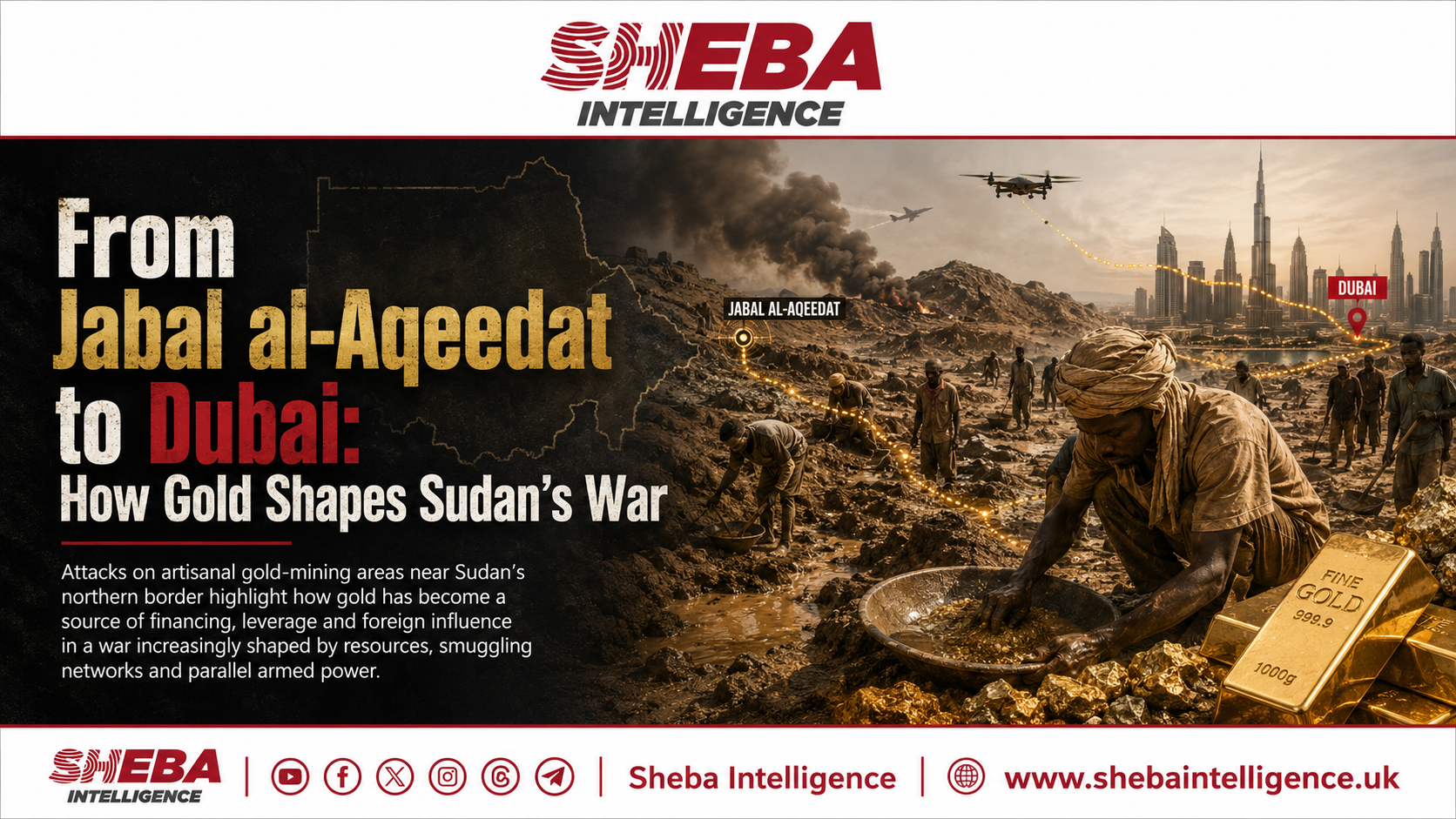
The attacks, which took place on Tuesday and Wednesday around Jabal al-Aqeedat, reportedly killed and wounded a number of traditional miners. The exact toll remains unclear due to the difficulty of reaching the targeted sites and the remote nature of the mining zones.
Videos circulated by activists on social media appeared to show explosions in crowded mining areas. Local accounts said warplanes, and at least one drone, struck sites where large numbers of miners were working. The bombing reportedly resumed early Wednesday, deepening panic among miners and raising fears that the number of casualties could rise.
Jabal al-Aqeedat, along with Jabal al-Ahmar, is among the most important artisanal gold-mining areas in northern Sudan. Mining activity in this belt extends toward Oseif in the Red Sea state, linking the far north to eastern Sudan and to routes that have long been associated with informal trade, smuggling and cross-border movement.
But the significance of the strikes goes beyond the immediate battlefield. They point to a wider reality: gold is no longer merely a national resource in Sudan. It has become one of the war’s most strategic assets.
Gold as the Currency of War
Since the outbreak of fighting between the Sudanese Armed Forces and the Rapid Support Forces in April 2023, gold has increasingly functioned as a parallel currency of war. As state revenues collapsed, banking systems weakened and formal trade routes were disrupted, control over gold-producing areas and smuggling corridors became a vital source of power.
Gold is easy to move, difficult to trace and quickly convertible into cash, weapons, fuel and political loyalty. For armed actors, tribal brokers, military-linked companies and cross-border networks, it offers a flexible financial lifeline. In Sudan’s fragmented war economy, those who control mines, roads and export channels do not merely control wealth; they control the ability to keep fighting.
This is why artisanal mining zones have become strategically sensitive. They are not always formal military positions, but they are often embedded in wider networks of taxation, protection, smuggling and armed influence. Targeting such areas may therefore be aimed at denying rivals access to revenue, disrupting gold flows or imposing control over territories where the state’s authority has been weakened by war.
The Northern Route and the Red Sea Connection
The location of the latest strikes is particularly significant. Northern Sudan and the Red Sea corridor are not only mining zones; they are also gateways connecting Sudan to Egypt, the Red Sea coast and external markets.
Jabal al-Aqeedat and nearby mining areas host thousands of traditional miners who depend on gold extraction for survival. Yet these same areas sit within a broader geography of wartime logistics. Gold, fuel, mining equipment and hard currency can move through informal channels that are difficult to monitor, especially when state institutions are divided or absent.
In this sense, the bombing of mining sites reflects a broader struggle over Sudan’s economic arteries. The war is no longer limited to barracks, cities and front lines. It is increasingly fought over resources, supply chains and access to external financial networks.
Dubai and the External Gold Pipeline
Sudan’s gold economy cannot be understood without examining its external destination markets. For years, Dubai has served as one of the main hubs for Sudanese gold, both through official exports and alleged smuggling routes.
International investigations and trade data have repeatedly pointed to the United Arab Emirates as the dominant destination for Sudanese gold. Some of this trade is legal and declared. But experts and watchdog groups have also warned that large volumes of African gold, including Sudanese gold, may enter the UAE through informal or illicit channels before being refined, re-exported or absorbed into the global market.
This has made Dubai a central node in Sudan’s war economy. Gold leaving Sudan through opaque channels can acquire commercial legitimacy once it reaches established trading hubs. In practical terms, this means that wealth extracted from conflict-affected areas may be transformed into liquidity, property, commercial assets or arms-purchasing capacity.
The UAE denies accusations that it supports the RSF or fuels the war. However, Sudanese authorities, UN experts, rights groups and investigative reports have repeatedly raised concerns about alleged Emirati support for the Rapid Support Forces, as well as the role of UAE-based gold networks and companies in sustaining paramilitary-linked wealth.
The issue is not only whether gold is smuggled to Dubai. It is whether Sudan’s gold has become part of a regional system in which external actors benefit from a weakened Sudanese state, fragmented sovereignty and the rise of armed groups operating outside normal state control.
UAE Ambitions and Parallel Power Structures
The Sudanese war has exposed a wider regional pattern: support for parallel armed actors who compete with, weaken or bypass state institutions.
In Sudan, the Rapid Support Forces emerged from a militia structure and built extensive economic interests, particularly in gold-rich areas such as Darfur. Over time, the group developed external relationships, financial channels and military capabilities that allowed it to operate as a state-like force without being accountable to a civilian government.
This model aligns with a broader regional concern about the role of external powers in backing non-state or semi-state actors when doing so serves strategic, economic or geopolitical interests. In the Sudanese case, critics argue that the UAE’s alleged support for the RSF is not separate from its interest in gold, ports, logistics corridors and influence across the Red Sea and the Horn of Africa.
From this perspective, Sudan’s gold is not merely a commodity. It is a tool of leverage. It can finance armed groups, create dependency networks, buy political influence and weaken the central state’s monopoly over resources and force.
Civilians Pay the Price
The miners killed or wounded in the latest strikes are part of a much larger civilian tragedy. Most artisanal miners are not combatants. They are workers pushed into dangerous mining zones by poverty, displacement and the collapse of Sudan’s formal economy.
As the war deepens, civilians are increasingly trapped inside the infrastructure of the war economy. Farmers, traders, miners, drivers and local brokers all become exposed to violence because their livelihoods intersect with resources sought by armed actors.
The bombing of mining sites therefore raises urgent humanitarian and legal questions. If the targeted areas were crowded with civilians, the attacks must be investigated. The presence of economically valuable resources does not remove the obligation to distinguish between military targets and civilians.
A War Funded by the Ground Beneath It
The latest airstrikes show that Sudan’s war is also a war beneath the surface: a battle over gold veins, desert routes, smuggling chains and external markets.
Gold has become one of the conflict’s hidden engines. It helps finance weapons, sustain armed groups, reward loyalists and connect local violence to international financial circuits. As long as this economy remains intact, the war will remain difficult to end.
Any future settlement in Sudan that ignores the gold sector will be incomplete. Restoring state authority requires more than a ceasefire. It requires dismantling illicit gold networks, regulating artisanal mining, cutting the link between armed actors and export routes, and holding external beneficiaries accountable.
The strikes on Jabal al-Aqeedat are therefore not an isolated incident. They are a warning that Sudan’s war is increasingly being fought through its resources — and that gold, instead of funding recovery and state-building, is being turned into fuel for fragmentation, foreign influence and prolonged conflict.