From Qasef to Meraj: How Iranian Drones Reach the Houthis and Are Assembled in Yemen
Military information, photographs and international investigations trace an arsenal dependent on imported components, locally produced airframes and Iranian expertise—including two Meraj models reportedly delivered but not yet used in combat.
The Houthis have received Iranian Meraj-532 and Meraj-521 drones but have not yet used them in operations, according to a military source who spoke to Sheba Intelligence. Their arrival adds two models to an arsenal spanning reconnaissance aircraft, munition-dropping multirotors and long-range attack drones.
The source said Houthi activity inside Yemen centres on assembling aircraft and fitting them with imported components, alongside producing moulds for some airframes with assistance from Iranian experts. Manufacturing the airframes locally, the source said, helps overcome the difficulty of smuggling bulky aircraft structures.
This investigation brings together the new military information, photographs compiled by a military expert, Sheba Intelligence’s October 2023 investigation, and international examinations of recovered drones and their components.
Airframe Moulds and the Limits of Local Production
According to the information provided to Sheba Intelligence, work inside Yemen focuses on assembly and airframe production, while engines, navigation equipment, control systems and advanced electronics are obtained from abroad.
Producing airframes in Yemen reduces the need to transport complete aircraft and allows imported components to be installed in models presented under local names.
These activities differ from an integrated industry capable of manufacturing an aircraft and its critical systems. Making a mould, producing an airframe and installing imported propulsion and electronics are separate stages with different technical requirements and supply chains.
Published field investigations nevertheless do not support a blanket claim that no components are manufactured in Yemen. Conflict Armament Research (CAR) found that the Houthis can produce some components domestically while obtaining more sophisticated electronics through foreign supply networks.
The more accurate description is therefore foreign-dependent assembly, combined with limited production of selected parts and airframes. CAR’s investigation into Houthi drone development.
Nor does the available evidence justify restricting Iran’s own manufacturing capabilities to airframes and certain piston engines. What the evidence establishes is a supply system involving components from multiple sources, with Iran playing a role in design, equipment supply and the transfer of expertise.
Meraj-532 and Meraj-521: Delivered but Not Used
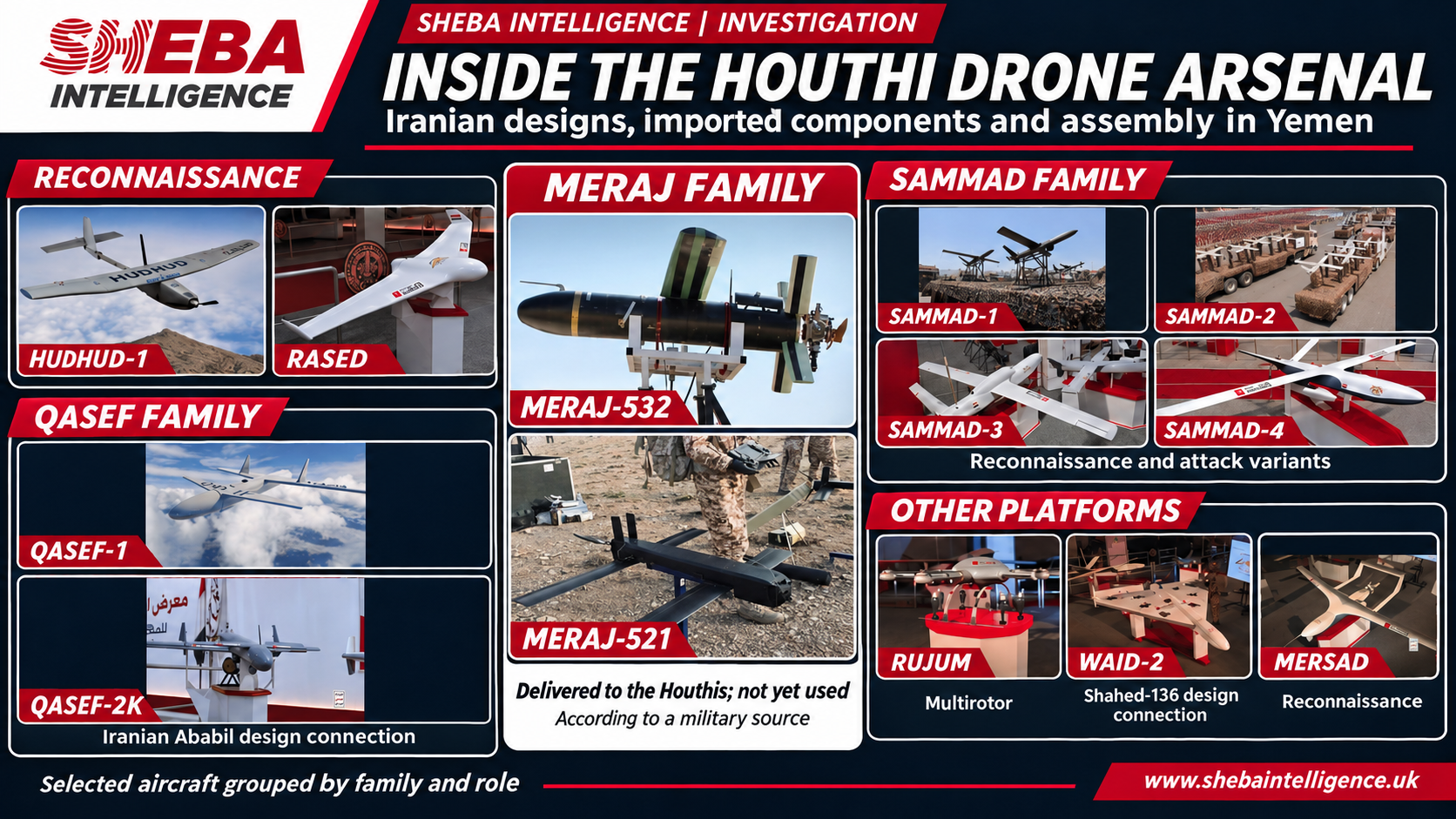
The reference photographs show two distinct aircraft. The Meraj-532 has a cylindrical fuselage and a visible rear-mounted propeller engine. The smaller Meraj-521 has a different airframe, wing and tail configuration.
According to the military source, the Houthis possess both models but have not yet deployed them in combat. Their presence in the inventory must therefore be distinguished from operational use.
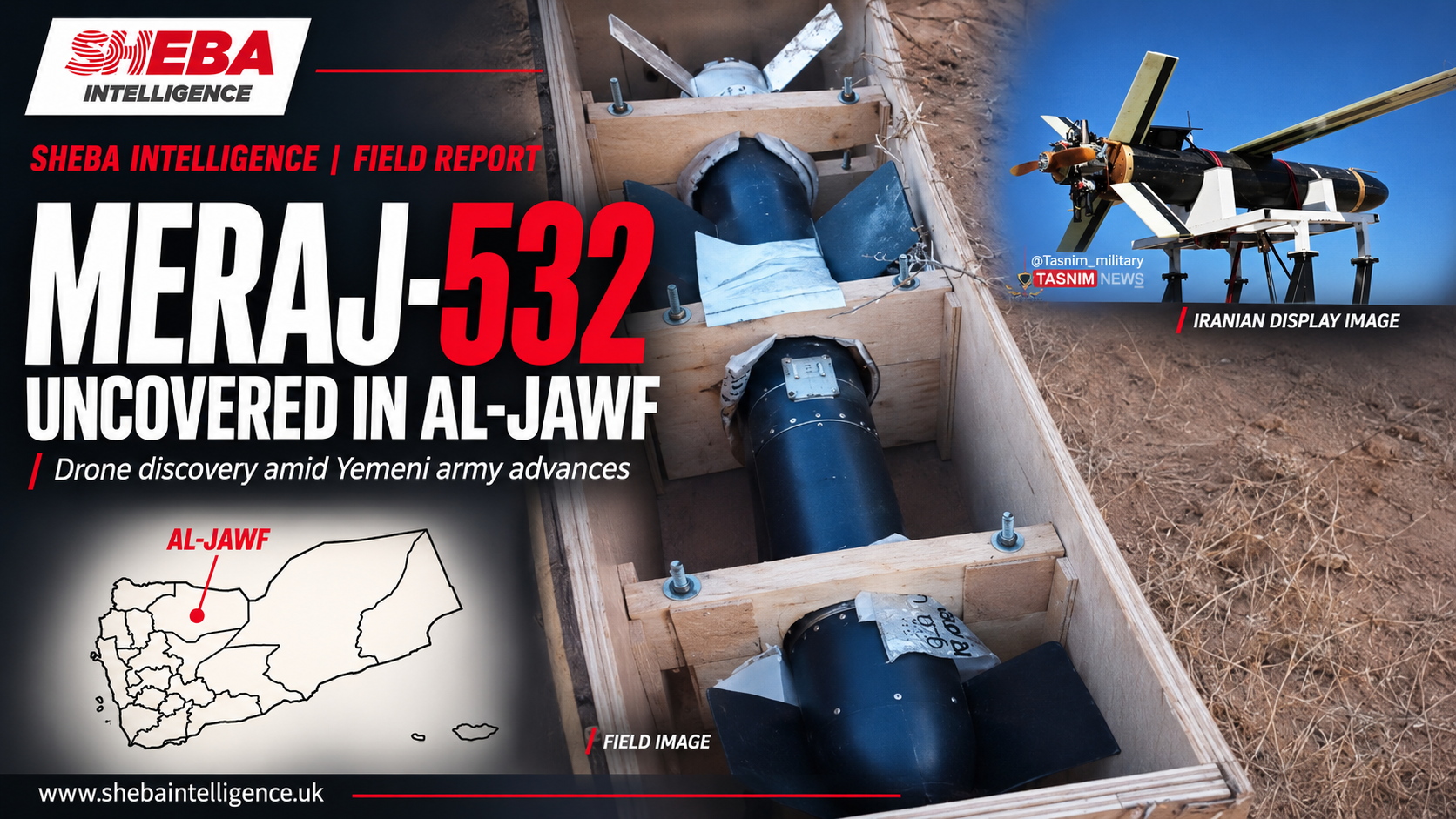
Sheba Intelligence previously reported the recovery of an aircraft provisionally identified as a Meraj-532 among weapons captured by government forces in Al-Jawf. Sources told the platform that the model had reached Houthi inventories in 2025.
The new information clarifies its reported operational status: delivery has not yet been followed by combat deployment. Sheba Intelligence’s report on the Al-Jawf recovery.
Qasef: A Documented Iranian Design Connection
The Qasef family includes Qasef-1 and Qasef-2K, among the Houthi aircraft most frequently examined in international technical comparisons.
The UN Panel of Experts documented similarities between Qasef-1 and Iran’s Ababil-2/T, reporting a maximum range of approximately 150 kilometres for Qasef-1. That figure applies to the model examined and should not automatically be assigned to every subsequent variant. UN Panel of Experts report, 2019.
The family illustrates how local naming can obscure an aircraft’s technical origins. Assembly inside Yemen does not establish that its engines or electronic systems were manufactured there.
Sammad: Reconnaissance and Attack Variants
The photographs include Sammad-1, Sammad-2, Sammad-3 and Sammad-4. Their different configurations point to a family serving several roles rather than a single aircraft with fixed specifications.
UN experts examined aircraft designated UAV-X, distinguished by a V-shaped tail and a more powerful engine, and associated them with aircraft described in Houthi media as Sammad-2 or Sammad-3.
The Panel documented reconnaissance and attack configurations. In the attack version, it identified a warhead containing 18 kilograms of explosives mixed with ball bearings. UN technical findings.
Exhibition photographs show Sammad-4 carrying munitions beneath its wings. This differs from a one-way attack aircraft destroyed during its mission and makes it necessary to distinguish each variant’s payload, range and ability to return.
Rujum: The Iranian Army Multirotor Connection
Rujum is a six-rotor drone used for reconnaissance and munition delivery. The military expert identifies a connection between the Houthi aircraft and the Iranian Army Ground Force’s multirotor bomber, described in Iranian material as the NEZAJA multirotor.
NEZAJA is the Persian abbreviation for the Iranian Army Ground Force; it should not be treated as a confirmed standalone model name.
The aircraft belongs to the hexacopter category, using six electrically powered rotors. Photographs show a platform configured to carry and release small munitions.
Its relationship to Iranian military equipment adds another dimension to references describing Rujum as an adaptation of a Chinese civilian platform. A commercial airframe or components can form the basis of a system subsequently equipped and fielded for military use. ACLED’s analysis of Houthi drone warfare.
Rujum provides a capability distinct from one-way attack drones: it can release its payload and return for reuse.
Waid-2 and Yafa: Extending the Reach
The delta-wing Waid-2 represents another connection to Iranian designs. The US Defense Intelligence Agency compared it directly with the Shahed-136 in its report on Iranian weapons used by the Houthis. DIA report.
Yafa, meanwhile, became associated with the July 2024 attack on Tel Aviv. A UN briefing cited an initial Israeli assessment describing the aircraft used in the attack as a modified Sammad-3. UN briefing.
The two cases show different routes toward longer-range attacks: introducing a different design and modifying an existing aircraft family.
Hudhud, Rased, Raqib and Mersad: Reconnaissance Aircraft
Alongside the attack systems, the photographic collection includes aircraft named Hudhud, Rased, Raqib and Mersad, as well as Shihab and Khatif.
The UN Panel documented Hudhud-1 as a reconnaissance drone with a range of approximately 30 kilometres. It identified Rased as almost certainly the Chinese commercial Skywalker X8. UN report, 2018; UN report, 2019.
Rased demonstrates that commercial technology enters the arsenal through more than small electronic components. It can include the aircraft’s basic structure before equipment is added for military use.
The remaining photographs expand the record of models publicly displayed by the Houthis. Display records, however, must remain separate from evidence establishing operational numbers or combat performance.
A Supply Network Beyond Complete Aircraft
CAR documented more than 800 missile and UAV components recovered from maritime seizures in the Red Sea during 2024 and 2025, providing evidence of continuing supplies of Iranian-origin materiel. CAR’s analysis of seized components.
Those findings are consistent with the source’s account of airframe moulds being prepared inside Yemen. Supply does not depend solely on moving complete aircraft; it also involves components and technical expertise used in assembly and preparation.
This helps explain the variety of names and shapes displayed by the Houthis. An Iranian design, foreign-made components and an airframe produced in Yemen can all form part of the same aircraft.
The reported arrival of Meraj-532 and Meraj-521 also shows that the group’s inventory includes systems that, according to the military source, have yet to appear in combat.