Houthi Attacks Turn Somaliland’s Coastline into a Diplomatic Asset
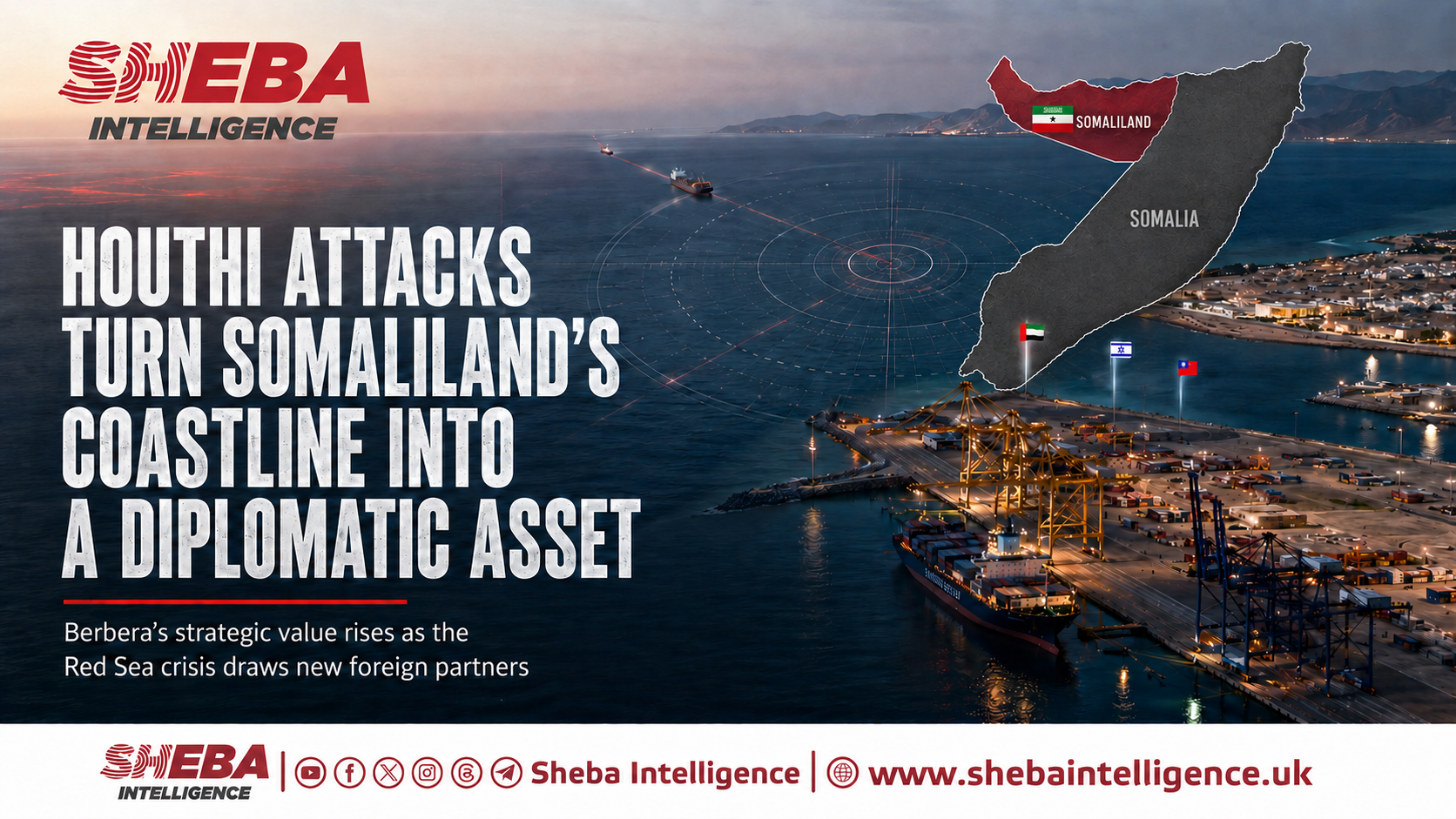
UAE investment transformed Berbera into a logistics hub, while the Red Sea crisis has drawn Israel, Taiwan and the United States closer as Hargeisa leverages its location in pursuit of recognition
Somaliland is using its position on the Gulf of Aden to expand its external relations and advance its campaign for international recognition, as Houthi attacks around Bab al-Mandab increase the strategic value of ports and airfields across the water from Yemen.
The strategy began taking shape with the United Arab Emirates’ investment in Berbera nearly a decade ago. It has since moved beyond trade and infrastructure into maritime surveillance, counterterrorism and potential military access, drawing interest from Israel, Taiwan and the United States.
Somaliland’s authorities now present the self-declared territory not only as a commercial gateway to Ethiopia and East Africa, but also as a stable partner capable of monitoring shipping, countering piracy and supporting operations against threats emerging from Yemen.
The UAE Built the Berbera Platform
The UAE was the first external power to treat Berbera as a strategic asset separate from the federal government in Mogadishu.
In 2016, Dubai-owned DP World signed a deal worth up to $442 million to develop and operate Berbera Port. A new container terminal opened in 2021 with an annual capacity of 500,000 twenty-foot equivalent units, while a planned second phase could raise capacity to two million.
The project included the Berbera Economic Zone and a transport corridor linking the port with Ethiopia, giving the landlocked country a potential alternative to Djibouti.
The relationship also developed a security dimension. Somaliland’s parliament approved an agreement in 2017 allowing the UAE to establish a military facility near Berbera, and officials later said the deal included training for local security forces.
Although the intended use of the facility changed over subsequent years, the UAE investment left Berbera with infrastructure that has both commercial and strategic value: a deep-water port, an extended airport runway and direct access to the Gulf of Aden opposite Yemen.
President Abdirahman Mohamed Abdullahi Irro maintained the relationship after taking office in December 2024. The UAE was among his first foreign destinations, and he met Vice President and Prime Minister Sheikh Mohammed bin Rashid Al Maktoum and Vice President Sheikh Mansour bin Zayed Al Nahyan.
Abu Dhabi has not formally recognised Somaliland, but its direct agreements and investments helped Hargeisa demonstrate that foreign governments could work with it independently of Mogadishu.
The Red Sea Crisis Raises Somaliland’s Value
The Houthi maritime campaign, which began in late 2023, changed the way Somaliland promoted its coastline.
Before the attacks, Berbera was marketed mainly as a commercial gateway to Ethiopia. As missiles, drones and explosive boats threatened shipping around Bab al-Mandab, Somaliland began emphasising maritime surveillance, counter-piracy operations and its proximity to Houthi-controlled areas of Yemen.
Berbera lies east of Bab al-Mandab along the shipping route connecting the Red Sea with the Arabian Sea and Indian Ocean. Its port and airport could provide logistical or surveillance options outside Djibouti, where the United States, China, France and other countries already maintain military facilities.
The escalating threats allowed Somaliland to link its recognition campaign to a wider security argument: that international partners should treat it as a state because they already need its coastline, stability and willingness to cooperate.
Israel Converts Strategic Interest into Recognition
Israel made the most significant move when it formally recognised Somaliland as an independent state on December 26, 2025, becoming the first UN member state to do so since Somaliland declared separation from Somalia in 1991.
The two sides signed a declaration establishing full diplomatic relations, with plans to exchange ambassadors and open embassies. Israel also announced its intention to cooperate in technology, agriculture, health and economic development.
The timing gave the decision a clear Red Sea dimension. Israel had spent more than two years confronting Houthi missile and drone attacks while conducting repeated strikes in Yemen. Somaliland offered a position on the opposite side of the Gulf of Aden from which maritime movements and activity along Yemen’s western and southern coasts could potentially be monitored.
Israeli Foreign Minister Gideon Sa’ar visited Hargeisa in January 2026 and met President Irro, saying Israel would establish a permanent diplomatic presence. Somaliland later appointed its first ambassador to Israel, followed by Israel’s appointment of an ambassador to Somaliland.
Irro said Somaliland expected to conclude a trade and partnership agreement with Israel and was prepared to offer opportunities in minerals, oil, gas, agriculture and renewable energy in exchange for investment and technology.
He denied that an agreement had been signed for an Israeli military base. Reports of Israeli security access or a joint UAE-US-Israeli facility in Berbera remain unconfirmed by the governments involved, although the existing infrastructure and proximity to Yemen continue to drive such speculation.
The relationship has also increased the territory’s exposure to the Red Sea conflict. The Houthis warned that any Israeli military presence in Somaliland would become a target, while Al-Shabaab issued threats following the recognition.
Taiwan Moves into Maritime Security
Somaliland’s relationship with Taiwan predates the Red Sea crisis. The two sides opened reciprocal representative offices in 2020 and initially concentrated on health, agriculture, education, communications and technical assistance.
The partnership began moving into maritime security in July 2025, when the Taiwan Coast Guard Administration and Somaliland Coast Guard signed a cooperation agreement covering training, official exchanges and joint search-and-rescue activities.
On August 28, 2026, Taiwan announced that it had funded the launch of the Red Sea Fusion Centre project in Somaliland to support freedom of navigation and improve maritime situational awareness.
The launch was attended by Taiwan’s representative in Hargeisa, Allen Lou, as well as Somaliland’s interior minister, presidency minister and coast guard commander.
Taiwan has not disclosed the centre’s location, funding, technical capabilities or the foreign organisations with which it may exchange information. There is also no evidence that the project constitutes a Taiwanese military base. Its declared function is centred on maritime information and navigation security.
The project nevertheless gives Taiwan an operational role near a shipping corridor of strategic importance to China. It also enables Somaliland to demonstrate that its foreign partnerships now extend beyond development assistance into regional maritime security.
The United States Examines Berbera
Somaliland has promoted Berbera to Washington as a possible logistics and security location for counterterrorism operations and monitoring threats from Yemen.
Foreign Minister Abdirahman Dahir Adam led a delegation to Washington in May 2025 and met members of Congress, including Senator Ted Cruz and Representative Tim Burchett, as part of the effort to build support for recognition.
Security contacts later expanded. US Africa Command chief General Dagvin Anderson visited Somaliland and inspected Berbera during an East Africa tour in November 2025. He met President Irro alongside other US officials, with talks covering counterterrorism, maritime routes and Red Sea security.
A Somaliland delegation led by the defence minister subsequently held discussions with AFRICOM officials in Germany in August 2026.
Hargeisa has highlighted Berbera’s deep-water port and long airport runway as potential facilities for the United States. However, Washington has not announced a basing agreement or changed its formal support for Somalia’s territorial integrity.
Regional Outreach Expands
The current Somaliland administration has combined its security campaign with direct presidential diplomacy across the Horn of Africa and the Gulf.
Irro met Ethiopian Prime Minister Abiy Ahmed in Addis Ababa in October 2025. Their discussions followed the controversial January 2024 memorandum under which Somaliland offered Ethiopia access to the coast and a possible naval facility, with Hargeisa expecting Addis Ababa to consider recognition.
Implementation was complicated by Ethiopia’s subsequent reconciliation with Somalia and the Ankara Declaration, which committed Addis Ababa and Mogadishu to pursue Ethiopian access to the sea under arrangements respecting Somalia’s sovereignty.
Irro also met Kenyan President William Ruto and senior Kenyan officials. Discussions covered trade, investment, education and air links, while Somaliland expanded its representative presence in Nairobi.
In May 2025, he met Djiboutian President Ismail Omar Guelleh during a two-day visit focused on economic, transport and regional cooperation. The outreach is significant because an expanded Berbera Port could compete with Djibouti for Ethiopian trade.
Irro also met Qatari Prime Minister and Foreign Minister Sheikh Mohammed bin Abdulrahman Al Thani in Doha in June 2025, opening a higher-level channel with a country that has traditionally maintained close relations with the federal government in Mogadishu.
Somaliland has separately pursued relations with the UAE, Kenya and Ethiopia as the states most likely to translate practical cooperation into a future political upgrade. None has followed Israel in granting recognition.
European Contacts Remain Below Recognition
Somaliland has expanded contact with European governments, although the relationships remain focused on development, governance and security rather than diplomatic recognition.
President Irro held separate meetings in November 2025 with the ambassadors of the United Kingdom and the European Union. Discussions covered security cooperation, governance, elections and development programmes.
He also received EU Special Representative for the Horn of Africa and the Red Sea Annette Weber in July 2025, presenting Somaliland as a stable partner in regional security.
Denmark has maintained direct development engagement and cooperation on public institutions, economic infrastructure, peacebuilding and elections. Irro met Danish Ambassador Steen Sonne Andersen in November 2025 and sought broader cooperation in security and economic development.
Irro later said Israel and Denmark were the only countries to respond formally after his government sent letters to UN member states requesting recognition. Denmark, however, did not recognise Somaliland or abandon its support for Somalia’s territorial integrity.
The administration has also received Sweden’s ambassador and held contacts involving German officials. These engagements provide Somaliland with direct access to European governments but have not produced a coordinated European move toward recognition.
Britain remains particularly important because of Somaliland’s history as a former British protectorate, its large diaspora and support within parts of the UK Parliament. London continues to engage directly with Hargeisa while leaving Somaliland’s final status to a political process involving Mogadishu and regional institutions.
Norway Supports Dialogue, Not Recognition
Norway maintains contacts with Somaliland through peace, development and reconciliation initiatives, but there is no evidence of a new Norwegian shift toward recognition or a strategic security partnership centred on Berbera.
Norwegian policy documents show that Oslo has supported preparations for the possible resumption of negotiations between Somalia and Somaliland. Its stated objective remains a negotiated political solution between Mogadishu, which supports a unified state, and Hargeisa, which seeks independence.
Norway has previously received Somaliland delegations and remains involved through diplomatic and aid channels. Unlike Denmark, the UK and the EU, however, no major new meeting with President Irro or maritime security initiative has been publicly documented during the current expansion of Somaliland’s foreign relations.
No Current Rapprochement with Russia
Russia has previously shown interest in strategic access around Berbera, and Russian delegations visited Somaliland during earlier administrations. The port also carries historical significance because the Soviet Union developed military facilities there during the Cold War.
However, no verified agreement or major rapprochement between Moscow and the Irro administration has been announced.
Russia opposed Israel’s recognition of Somaliland at the UN Security Council in December 2025 and reaffirmed Somalia’s sovereignty and territorial integrity. Reports of renewed Russian interest in Berbera therefore remain separate from Moscow’s official diplomatic position.
China Moves in the Opposite Direction
China attempted to persuade Somaliland to abandon its relationship with Taiwan in 2020. Chinese representatives met then-president Muse Bihi Abdi and reportedly offered increased engagement and development support if Hargeisa cut ties with Taipei. Somaliland rejected the proposal.
Relations have since deteriorated. Beijing strongly supports the federal government in Mogadishu and describes Somaliland’s partnership with Taiwan as an attempt to advance separatism.
Following Israel’s recognition, Chinese Foreign Minister Wang Yi reaffirmed support for Somalia’s sovereignty and said Beijing opposed what it called Somaliland’s “collusion” with Taiwan.
Somaliland, meanwhile, opened an expanded representative office in Taiwan in June 2026 and said it would not yield to pressure from China or Somalia.
There is therefore no current rapprochement between Hargeisa and Beijing. Instead, maritime cooperation with Taiwan has placed Somaliland more directly within the wider strategic competition between China and its rivals around the Red Sea and the Horn of Africa.
Somaliland’s expanding network now runs from UAE-controlled commercial infrastructure and Israeli recognition to Taiwanese maritime surveillance, US security contacts and European development partnerships. Hargeisa has yet to turn this wider engagement into a second formal recognition, but the Houthi threat has made its coastline more valuable to states seeking access, information and reliable partners around Bab al-Mandab.