Information obtained by Sheba Intelligence indicates that the Houthis and Iran’s Islamic Revolutionary Guard Corps are restructuring their financial and commercial networks to sustain military funding amid mounting US pressure on Iranian banks and money-laundering channels.
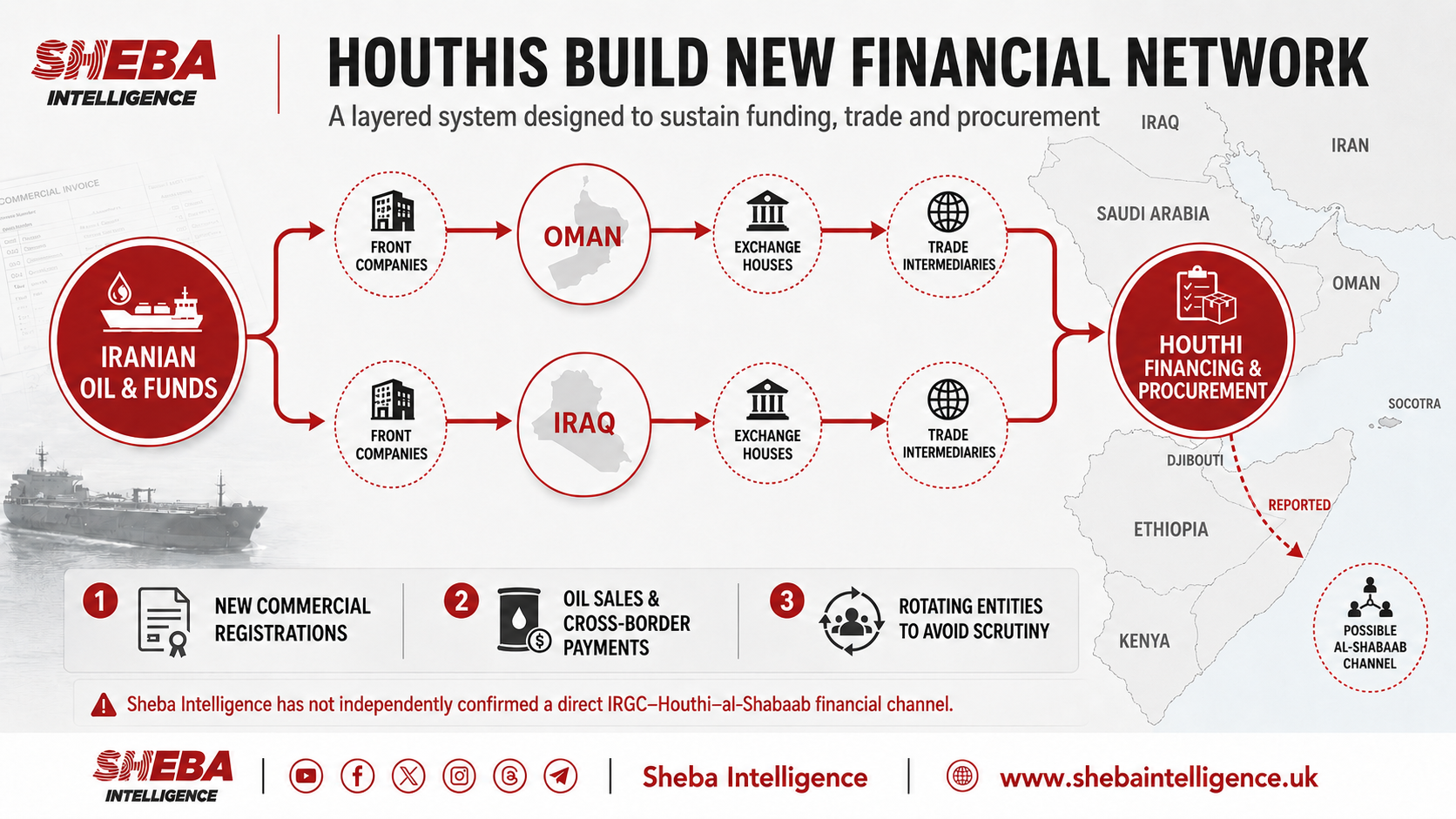
The plan relies on companies and intermediaries operating through Oman and Iraq to move funds, trade Iranian petroleum and conclude procurement deals without exposing the ultimate beneficiaries. According to the information, the network is also intended to maintain support channels for the Houthis and Somalia’s al-Shabaab.
A Layered Commercial Network
Rather than transferring funds directly to Houthi-controlled entities, the network creates layers between the source of the money and its final recipient. New companies are registered under individuals with no publicly visible connection to the group and used to import goods, settle payments with foreign suppliers and provide commercial documents for sensitive shipments.
The Houthis have reportedly sought new commercial registrations under nominee or previously unknown names to conceal the companies, exchange houses and intermediaries moving funds to overseas suppliers. The structure is supervised through several intelligence-linked nodes and allows exposed entities to be replaced without disrupting the wider network.
The use of companies registered in Oman or Iraq does not imply involvement by the authorities or wider business communities in either country. The reported scheme depends on operating through legitimate commercial systems while concealing beneficial ownership and the destination of funds.
Oman and Iraq as Rear Commercial Hubs
The emerging structure assigns complementary roles to Oman and Iraq. Oman provides access to international markets, financial services and commercial documentation, while Iraq offers links to Iranian petroleum networks and intermediaries associated with Iran-backed armed groups.
The US Treasury has previously identified networks that blended Iranian petroleum with Iraqi oil before marketing it as Iraqi-origin product. It has also documented the use of smaller vessels and routes near Iraq’s Khor al-Zubair to obscure Iranian oil shipments.
In January 2026, the US Treasury sanctioned an Oman-based company for transporting Iranian liquefied petroleum gas to Pakistan and Somalia during 2025. This does not establish a connection to the network identified by Sheba Intelligence, but it demonstrates the use of Oman-based commercial entities in sanctioned Iranian energy trade.
Oil Revenue and Foreign Procurement
Iranian petroleum forms a central part of the reported arrangement. Oil and petroleum products can be transferred as economic assets, sold through intermediaries and converted into funds used to pay foreign suppliers. This reduces the need for direct transfers from Iran to Houthi-linked accounts.
The mechanism allows the network to generate liquidity, settle procurement costs outside Yemen and keep the Houthi beneficiary’s name off banking and shipping documents.
The US Treasury reported in January 2026 that illicit petroleum sales generate more than $2 billion annually for the Houthis. Previous sanctions actions have documented the use of front companies, exchange houses and international facilitators to move Iranian oil revenue and finance Houthi operations.
The Somalia Connection
The information reviewed by Sheba Intelligence suggests that the same network may facilitate financial or material support for al-Shabaab through commercial and smuggling routes linking Yemen with the Horn of Africa.
Sheba Intelligence has not independently confirmed a direct financial channel connecting the IRGC, the Houthis and al-Shabaab. US sanctions investigations have, however, previously identified arms-trafficking and financial networks operating between Yemen and Somalia that supplied armed groups, including al-Shabaab.
The new structure disperses financial and procurement operations across recently registered companies, oil traders, exchange houses and intermediaries. By separating funding sources from recipients and rotating companies when they attract scrutiny, the network is designed to preserve the flow of money, petroleum and military-related purchases despite sanctions and financial surveillance.