Intelligence Source: Preliminary Inquiries Point to Houthi Use of Mustard Gas in Taiz
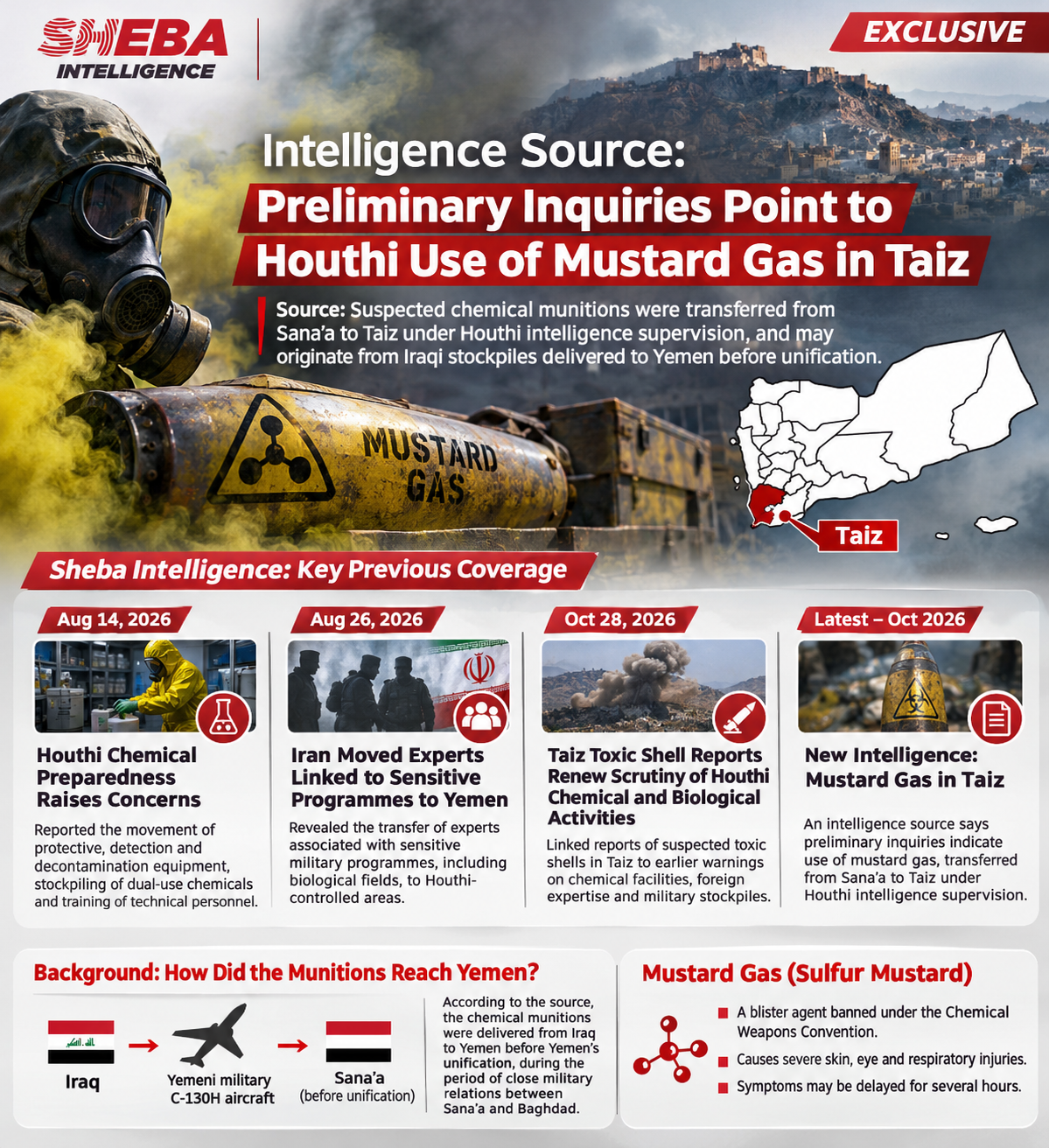
Source says suspected chemical munitions were transferred from Sana’a to Taiz under Houthi intelligence supervision and may originate from Iraqi stockpiles delivered to Yemen before unification.
An intelligence source told Sheba Intelligence that preliminary, unofficial inquiries indicate that Houthi forces may have used munitions containing sulfur mustard, commonly known as mustard gas, in attacks in Yemen’s southwestern Taiz governorate.
The findings raise serious concerns about the possible use of internationally prohibited chemical weapons amid ongoing fighting in the governorate.
According to the source, the suspected chemical munitions were transferred from Sana’a to Taiz under the supervision of the Houthi-controlled Security and Intelligence Service.
The source said the exact storage facility from which the munitions were removed remains unknown, as does their previous storage location.
The source identified the substance as sulfur mustard, a chemical warfare agent prohibited under international law.
The new intelligence follows reports received by Yemeni authorities concerning shells suspected of containing toxic substances in several Taiz frontline areas, including Al-Aqroud and Kahlan. Earlier incidents reportedly caused breathing difficulties and loss of consciousness among civilians and members of the Popular Resistance.
No independent laboratory findings confirming the identity of the substance have yet been made public.
Intelligence Background: Iraqi Chemical Munitions Allegedly Delivered to Yemen Before Unification
In additional information provided to Sheba Intelligence, the intelligence source said the suspected chemical munitions originated from stockpiles allegedly acquired by the government of former Yemeni President Ali Abdullah Saleh from Iraq during Saddam Hussein’s rule.
According to the source, the shipment arrived in Sana’a before Yemen’s unification, aboard a Yemeni military C-130H Hercules transport aircraft, when Saleh was president of the Yemen Arab Republic, commonly known as North Yemen.
The alleged transfer dates to the period surrounding the end of the Iran–Iraq War, which concluded in 1988, when military relations between Sana’a and Baghdad were particularly significant.
The account raises new questions about the fate of military stockpiles accumulated during that period and their possible transfer to armed groups following the collapse of Yemen’s state military institutions.
The source did not identify the facilities where the munitions were stored over subsequent decades or establish precisely when they came under Houthi control.
The historical shipment and its alleged connection to the recent Taiz incidents have not been independently documented.
Mustard Gas: A Prohibited Chemical Warfare Agent
Sulfur mustard is a blister agent capable of causing severe injuries to the skin, eyes and respiratory system.
Symptoms may not appear immediately after exposure and can include eye inflammation, skin blistering and breathing difficulties. Severe exposure can result in long-term complications or death.
The use of mustard gas as a weapon is prohibited under the Chemical Weapons Convention.
Identifying the substance involved in the reported Taiz incidents would require specialised analysis of medical and environmental samples, as well as any recovered munition remnants.
Previous Sheba Intelligence Investigations
The latest intelligence builds on a series of earlier Sheba Intelligence investigations examining suspected Houthi chemical and biological weapons-related activities.
On August 14, Sheba Intelligence published Houthi Chemical Preparedness Raises Concerns, reporting intelligence information about the movement of specialised protective, detection, decontamination and containment equipment designed for chemical and biological hazards.
The investigation also described the reported stockpiling of dual-use chemicals, the training of technical personnel and an explosion at a warehouse believed to contain some of the materials.
On August 26, Sheba Intelligence published Iran Moved Experts Linked to Sensitive Programmes to Yemen, Sources Say, detailing intelligence allegations concerning the transfer of specialists associated with sensitive Iranian military programmes, including biological fields, to Houthi-controlled Yemen.
Further intelligence reporting examined discussions between senior Houthi figures and Iranian military representatives concerning possible assistance involving chemical and biological weapons.
Most recently, on October 28, Sheba Intelligence published Taiz Toxic Shell Reports Renew Scrutiny of Houthi Chemical and Biological Weapons Activities Previously Exposed by Sheba Intelligence.
That investigation linked official complaints about suspected toxic munitions in Taiz to earlier intelligence warnings concerning hazardous materials, alleged chemical facilities, foreign technical expertise and military stockpiles inherited from Yemen’s former armed forces.
It also examined intelligence allegations that certain chemical materials held by Yemen’s former military originated from arrangements between the governments of Ali Abdullah Saleh and Saddam Hussein.
The latest source account adds a more specific allegation concerning the identity of the chemical agent, the historical origin of the munitions and their reported transfer from Sana’a to Taiz under the supervision of the Houthi-controlled Security and Intelligence Service.
The information places renewed attention on the fate of Yemen’s former military stockpiles and the possibility that prohibited chemical munitions may have survived for decades before being brought into the current conflict.
Establishing the substance used in Taiz and tracing the origin of the suspected munitions will require an independent technical investigation, including laboratory testing and examination of relevant military records.