Mecca Defense Alliance Pledges to Accelerate Support for Saudi Arabia Against Houthi Attacks as “Dawn of Yemen” Nears 59,000 Targeting Operations
Saudi Arabia, Türkiye and Pakistan reaffirm collective defense commitments as Erdoğan formally ratifies the agreement, amid reported preparations for a broader ground and naval campaign in Yemen.
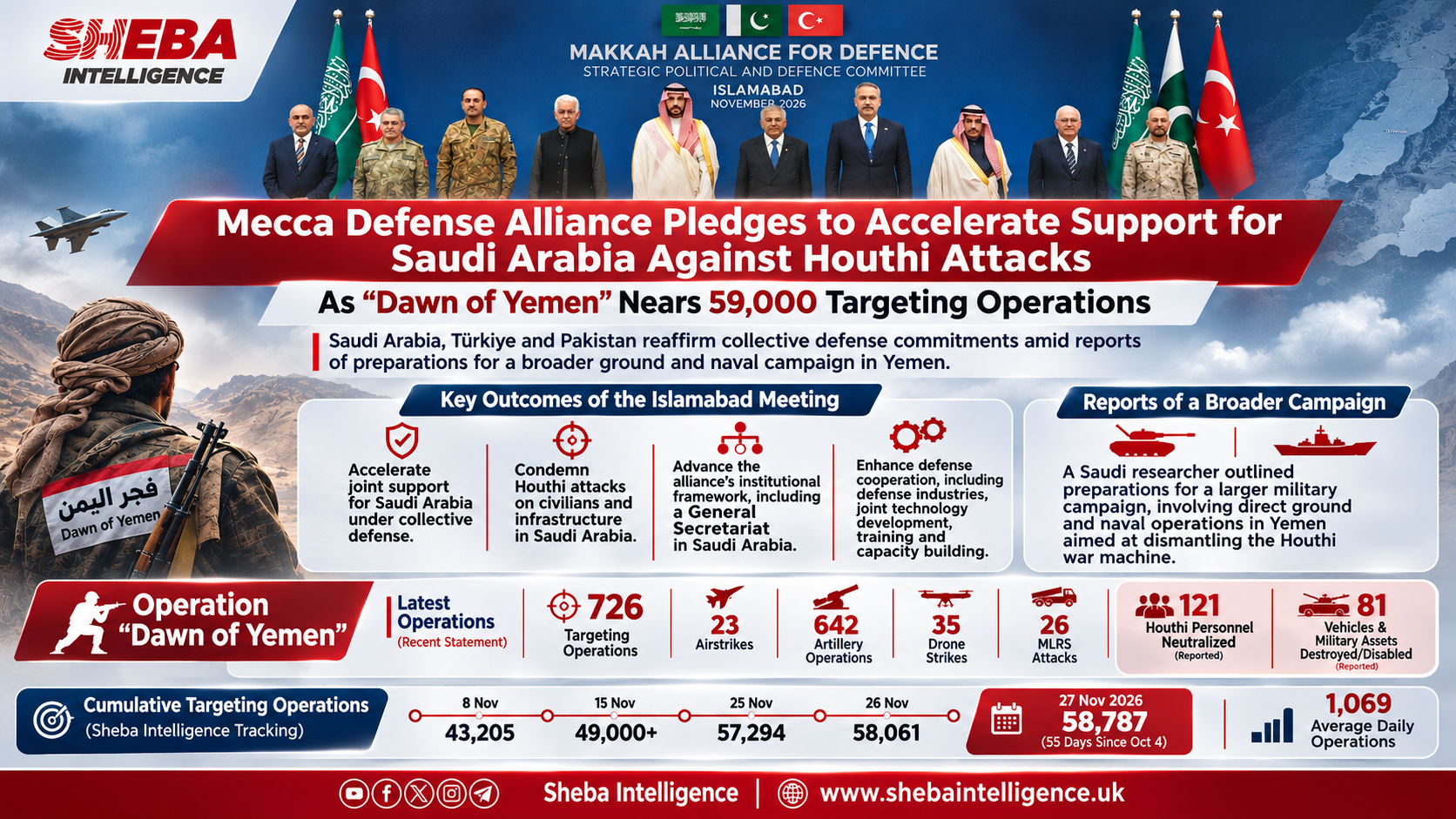
The Mecca Defense Alliance, comprising Saudi Arabia, Türkiye and Pakistan, has pledged to accelerate joint efforts to support the Kingdom against ongoing Houthi attacks under the collective defense provisions of the Mecca Mutual Defense Agreement, amid indications that the war in Yemen could enter a new military phase.
The commitment came in a joint statement issued following the second meeting of the alliance’s Strategic Political and Defense Committee, held Friday, November 27, in the Pakistani capital, Islamabad.
The three countries strongly condemned continued Houthi attacks targeting civilians and civilian infrastructure in Saudi Arabia, reaffirming their determination to accelerate joint efforts to safeguard the Kingdom’s security in accordance with the collective defense provisions of the agreement.
The Islamabad meeting coincided with Turkish President Recep Tayyip Erdoğan’s formal ratification of the mutual defense agreement following its approval by the Turkish parliament earlier this month.
From Institutional Development to Collective Defense
The committee reviewed the regional security situation and reaffirmed the three countries’ commitment to collective defense, mutual solidarity, and respect for the sovereignty and territorial integrity of each member state.
It also reviewed the outcomes of its first meeting, held in Istanbul on August 31, 2026, and its emergency meeting in Riyadh on October 5, as well as progress toward implementing previous decisions concerning the alliance’s institutional framework and the practical implementation of collective defense commitments in accordance with national legislation.
The committee welcomed progress toward establishing and operationalizing the alliance’s General Secretariat in Saudi Arabia, emphasizing its role in strengthening institutional cooperation and effective coordination.
The three countries also reaffirmed their commitment to enhancing cooperation in defense industries, joint technological development, military training, capacity building and coordination among their armed forces to address shared security concerns.
Reported Preparations for a Ground and Naval Campaign
The Islamabad statement came three days after Saudi researcher Dr. Nawaf Obaid published an analysis outlining reported Saudi preparations for a potential new phase of the war against the Houthis.
Obaid said Riyadh was finalizing a military plan involving Saudi and other coalition ground forces, with direct responsibility for ground and naval operations in Yemen alongside the ongoing air campaign.
According to Obaid, the military objective is to dismantle the Houthi war machine, while the political objective is to prevent the group from governing Yemen.
He identified divisions among Yemen’s anti-Houthi military formations as one of the principal challenges facing military operations, despite the existence of a joint command structure and a unified source of funding.
Obaid also linked developments in Yemen to international maritime security in the Red Sea and the Bab al-Mandab Strait, as well as the future of Iranian influence in the region.
Operation “Dawn of Yemen” Nears 59,000 Targeting Operations
The diplomatic and military developments coincide with sustained fighting in Yemen under Operation “Dawn of Yemen,” launched by the Yemeni armed forces on October 4, 2026.
In their latest statement, the Yemeni armed forces announced that they had conducted 726 targeting operations, including 23 airstrikes, 642 field artillery operations, 35 drone operations and 26 rocket artillery operations.
The military claimed that the operations had neutralized 121 Houthi commanders and fighters and destroyed or disabled 81 vehicles and military assets.
Fighting continues across multiple fronts in Taiz, Marib, Al-Jawf, Lahj, Al-Dhalea, Al-Bayda and Shabwa, with Yemeni government forces supported by popular resistance formations and continued air support.
According to cumulative calculations by Sheba Intelligence, the estimated number of targeting operations has reached 58,787 over 55 days, averaging approximately 1,069 operations per day.
The cumulative figure stood at 43,205 on November 8 and surpassed 49,000 by mid-November, before reaching 57,294 on November 25, as documented in a previous Sheba Intelligence report on escalating Houthi attacks against Saudi Arabia.
The tally subsequently rose to 58,061 amid the Houthi attack on the Jazan refinery and announcements of new military mobilization and recruitment initiatives in Yemen.
The latest military statement brings the estimated cumulative total close to 59,000 targeting operations.
These figures are based on official Yemeni military statements compiled by Sheba Intelligence, assuming no overlap between reporting periods. Reported battlefield losses have not been independently verified.
Escalating Houthi Attacks and an Early Test of Collective Defense
The latest commitments by the Mecca Defense Alliance come amid escalating Houthi missile and drone attacks against Saudi Arabia, targeting economic, oil and civilian infrastructure, including the Jazan refinery, ports and facilities in major Saudi cities.
The coalition recently announced the destruction of 50 Houthi military targets in Sanaa, Hodeidah and Saada following the attack on the Jazan refinery.
Meanwhile, military mobilization efforts inside Yemen have expanded, including an initiative by Marib’s mobilization council to establish a 30,000-strong popular force and a separate recruitment campaign announced by Yemen’s Emergency Forces.
The convergence of escalating Houthi attacks, sustained military operations in Yemen, new mobilization initiatives and the implementation of collective defense commitments provides important context for reports of a potentially broader military campaign.
The Islamabad statement places the Houthi threat within the framework of the alliance’s collective defense commitments, presenting an early test of its ability to translate political and legal commitments into practical security cooperation.
However, while Obaid’s analysis points to a potential expansion of military intervention in Yemen, the Mecca Defense Alliance has not announced direct Turkish or Pakistani participation in ground or naval operations against the Houthis, nor has it specified the nature or scope of the additional military support envisaged for Saudi Arabia.
At the same time, the alliance reaffirmed its commitment to regional de-escalation and the peaceful settlement of disputes through dialogue and diplomacy.