Military Airlift Signals Initial Implementation of the Mecca Defence Agreement
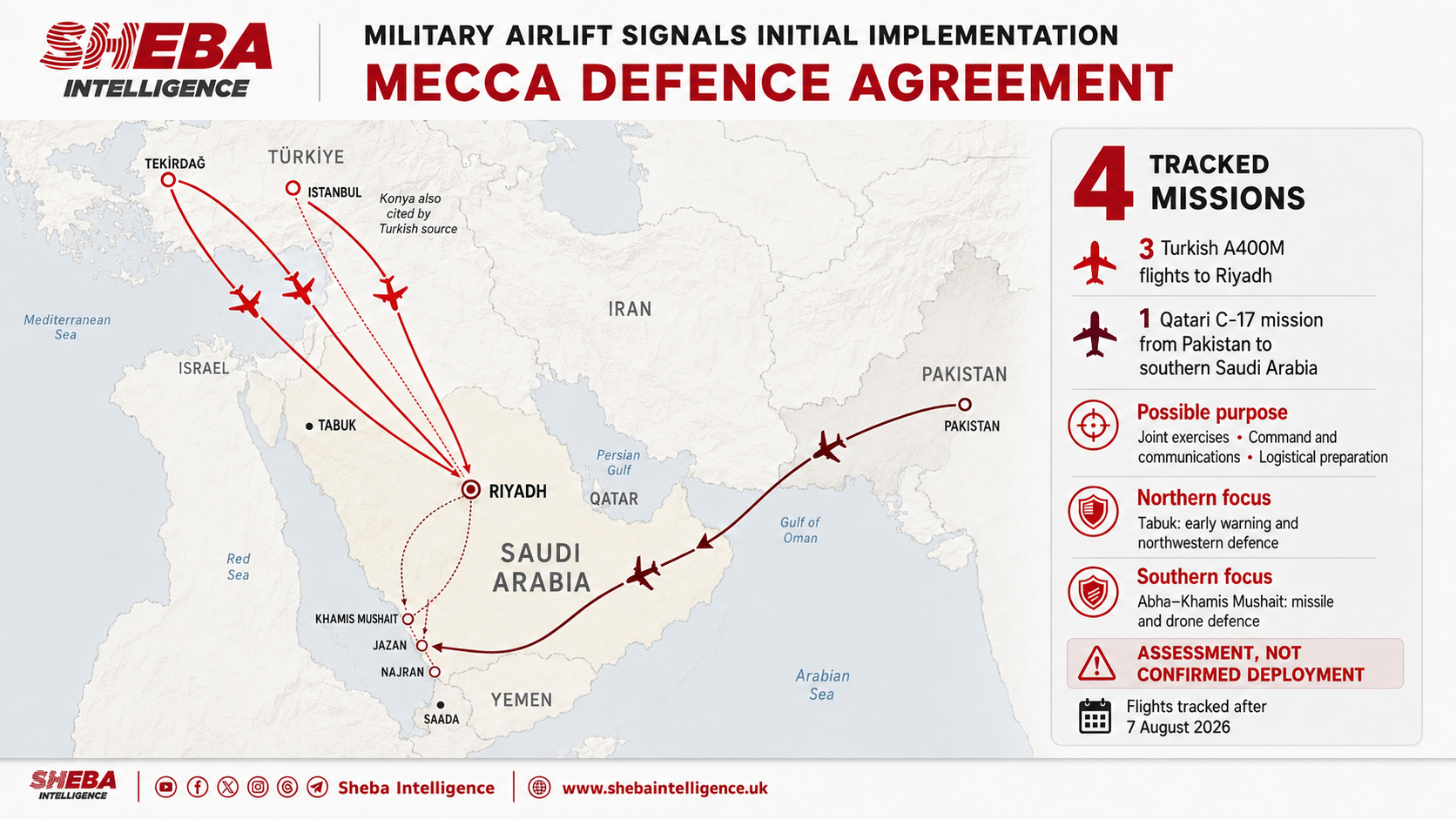
At least four military airlift missions have been tracked to Saudi Arabia since the Mecca Joint Defence Agreement was signed with Türkiye and Pakistan on 7 August. Three Turkish A400M aircraft flew to Riyadh, while a Qatari C-17 transported an undisclosed load from Pakistan to southern Saudi Arabia. The flights may be supporting preparations for joint exercises or the establishment of command, communications and logistical mechanisms under the new agreement.
The Turkish aircraft operated under the callsigns TUAF905, TUAF906 and TUAF907, departing from Istanbul and Tekirdağ. Turkish sources also reported related movements from Konya.
The Qatar Emiri Air Force C-17, operating as LHOB262, flew between Pakistan and southern Saudi Arabia before returning on 14 August. Tracking data did not confirm its final destination, although possible locations include King Khalid Air Base near Khamis Mushait or the airports in Jazan and Najran.
No official information has been released about the cargo carried by the four aircraft or any new combat deployment. The movements could involve equipment and personnel required for joint exercises, command and control, communications or logistical support.
The Turkish Defence Ministry has announced that the three countries will establish political and military mechanisms involving their foreign and defence ministers and armed forces commanders. The implementation framework also provides for joint land, air, maritime and cyber exercises.
Securing the Northern and Southern Approaches
Turkish academic Dr Muhammed Mazhar Şahin said he had monitored A400M flights from Istanbul, Tekirdağ and Konya to Riyadh, alongside the movement of military equipment from Pakistan. He assessed the flights as an initial step toward strengthening Saudi Arabia’s defences through a central command structure in Riyadh and arrangements covering the kingdom’s northern and southern approaches.
According to Şahin, Tabuk is strategically important for securing northwestern Saudi Arabia against potential threats originating from the direction of Israel. The city lies approximately 450–500 kilometres from Israel in a straight line, making its military facilities suitable for early warning, air surveillance, joint exercises and the possible deployment of deterrence assets.
In the south, Abha and King Khalid Air Base near Khamis Mushait are important because of their proximity to Houthi-controlled territory. Abha lies approximately 220–250 kilometres from Saada, giving the area a potential role in countering missile and drone threats and protecting Jazan, Najran and critical infrastructure across southern Saudi Arabia.
Riyadh would serve as the centre for command and coordination and for protecting the capital and strategic facilities against long-range missile and aerial threats. Şahin said Saudi bases in Riyadh, Tabuk and Abha could potentially host Turkish and Pakistani forces, joint command elements and regular military exercises.
His proposed distribution of forces remains an analytical assessment. The three governments have not announced deployment locations or the establishment of a joint command.
Pakistani Foreign Minister Ishaq Dar has affirmed Islamabad’s commitment to collective defence, while Turkish Foreign Minister Hakan Fidan said implementation details would be addressed through a ministerial committee and a permanent secretariat in Saudi Arabia. Riyadh has not released a detailed implementation plan or officially linked the flights to the agreement.
The observed flights point to an initial logistical phase that may support training or the establishment of joint command mechanisms. Further airlift missions to Tabuk, Khamis Mushait, Jazan or Najran would provide stronger evidence that the agreement is moving into a broader operational phase.