Northeast State Threatens Military Action as Opposition to Somaliland’s Secession Expands
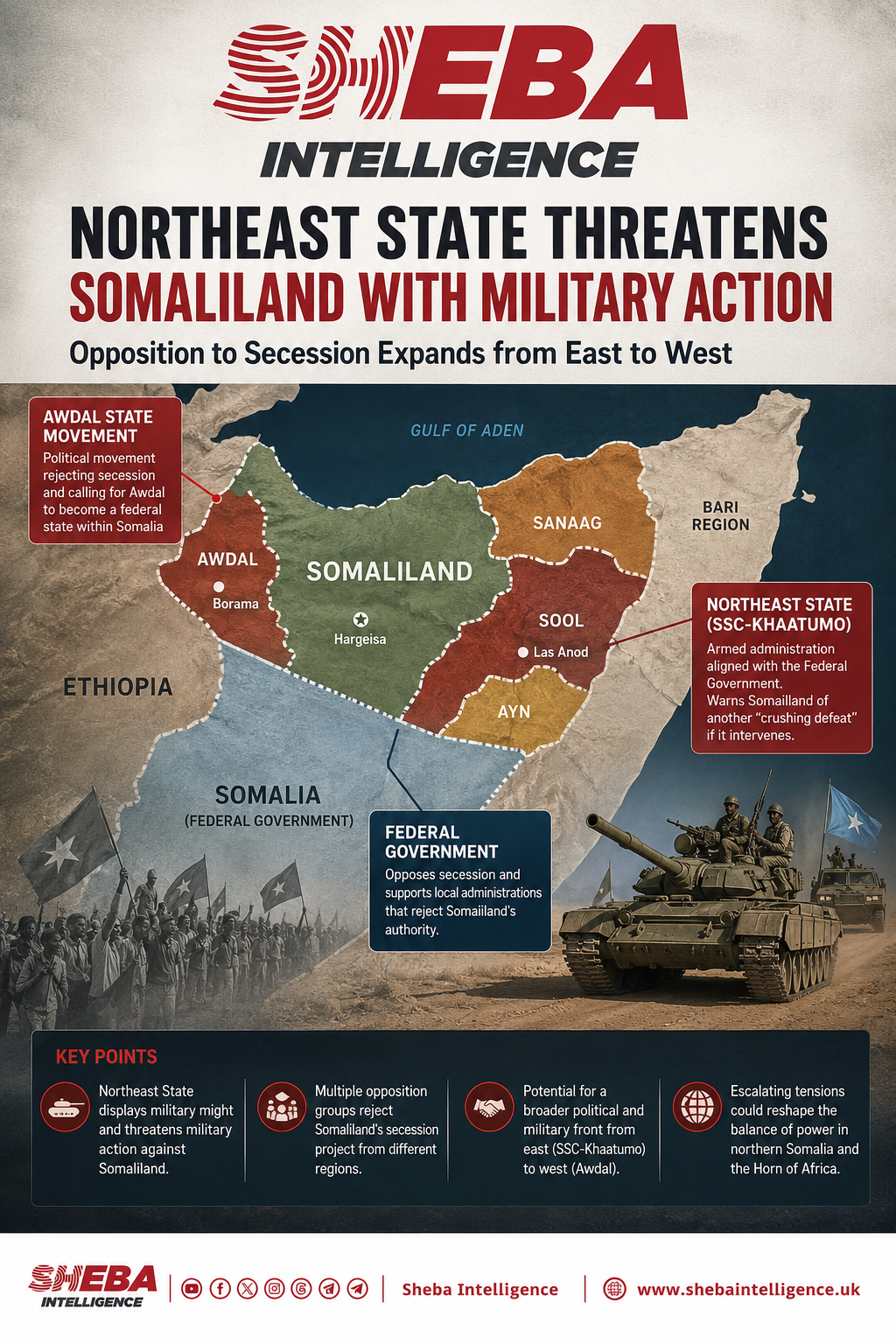
Military tensions in northern Somalia have escalated after the leadership of the Northeast State warned Somaliland against interfering in its internal affairs and displayed tanks, armored vehicles, and heavy weapons in a show of force.
The military parade followed a warning by the state’s president that Somaliland could face another “crushing defeat” similar to the battlefield setback it suffered in 2023, when its forces withdrew from Las Anod and lost control of most of the Sool region, along with significant areas of Sanaag and Ayn.
The latest threats indicate that the dispute has moved beyond political rivalry into direct military deterrence. The Northeast State is no longer merely a local opposition movement but an organized armed administration aligned with Somalia’s federal system and capable of challenging Somaliland’s military presence across the eastern territories.
The escalation comes as Somaliland faces growing opposition to its secessionist project from several local actors, not only from Somalia’s federal government in Mogadishu.
In the east, the Northeast State, which emerged from the SSC-Khaatumo movement, represents the most powerful armed force rejecting Somaliland’s authority. Local political and clan-based actors in parts of Sanaag also oppose rule from Hargeisa and favor either direct integration into the federal system or affiliation with other Somali federal administrations.
In the far west, the Awdal State Movement has emerged as another challenge to Somaliland’s claim of unified internal support for independence. The movement rejects secession and advocates the establishment of Awdal as a federal member state within Somalia.
The Awdal movement draws support from local clan and community networks, as well as from members of the diaspora. Although it has not developed an organized armed wing comparable to SSC-Khaatumo, it has become an increasingly visible political platform opposing decisions taken by Hargeisa over Awdal’s ports, coastline, external relations, and strategic resources.
Its political importance has grown amid Somaliland’s efforts to secure international recognition through closer relations with Ethiopia and Israel. These external partnerships have intensified concerns among opposition groups that Hargeisa is making strategic decisions affecting disputed territories without the consent of local communities.
Background to Somaliland’s Secessionist Project
Somaliland’s independence project dates back to May 1991, when the Somali National Movement and northern clan leaders declared the restoration of the sovereignty of the former British Somaliland protectorate.
British Somaliland had gained independence on June 26, 1960, before voluntarily uniting five days later with the former Italian-administered territory to form the Somali Republic.
The 1991 declaration followed the collapse of Mohamed Siad Barre’s government and years of conflict in northern Somalia. During the 1980s, government forces carried out widespread military operations in cities including Hargeisa and Burao, causing extensive destruction and civilian casualties.
Somaliland’s political leadership later used this experience to justify separation from Somalia and to establish its own government, security institutions, currency, electoral system, and administrative structures.
In 2001, Somaliland organized a constitutional referendum that formally endorsed independence. Authorities reported overwhelming support for the constitution, but participation was limited or contested in parts of Sool and Sanaag, where local communities rejected Somaliland’s authority.
For more than three decades, Somaliland functioned as a de facto independent entity without broad international recognition. Its claim to statehood has nevertheless remained disputed by the Somali federal government and by communities in several eastern and western regions.
The Federal Government’s Role
Somalia’s federal government considers Somaliland an integral part of the country and rejects any unilateral attempt to alter Somalia’s internationally recognized borders.
Mogadishu has increasingly treated the Northeast State and SSC-Khaatumo as part of the federal political structure, providing them with political and legal backing against Somaliland’s territorial claims.
The federal government also benefits strategically from the emergence of local movements such as the Awdal State Movement, because their existence weakens Somaliland’s argument that the entire population within the borders of the former British protectorate supports independence.
Through political recognition, institutional support, and potential security assistance, Mogadishu could seek to connect anti-secessionist forces across northern Somalia. However, the success of such a strategy would depend on its ability to coordinate competing regional and clan interests without turning the confrontation into a broader communal conflict.
Prospect of a Wider Eastern-Western Front
The military success of SSC-Khaatumo in 2023 provides a model that could encourage other communities opposed to Somaliland’s authority.
The Awdal State Movement currently remains primarily a political and social organization, and there is no confirmed evidence that it has formed a structured military wing or established formal operational coordination with the Northeast State.
However, both movements share several core objectives: rejection of Somaliland’s unilateral secession, opposition to Hargeisa’s control over disputed territories, and support for political integration into Somalia’s federal system.
These shared objectives create the potential for future political, security, or military coordination.
A major confrontation could become more likely if Somaliland attempts to impose new military, maritime, or foreign-policy arrangements in Awdal without local consent. Under such circumstances, sections of the movement and allied clan networks could seek to establish armed local forces, drawing lessons from the Las Anod uprising and the subsequent formation of the Northeast State.
A coordinated front would place Somaliland under simultaneous pressure from two directions: an established armed administration in the east and a potentially mobilized political and clan-based opposition in the west.
Such a development could stretch Somaliland’s military resources, weaken its control over disputed areas, and undermine its claim that the secessionist project represents the political will of all communities within the territory it claims.
For now, the prospect of a broad armed coalition remains a scenario rather than an established reality. Nevertheless, the convergence of anti-secessionist movements from Sool and Sanaag to Awdal is creating a more complex security environment and could significantly reshape the balance of power across northern Somalia.