
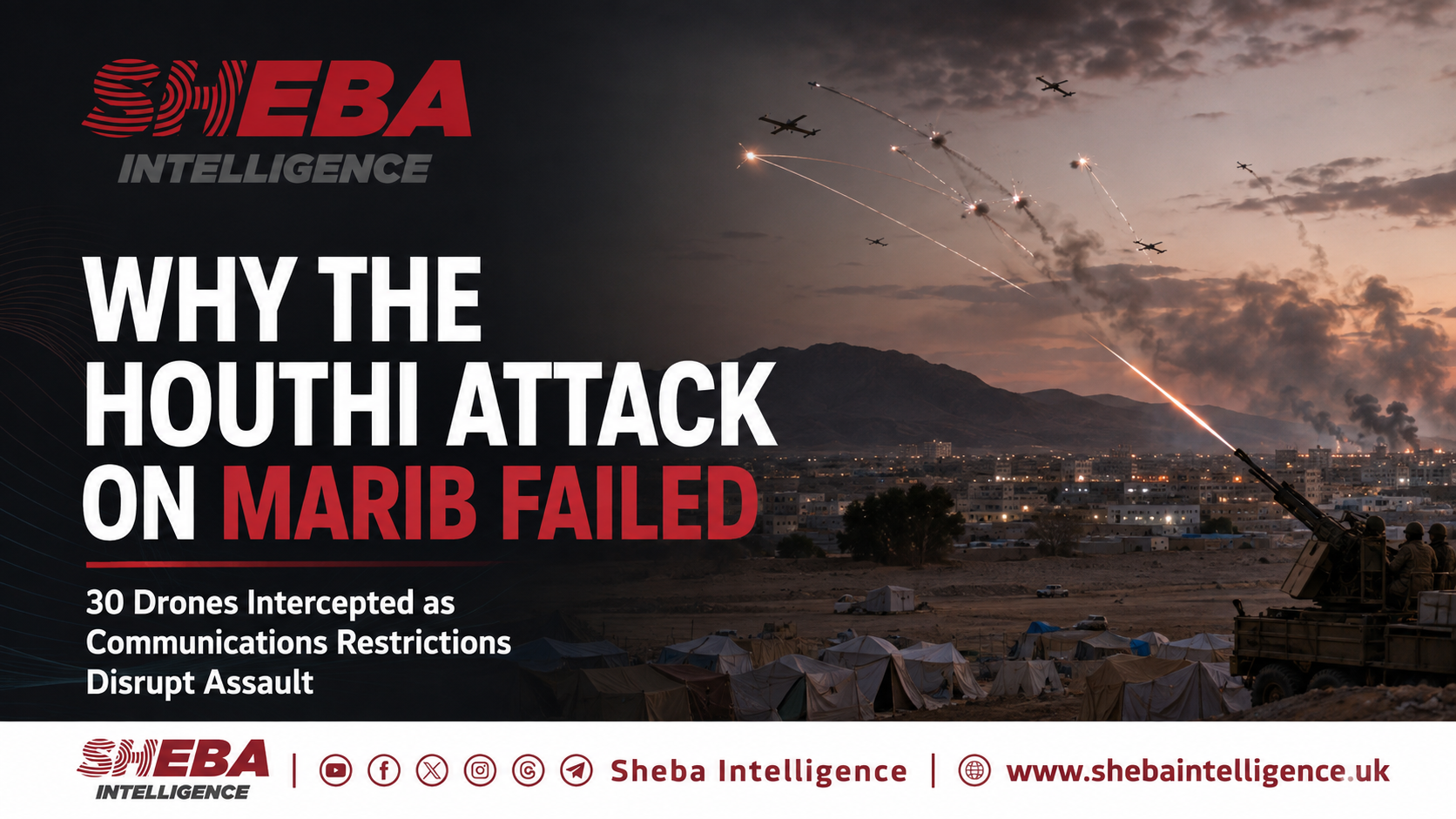
Communications restrictions and conventional air defences disrupted an assault involving 30 drones and nearly ten missiles
MARIB — August 7, 2026
A large-scale Houthi attack on Marib failed to reach its main suspected military objectives after local authorities restricted communications services controlled from Sanaa and government forces intercepted approximately 30 drones, a military source told Sheba Intelligence.
The attack came shortly after Sheba Intelligence warned that the Houthis were preparing an operation against Marib and had identified the governorate’s oil fields as an urgent target. It provides the first field indication that part of the plan revealed by the platform had moved into execution.
According to the military source, the Houthis launched nearly 30 drones and approximately ten missiles toward Marib. All the drones were reportedly shot down using conventional 12.7mm and 14.5mm anti-aircraft guns, while most of the missiles landed in displacement camps north and northwest of the city.
Before the assault, authorities reportedly suspended 4G services operated through Yemen Mobile while retaining secure communications channels. The measure may have disrupted Houthi field surveillance, communications with local operatives and the transmission of updated targeting information.
There is no evidence, however, that the loss of mobile coverage directly caused the missiles to miss their targets. Ballistic missiles and many drones can use navigation systems independent of telecommunications networks. The restrictions were therefore more likely to have affected intelligence collection and real-time battle damage assessment.
The interception of the drones with conventional anti-aircraft fire also suggests that they flew at altitudes or along routes that exposed them to heavy machine guns before reaching their suspected targets. Sheba Intelligence has not independently verified the number of drones launched or the full interception results.
Civilian Camps Bear the Impact
The Marib local authority confirmed that ballistic missiles and drones struck displacement camps and residential neighbourhoods, killing two civilians and wounding 14 others, including women and children.
Yemen’s Ministry of Public Health and Population confirmed the preliminary casualty toll and placed hospitals and health facilities on heightened alert.
It remains unclear whether the missiles landed in the camps because of technical or targeting failures or whether the sites were deliberately attacked. The military source raised the possibility that the Houthis sought to force displaced families out of Marib and later portray their movement as flight prompted by an approaching offensive. This assessment has not been independently substantiated.
Earlier Sheba Warning
Intelligence sources previously told Sheba Intelligence that the Houthis had designated Marib’s oil fields and southern Saudi Arabia as urgent targets.
The group’s war operations room had also reportedly placed military camps and government facilities in Marib on its target list, alongside Aden airport and locations in Taiz.
The plan was discussed during a meeting attended by 15 operational commanders representing members of the Houthi “Jihad Council,” including six assistants to Houthi Chief of Staff Yusuf al-Madani.
Government Raises Readiness
The escalation prompted an emergency meeting of Yemen’s National Defence Council in Riyadh, chaired by Presidential Leadership Council Chairman Rashad al-Alimi.
The council said the wider Houthi campaign included missile and drone attacks against military positions, sovereign facilities, civilian property and displacement camps across Marib, Hadramawt and Shabwa.
It ordered military, security, intelligence and civil-defence institutions to raise their readiness and strengthen coordination, while pledging a firm response to the sources of the attacks. The council also decided to remain in permanent session to respond to further developments.
It welcomed the Makkah Joint Defence Agreement between Saudi Arabia, Türkiye and Pakistan, describing it as an important step toward strengthening collective security and regional stability.
The failure of the Marib assault to reach its main suspected military objectives, combined with the government’s decision to maintain permanent defence consultations, indicates that the attack may represent the opening stage of a broader Houthi escalation rather than an isolated operation.