
Drones Reshape Yemen’s Battlefield: Artillery Eyes and Strategic Firepower on the Saada Border
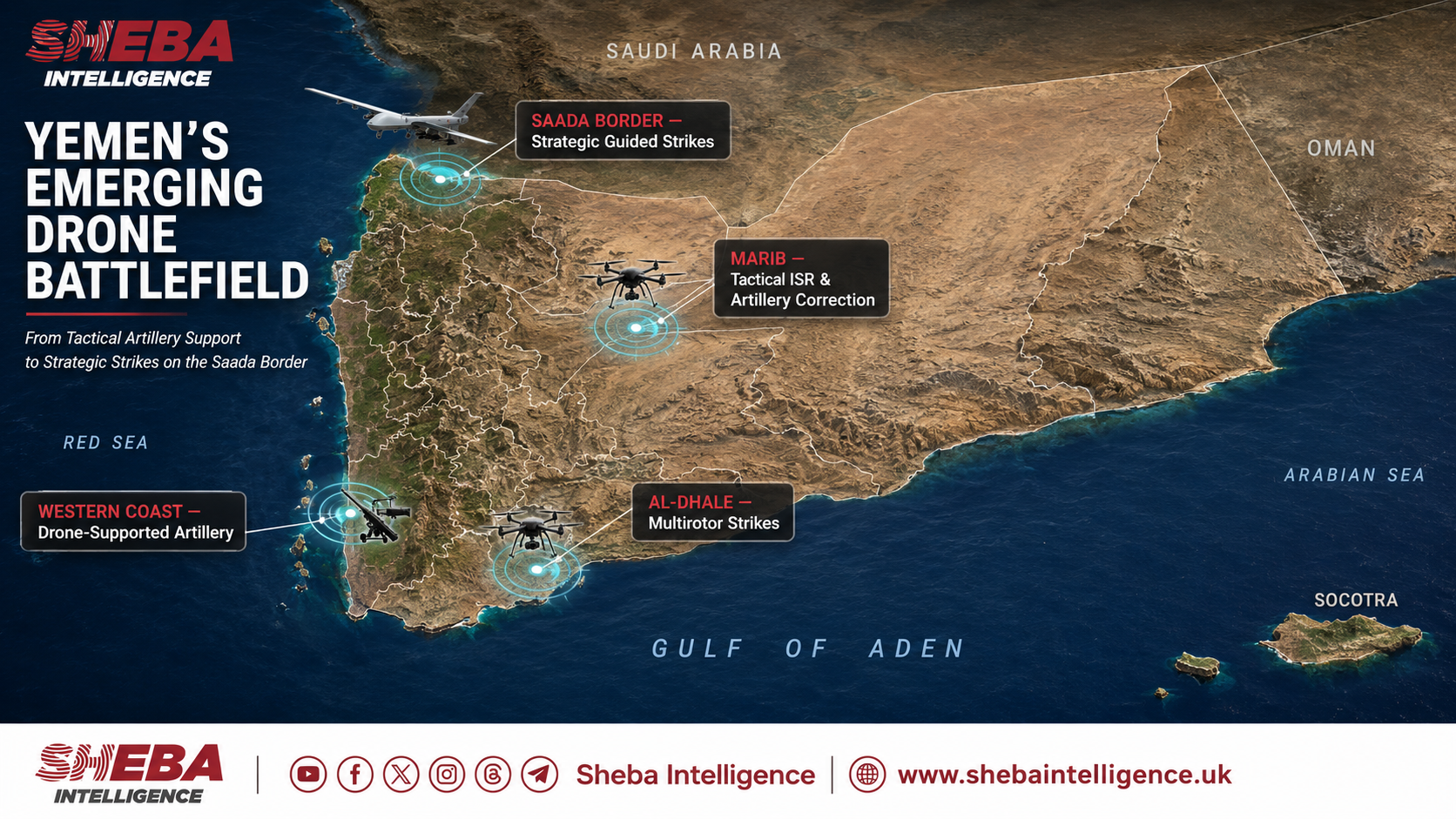
Video footage from Marib, Al-Dhale, the western coast, and Saada reveals a gradual shift in the Yemeni army’s use of unmanned aerial systems—from conventional reconnaissance to artillery fire control and precision strikes.
Analysis of the footage, supported by military experts’ assessments, indicates that tactical drones have become integrated into artillery operations across multiple fronts. Larger armed platforms, however, appear to have been deployed so far only in Saada, near the Saudi border.
Artillery Eyes Across the Frontlines
Footage from Marib, Al-Dhale, and the western coast shows a broadly similar operational pattern: small drones survey frontline positions, identify targets, and monitor shell impacts, enabling conventional and self-propelled artillery units to adjust their fire in near real time.
In some operations in Marib and Al-Dhale, munitions appear to descend vertically onto targets. This suggests that small multirotor drones may also be conducting direct attacks while a second drone records the strike and assesses its effects.
Many of the larger explosions, however, are consistent with artillery fire guided or corrected through aerial surveillance.
The western coast provides the clearest evidence of this integration. The National Resistance’s military media released aerial footage of Houthi positions south of Hodeidah being struck by artillery. The drone appears to support a complete targeting cycle: locating the target, observing shell impacts, helping adjust subsequent fire, and conducting post-strike assessment.
This capability enables self-propelled artillery to engage positions behind barriers or inside field fortifications while reducing the time and number of rounds required to suppress a target.
Operating Under Electronic Threat
Some missions were conducted close to Houthi lines despite the group’s possession of electronic-warfare systems and man-portable weapons designed to counter low-flying drones.
This does not prove that government forces have comprehensively neutralized Houthi defenses. It does, however, suggest an ability to operate tactical drones in a contested electronic environment.
Possible methods include low-altitude approaches, short mission windows, varying flight paths and frequencies, and deploying separate drones for attack and observation.
The persistent presence of drones also forces Houthi units to disperse personnel, conceal artillery and vehicles, and relocate more frequently—creating an operational effect even before a strike occurs.
Saada Reveals the Strategic Layer
Footage from the Razamat front in Saada differs substantially from material recorded elsewhere. The quality and stability of the imagery, automated target tracking, precision of impact, and size of the explosions inside mountainous fortifications point to a larger armed drone using guided missiles or aerial bombs.
The strikes are inconsistent with unguided mortar rounds dropped from a small commercial multirotor. Instead, they suggest a modern platform equipped with a multifunction electro-optical system, target-tracking capabilities, and a remote command station operated by a specialized crew.
Saada’s location along the Saudi border and the depth of Houthi fortifications may explain why this higher-level capability appeared there first. No comparable evidence has yet emerged showing the same strategic platform operating in Marib, Al-Dhale, or along the western coast.
A Multi-Layered Drone Network
The footage does not reveal a single aircraft type or unified system. Instead, it points to a functional distribution of capabilities:
- Tactical reconnaissance drones supporting artillery correction across multiple fronts.
- Small multirotor aircraft dropping munitions on nearby targets.
- Separate observation platforms recording strikes and assessing damage.
- A larger armed drone, so far seen in Saada, conducting precision attacks with guided munitions.
This suggests that government forces are developing a flexible drone capability tailored to each battlefield. Along the open western coast, drones improve artillery accuracy. In Marib and Al-Dhale, they combine surveillance with close-range attacks. In Saada’s mountainous terrain, a larger platform appears to be targeting fortified positions with guided weapons.
Assessment
The significance of this development lies not merely in the Yemeni army’s possession of drones, but in their integration with artillery and battlefield targeting units.
Drones are shortening the interval between detecting a target and striking it. They are also transforming artillery—including self-propelled systems—from a predominantly area-fire weapon into a more precise and responsive battlefield capability.
The apparent deployment of a larger armed platform in Saada represents the highest level of this transition. If its use expands to other fronts, it could undermine the Houthis’ ability to protect command positions, artillery batteries, vehicles, and fortified sites—and begin to erode the group’s long-standing advantage in aerial surveillance and drone-enabled warfare.
Editor’s Note:
A forthcoming Sheba Intelligence investigation will examine the strategic drone observed in operations on the Saada border, including its likely model, technical capabilities, operational range, payload and potential impact on the battlefield.