
The Yemeni Army’s Surprise for the Houthis: A Strategic Drone Enters the Battle
Editor’s Note:
This investigation builds on Sheba Intelligence’s earlier investigation, “Drones Reshape Yemen’s Battlefield: Artillery Eyes and Strategic Firepower on the Saada Border,” which examined how government forces are using tactical drones for reconnaissance, artillery correction and precision strikes. This follow-up identifies and assesses the strategic drone observed in operations on the Saada border.
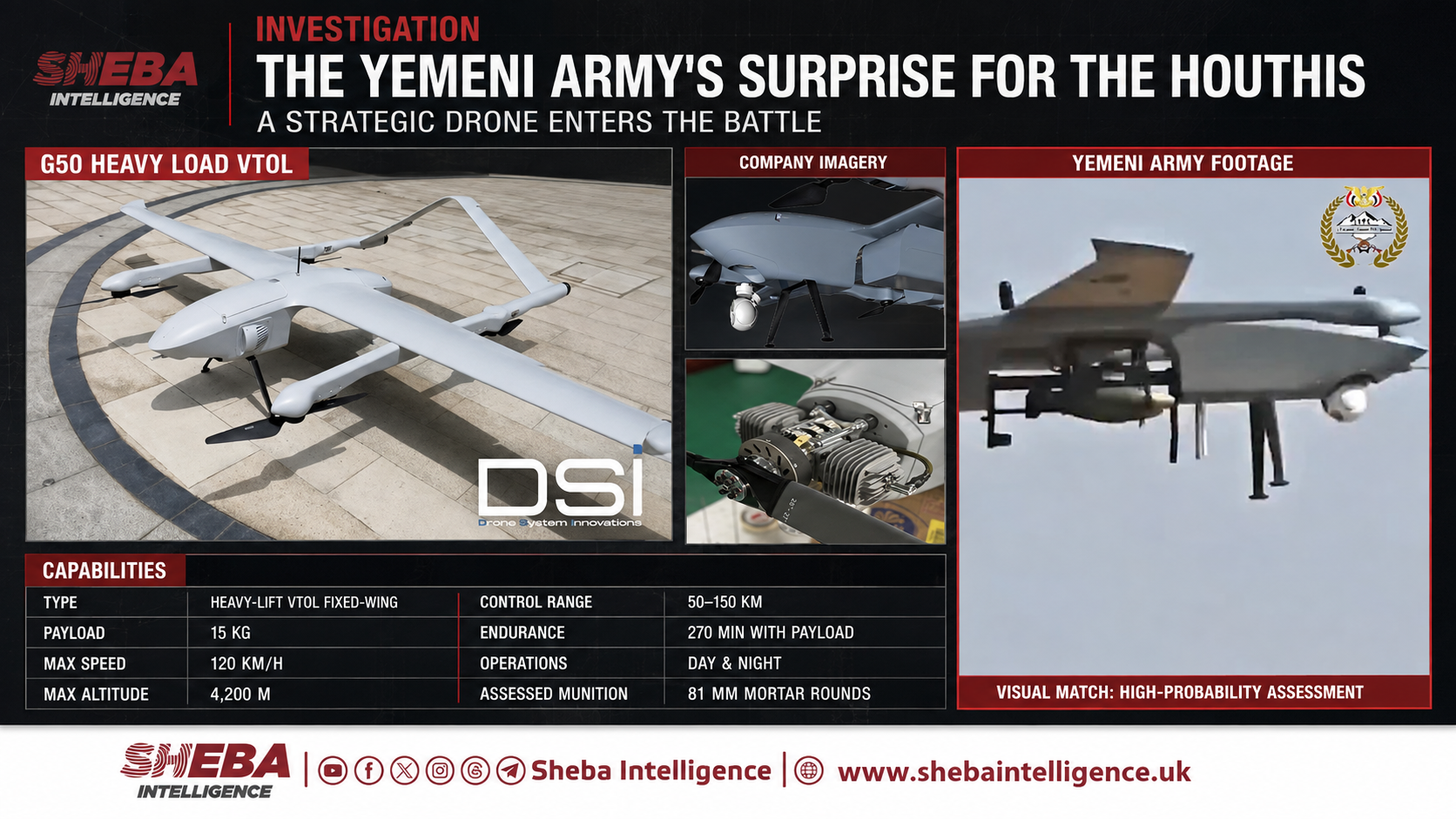
An open-source investigation by Sheba Intelligence, based on the examination and analysis of footage released by the Yemeni Armed Forces, has identified a new heavy-lift, multi-role drone being deployed against the Houthis.
Visual comparison indicates that the aircraft is most likely a DSTECHUAS G50 Heavy Load VTOL Fixed-Wing Drone, a Chinese-made platform capable of vertical takeoff and landing, long-endurance flight and carrying payloads significantly heavier than those transported by the small tactical drones previously seen on Yemen’s front lines.
Its appearance marks a potential expansion of the Yemeni army’s drone capabilities—from tactical reconnaissance and artillery correction to prolonged surveillance and direct strikes behind Houthi lines.
From a Commercial Platform to a Combat Drone
The G50 was originally designed for civilian and industrial missions, including cargo transport, aerial surveying, infrastructure inspection and carrying heavy LiDAR sensors or gimbal-mounted cameras.
However, footage examined by Sheba Intelligence suggests that the Yemeni army has modified the commercially available platform for military use. The aircraft appears capable of conducting reconnaissance, locating targets, correcting artillery fire and dropping munitions.
The weapons visible in the footage appear to be modified 81mm mortar rounds configured for aerial release. This does not mean that the G50 was manufactured as an armed drone; rather, its weapon system appears to be a locally integrated modification fitted to a commercially available dual-use platform.
Assessed Specifications
-
Likely model: DSTECHUAS G50 Heavy Load VTOL Fixed-Wing Drone
-
Aircraft type: Multi-role fixed-wing drone with vertical takeoff and landing
-
Manufacturer: Chinese drone systems supplier DSTECHUAS
-
Maximum takeoff weight: Approximately 50 kg
-
Maximum payload: Up to 15 kg
-
Maximum speed: Approximately 120 km/h
-
Maximum altitude: Around 4,200 metres above sea level
-
Control range: Between 50 and 150 km, depending on the communications system
-
Endurance with payload: Approximately 270 minutes
-
Maximum advertised endurance: Potentially up to 600 minutes in the hybrid configuration and under reduced-load conditions
-
Operating temperature: Between –10°C and 60°C
-
Wind resistance: Level 6, equivalent to approximately 13 metres per second
-
Airframe materials: Fibreglass and carbon fibre
-
Operational capability: Day and night, depending on the installed sensors
-
Observed munitions: Likely modified 81mm mortar rounds
-
Advertised base price: Approximately $29,599
-
The manufacturer offers both electric and hybrid variants of the G50. Its advertised package includes the fixed-wing airframe, four vertical-lift motors, a forward-flight motor, a CUAV X7 Pro flight controller, differential GPS and other control components.
The published price refers to the basic aircraft package and does not necessarily include the total cost of long-range communications, electro-optical equipment, ground-control systems or military modifications.
Why the Drone Matters
The significance of the G50 lies in its combination of three capabilities: vertical takeoff, extended endurance and the ability to carry comparatively heavy surveillance equipment or munitions.
This could enable government forces to:
-
Monitor Houthi movements and supply routes for several hours.
-
Operate from forward positions without prepared runways.
-
Correct artillery fire and assess strike damage.
-
Reach military positions behind the immediate front lines.
-
Switch between reconnaissance sensors and strike payloads.
-
Conduct day-and-night missions when equipped with suitable cameras.
Its vertical takeoff capability is particularly useful in Yemen’s mountainous terrain, where conventional runways and large launch areas are often unavailable.
A New Stage in the Drone Battle
Until recently, most footage released by government forces showed smaller tactical drones being used to detect targets, guide self-propelled artillery and document strikes across several fronts.
The G50 represents a different category. Its longer endurance, heavier payload and wider operational radius could allow the Yemeni army to maintain sustained aerial pressure on Houthi artillery positions, supply routes, command posts and military movements.
Although the aircraft is not a “strategic drone” in the conventional international military classification, it could have a strategic effect within the Yemeni battlefield. Its importance depends not only on the platform itself, but also on whether the army possesses multiple aircraft and can integrate them with intelligence, artillery and unified command-and-control systems.
If deployed in sufficient numbers, the platform could complicate Houthi movements behind the front lines and reduce the relative drone advantage the group has maintained during previous phases of the war.
The principal surprise, therefore, is not merely that the Yemeni army has acquired a commercially available Chinese aircraft. It is the apparent ability to modify the platform, arm it and incorporate it into combat operations under Yemen’s difficult geographical and operational conditions.