
Exclusive | Shahlai Meets Houthi Military Leaders to Discuss Tehran Plan to Seize Marib’s Oil and Control Bab al-Mandab
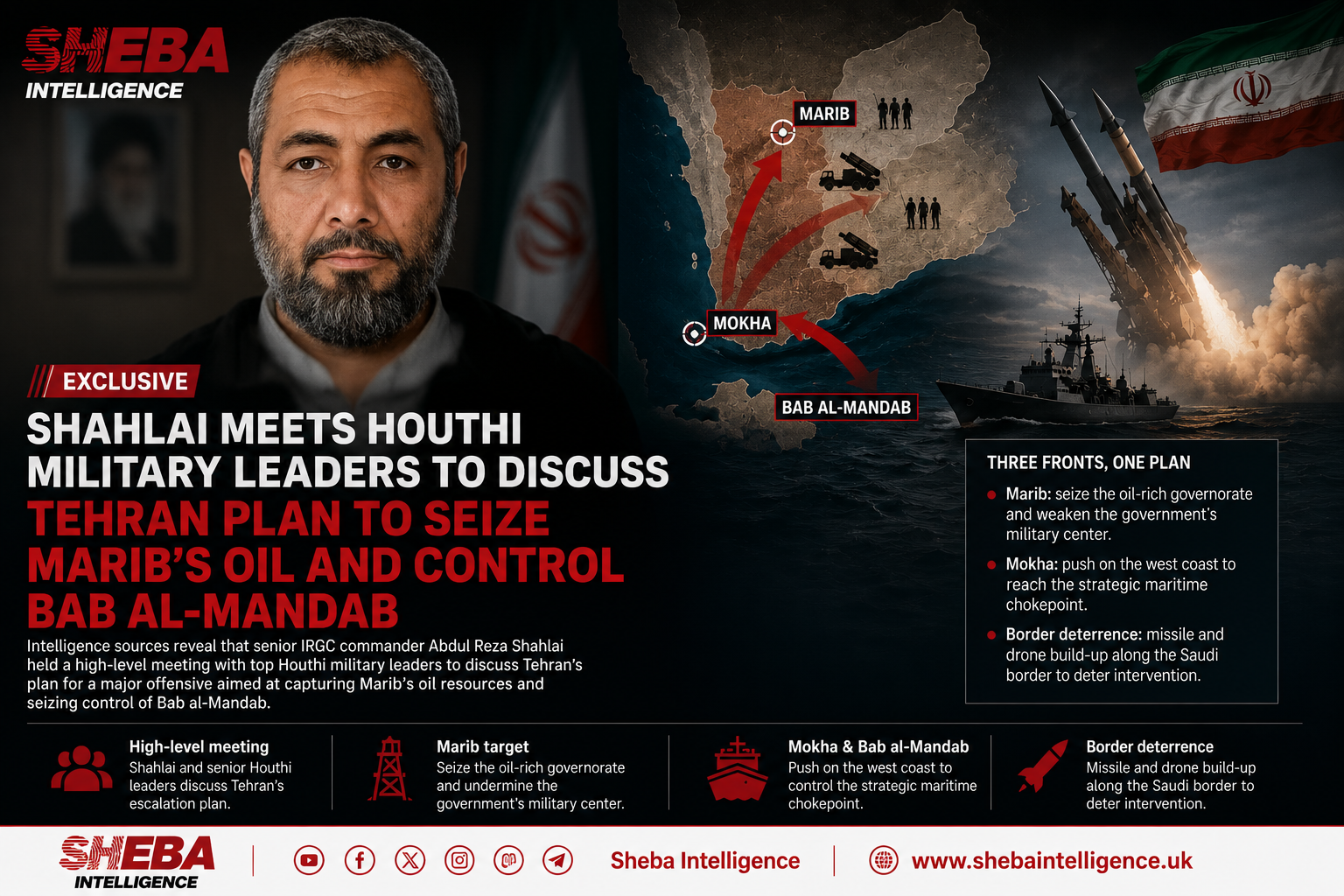
Intelligence sources say the senior IRGC commander toured Houthi fronts before a high-level meeting that discussed a major offensive centred on Marib and Mokha, while Iranian experts were subsequently sent to assess government defences.
Sheba Intelligence has obtained new intelligence indicating that senior Islamic Revolutionary Guard Corps commander Abdul Reza Shahlai recently toured several Houthi-controlled fronts before meeting senior Houthi military leaders to discuss what sources described as a Tehran-backed plan for a major new phase of the war.
According to the sources, the meeting took place approximately five days ago and was attended by most of the Houthis’ first-tier military leadership. The discussions focused on preparations for what participants described as a “decisive battle”, built around two strategic objectives: weakening or capturing Marib, including its oil resources, and escalating the western-coast campaign through Mokha toward Bab al-Mandab.
The sources described the broader escalation plan as Iranian-driven, with Shahlai playing a central role in coordinating military preparations and assessing readiness across the fronts.
Sheba Intelligence has not independently verified all details of the meeting, and neither Iranian nor Houthi authorities have publicly commented on the reported discussions.
Shahlai Moves from Strategic Coordination to Frontline Assessment
The latest information suggests that Shahlai’s involvement extends beyond strategic consultations with the Houthi leadership.
Sources said he visited several Houthi fronts as part of an assessment of preparations for the next phase of operations. Following the high-level meeting, Iranian military experts were also sent to selected fronts facing government forces, particularly around Marib and the western coast, to study defensive positions and identify possible vulnerabilities.
Recent Houthi activity on these fronts was described by the sources as partly designed to test government responses rather than immediately achieve major territorial gains. Limited attacks, pressure on frontline positions and the use of missiles and drones provided an opportunity to measure reaction times, firepower, command arrangements and weaknesses before a broader offensive.
The development follows earlier intelligence obtained by Sheba Intelligence on August 1 indicating that Houthi leader Abdul Malik al-Houthi had held a secret meeting with Shahlai in Yemen. That meeting demonstrated that the Iranian commander was already operating at the highest level of Houthi strategic decision-making.
Marib: The Military and Economic Centre of Gravity
The intelligence indicates that Marib is not viewed simply as another frontline. Within the reported plan, it represents a military and economic centre of gravity whose loss would significantly weaken Yemen’s internationally recognized government.
Marib remains one of the government’s most important military strongholds in northern Yemen and contains strategic oil and gas resources. Capturing the governorate, or significantly degrading government control there, would give the Houthis access to additional energy resources while reducing one of the principal military obstacles to a wider shift in Yemen’s balance of power.
The relationship between Marib and Bab al-Mandab is therefore strategic rather than geographic. The assessment is that weakening the government’s principal northern military and energy centre would make it more difficult for government forces to sustain simultaneous pressure across multiple fronts, including the western coast.
This objective had already begun to emerge in intelligence obtained by Sheba Intelligence earlier this month. On August 6, Sheba Intelligence reported that a closed Houthi leadership meeting attended by four IRGC officers had identified Marib’s oil fields, military installations and government facilities as priority targets.
Less than a day later, the Houthis launched a large-scale attack involving approximately 30 drones and nearly ten missiles toward Marib. Government forces intercepted much of the attack, providing the first battlefield indication that the earlier targeting plan had moved toward implementation.
Further reinforcements were subsequently moved toward the Raghwan front in western Marib, reinforcing evidence that military pressure around the governorate was continuing rather than representing an isolated missile-and-drone campaign.
Mokha: The Route to Bab al-Mandab
The second major axis identified in the latest intelligence is Mokha and the western coast.
Mokha has been subjected to repeated missile and drone attacks since August 9, including coordinated strikes involving ballistic missiles, UAVs and explosive boats. The campaign damaged civilian and port infrastructure and eventually forced Mokha Port out of service.
The attacks are significant because Mokha is the closest major government-controlled port and military-logistics centre to Bab al-Mandab. Weakening it would undermine the government-aligned presence on the western coast while increasing Houthi ability to project military pressure toward one of the world’s most strategically important maritime chokepoints.
Sheba Intelligence later assessed that the repeated concentration of attacks on Mokha was unlikely to be explained solely by the port itself. Its location links operations against government forces on land with the Houthis’ broader maritime campaign around Bab al-Mandab.
By August 14, the two campaigns had become increasingly connected: sustained pressure on Marib’s energy and military infrastructure was unfolding alongside attacks designed to weaken Mokha and expand Houthi leverage over the approaches to Bab al-Mandab.
The connection became even clearer after Mokha Port was forced completely out of service, with initial losses officially estimated at $79 million, while government forces sharply expanded operations against Houthi positions, particularly around Marib.
The Saudi Border as a Deterrence Front
A third component of the current military picture lies along Yemen’s border with Saudi Arabia.
Over recent weeks, the Houthis have accumulated forces and repositioned missile and drone capabilities in northern Yemen, including areas facing Saudi territory. The deployments could provide the group with an additional pressure mechanism if Saudi Arabia or coalition-aligned forces intervene more directly in support of the Yemeni government during a wider confrontation.
Rather than necessarily indicating that an attack on Saudi Arabia is the primary objective, the northern deployments may serve a deterrence function: maintaining the ability to threaten Saudi territory while the Houthis concentrate offensive operations elsewhere.
Sheba Intelligence reported as early as July 12 that the Houthis had deployed cruise-missile launch platforms near the Saudi border while simultaneously expanding missile, drone and maritime preparations along Yemen’s Red Sea coast.
One week later, Sheba Intelligence revealed that a high-level meeting overseen by Iran’s representative to the Houthis had identified three priority theatres for a possible return to full-scale war: Marib–Al-Jawf, Taiz–Bab al-Mandab and the Saudi border.
The three fronts identified in July now closely correspond to the areas experiencing the most significant military preparations and escalation.
A More Complicated Saudi Calculation
The deterrence calculation, however, has become more complicated since Saudi Arabia, Türkiye and Pakistan signed the Mecca Joint Defence Agreement on August 7.
The agreement states that an armed attack against one member will be considered an attack against all three and establishes mechanisms for political and military coordination, joint exercises and defence cooperation. It does not predetermine the precise military response to any future Houthi attack, but it adds a new layer to the risks surrounding any attempt to use missile or drone strikes against Saudi Arabia to discourage intervention in Yemen.
A major Houthi strike on Saudi territory during a renewed Yemeni ground war could therefore produce the opposite of the intended deterrent effect by widening the confrontation and activating stronger regional military coordination.
Iran’s Wider Regional Calculation
The timing of the reported plan also comes amid a deepening deadlock between Iran and the United States.
On August 18, U.S. President Donald Trump said no talks with Iran were taking place and none were scheduled, while Tehran has said there has been no progress in restoring the interim arrangement between the two sides. Washington has since announced plans for substantially tougher economic pressure on Iran.
This diplomatic deadlock does not itself prove that Tehran ordered a Houthi offensive in Yemen as a direct response to failed negotiations. However, the intelligence obtained by Sheba Intelligence indicates that Iranian officials are actively involved in the current Houthi planning cycle.
In that context, a major change in Yemen would give Tehran another source of regional leverage. A successful Houthi campaign in Marib could weaken the Yemeni government and expand access to energy resources, while greater military control around Bab al-Mandab would create pressure on another strategic maritime chokepoint at a time when the Strait of Hormuz remains central to Iran’s confrontation with Washington.
The strategic value would be significantly greater if both objectives were achieved: energy leverage inside Yemen and maritime leverage at Bab al-Mandab.
The Pattern Is No Longer Fragmented
The significance of the latest intelligence lies in how closely it connects developments that previously appeared as separate military events.
Missile and drone deployments along the Saudi frontier, Houthi reinforcements around Marib, attacks on its military and energy centre, the sustained campaign against Mokha, preparations along the western coast and the presence of Iranian personnel across the operational fronts now converge around the same three theatres first identified by Sheba Intelligence in July.
An earlier Sheba assessment had already described the emerging strategic triangle as Bab al-Mandab, Marib’s oil and pressure on Saudi Arabia.
The latest information adds a critical element: according to the intelligence sources, these theatres are now being discussed within a single Iranian-backed operational framework, with Shahlai directly involved in consultations with senior Houthi commanders and Iranian experts assessing the fronts ahead of possible larger operations.
It remains unclear whether a final timetable for a major ground offensive has been approved. Military preparations can also be used to create negotiating leverage without ultimately developing into a full-scale assault.
However, the sequence of leadership meetings, Shahlai’s reported frontline visits, the deployment of Iranian experts, probing operations against government defences, force concentrations and the sustained missile-and-drone campaigns against Marib and Mokha indicate that the current escalation has moved beyond isolated attacks and into a more coordinated phase of military preparation.