
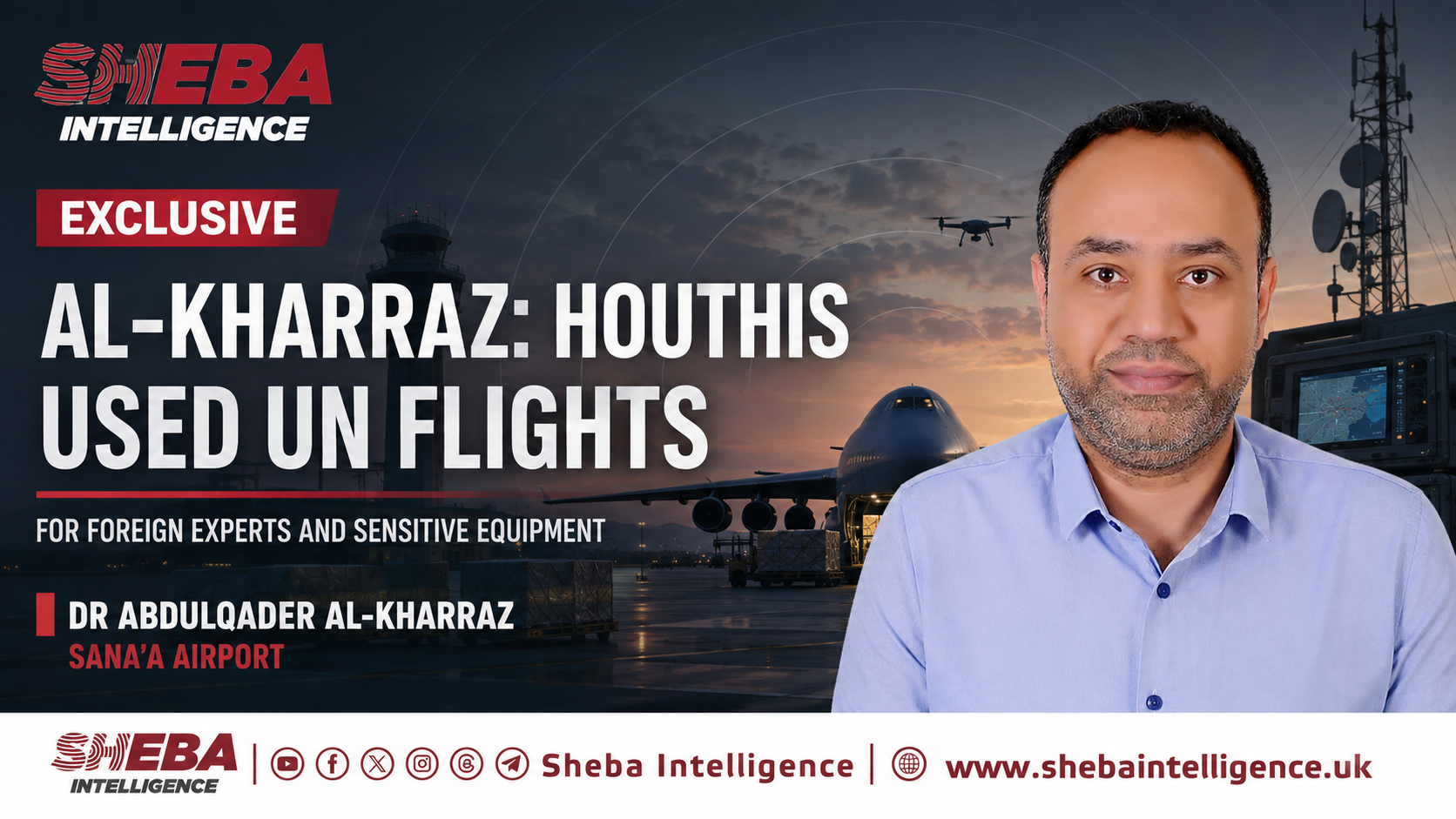
Al-Kharraz: Houthis Used UN Flights to Bring Foreign Experts and Sensitive Equipment into Sana’a
The suspension of flights follows growing scrutiny over unusually frequent arrivals, large cargo aircraft and flights operating without publicly available identification data
Dr Abdulqader Al-Kharraz has confirmed to Sheba Intelligence earlier reports that foreign experts, sensitive cargo and specialised drone-related equipment were transported into Houthi-controlled territory through Sana’a International Airport.
In an exclusive statement, Al-Kharraz said communications equipment was also brought into Sana’a as part of the unusual air traffic involving five aircraft that landed in a single day, followed by another large aircraft the next morning.
Al-Kharraz said his monitoring team, which operates in a high-risk environment, had obtained what he described as near-confirmed information that the Houthis had exploited some United Nations flights for non-humanitarian purposes.
Sheba Intelligence has not independently verified the contents of the aircraft or identified the flights allegedly used to transport the equipment. The United Nations has not publicly responded to the allegations.
Unusual Flight Frequency
According to Al-Kharraz, the frequency of UN flights to Sana’a was inconsistent with ordinary humanitarian requirements, which he estimated would need no more than two flights a week.
Instead, he said, the airport had been receiving at least one or two aircraft a day—and sometimes more. He estimated that around 60% of the monitored flights entered Yemeni airspace without transmitting publicly available identification data.
Al-Kharraz said the arrival of five aircraft in a single day, shortly before UN flights subsequently stopped, was particularly significant. Some of the aircraft involved were large cargo planes.
Technical sources previously told Sheba Intelligence that three of the five aircraft entered Yemeni airspace without transmitting public identification data. The other two arrived from Djibouti and were identified through flight-tracking platforms as UN-chartered aircraft.
Flights During Houthi Launch Operations
Al-Kharraz also said UN aircraft had operated in Yemeni airspace while the Houthis were launching missiles and drones.
He argued that this raised questions about the level of coordination between the UN and the Houthis and whether it extended beyond flight safety and routine humanitarian arrangements.
The timing alone, however, does not establish that UN aircraft were used to transport experts or sensitive materials. Verifying the allegations would require an independent examination of passenger manifests, cargo records, flight permits and operational coordination procedures.
Flight Suspension and Government Investigation
Al-Kharraz said the suspension of UN flights to Sana’a in the following days may be linked to action by the internationally recognised Yemeni government and an ongoing investigation into the frequency and purpose of the flights.
A Yemeni government source previously told Sheba Intelligence that authorities were considering suspending UN flights amid concerns that humanitarian permits were being exploited to move dual-use materials or foreign specialists into Houthi-controlled territory using false identities or forged documents.
The concerns prompted calls for tighter inspections and greater transparency over passenger manifests, cargo contents and flight routes.
Officials, Wounded Fighters and Human Remains
Al-Kharraz previously said information available to him indicated that one of the five aircraft carried an Omani official and an Iranian official to Sana’a.
According to his account, the aircraft later departed carrying the remains of Iranian nationals, wounded Iranians and injured Houthi members.
He did not identify the officials or specify which aircraft was involved. Sheba Intelligence was unable to verify the claims independently. Further details are available in Sheba Intelligence’s earlier report on the five Sana’a flights.
Iranian Counter-Drone Equipment
Al-Kharraz’s account of drone and communications equipment is consistent with information published in an earlier Sheba Intelligence investigation.
A source told Sheba Intelligence that Iranian personnel had brought technical equipment designed to detect drones, trace their signals and locate their operators or ground-control stations.
The described capability is consistent with radio-frequency detection and direction-finding technology—RF Detection/Direction Finding (RF/DF)—which can be integrated with radar, electro-optical sensors and electronic jamming systems as part of a broader counter-unmanned aircraft and electronic-warfare architecture.
The equipment’s manufacturer, model and operational range remain unknown. It is also unclear whether Iran transferred a complete system or only separate components.
If confirmed, the transfer could indicate an effort to strengthen the Houthis’ ability to detect hostile drones, locate their control networks and pass targeting data to jamming systems or strike units.