
Islamic State Spokesman and Yemen Branch Leader Killed in Joint Operation
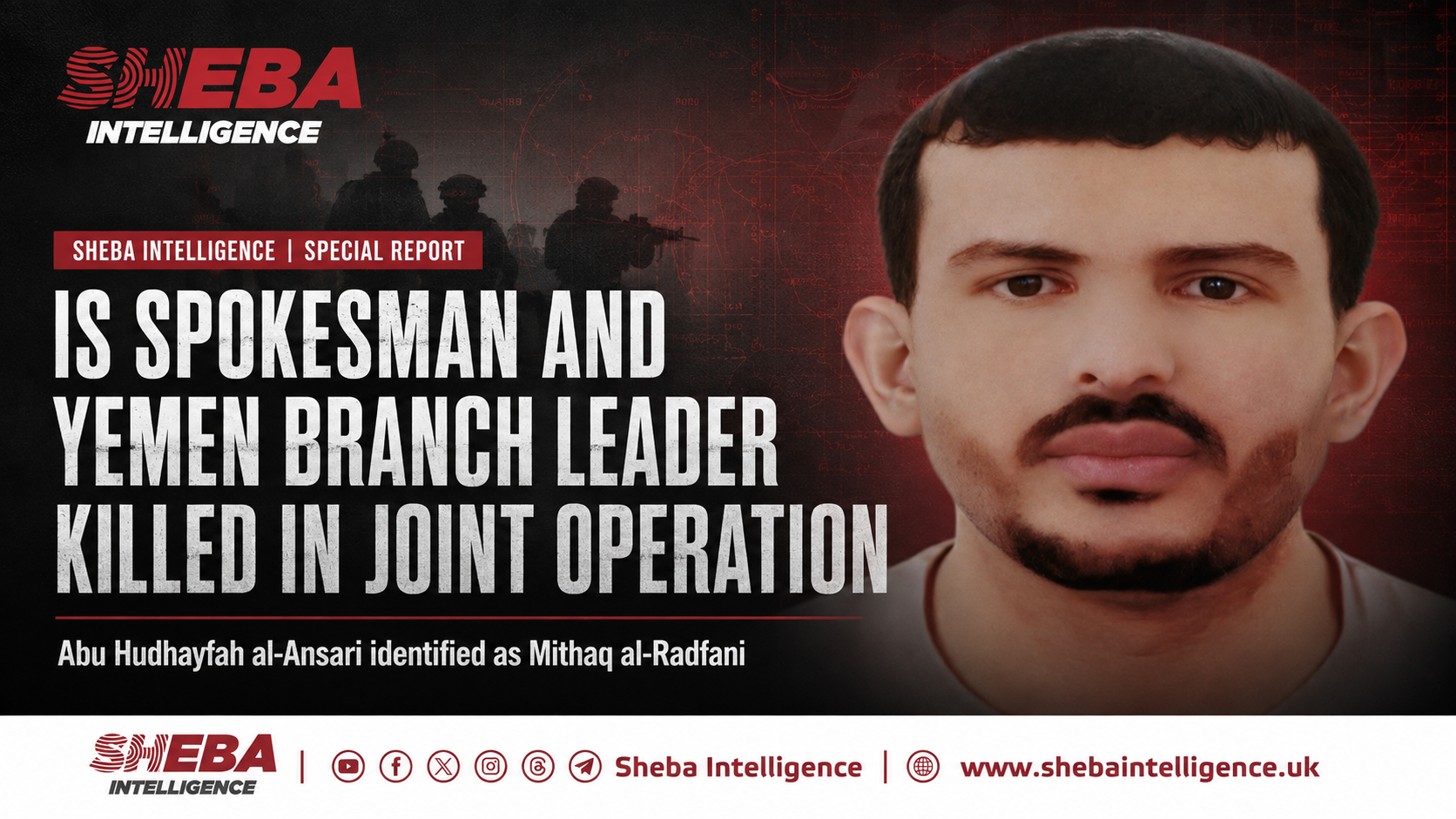
Expert identifies Abu Hudhayfah al-Ansari as Yemeni national Mithaq Thabit Haitham al-Radfani, one of the group’s most prominent religious officials
Yemen’s Central State Security Agency announced the death of Islamic State commander Abu Hudhayfah al-Ansari in a joint special operation carried out by Coalition special forces with support from Yemen’s Counterterrorism Force 22.
The agency said the operation was intended to capture al-Ansari but ended with his death. It added that the participating forces withdrew from the area after completing the mission, with no civilian casualties or damage reported.
The statement did not disclose when or where the operation took place. It also provided no details about how al-Ansari was killed or whether the raid resulted in further arrests or the seizure of documents and communications equipment.
According to Aden Al-Ghad editor-in-chief Fathi bin Lazraq, the raid took place at around 1:00 a.m. in an old mud-brick house in Al-Zawiyah Square, Al-Hawta district of Seiyun. He said al-Ansari was wounded and captured before dying from his injuries, while another person staying with him was killed. Drones reportedly supported the joint special forces operation. These details were not included in the official statement.
Islamic State Spokesman and Yemen Branch Leader
Mohammed bin Faisal, a specialist in militant groups, identified Abu Hudhayfah al-Ansari as Yemeni national Mithaq Thabit Haitham al-Radfani. According to Faisal, al-Radfani served as the official spokesman for Islamic State while also leading the group’s self-proclaimed “Yemen Province.”
Faisal said al-Radfani was one of the group’s most prominent religious officials, combining ideological guidance with leadership of the Yemen branch and his role as spokesman for Islamic State’s central command.
Abu Hudhayfah al-Ansari first emerged as the group’s official spokesman in August 2023, when he announced the death of Islamic State leader Abu al-Hussein al-Husseini al-Qurashi and the appointment of Abu Hafs al-Hashimi al-Qurashi as his successor.
He subsequently issued central audio messages outlining the group’s positions and delivering instructions to its branches and supporters.
Identifying him as a Yemeni national makes his death more significant than the removal of a local commander. It indicates that Yemen hosted a figure connected to Islamic State’s central leadership and media apparatus, rather than solely to its relatively limited local branch.
Capturing Him Alive Was Nearly Impossible
Faisal said al-Radfani never went without an explosive belt, making it extremely difficult to capture him alive.
He added that Islamic State’s security instructions require senior figures to detonate their explosive belts when surrounded or facing capture. The group reportedly views commanders who are taken alive without resisting or detonating their explosives with suspicion and may accuse them of cooperating with intelligence services.
This may explain why the operation ended with al-Ansari’s death despite the stated intention to capture him. The State Security Agency, however, has not said whether he detonated his explosive belt or was killed during an exchange of fire with the raiding force.
Release Preceded the Operation by Days
The announcement of al-Ansari’s death came days after Abu Musab al-Adeni, a prominent former chanter for Al-Qaeda in the Arabian Peninsula, was released from detention in Aden after more than three years.
Al-Adeni defected from Al-Qaeda and joined Islamic State in 2015 before leaving the group in late 2016 and returning to Al-Qaeda. His time inside Islamic State may have given him knowledge of its personnel and structure in Yemen during a significant period of its activity.
There is no information so far establishing a direct connection between al-Adeni’s release and the operation targeting al-Ansari. The timing of the two developments should therefore be treated as a line of inquiry rather than evidence that they were linked.
Al-Radfani’s death represents a security blow to Islamic State. The operation’s wider impact, however, will depend on whether the forces recovered documents, communications devices or intelligence capable of exposing the group’s networks and the channels connecting its central leadership with its branch in Yemen.