
Smuggling Cell Statements Reveal Three Supply Routes to the Houthis Through Iran, Somalia and Djibouti
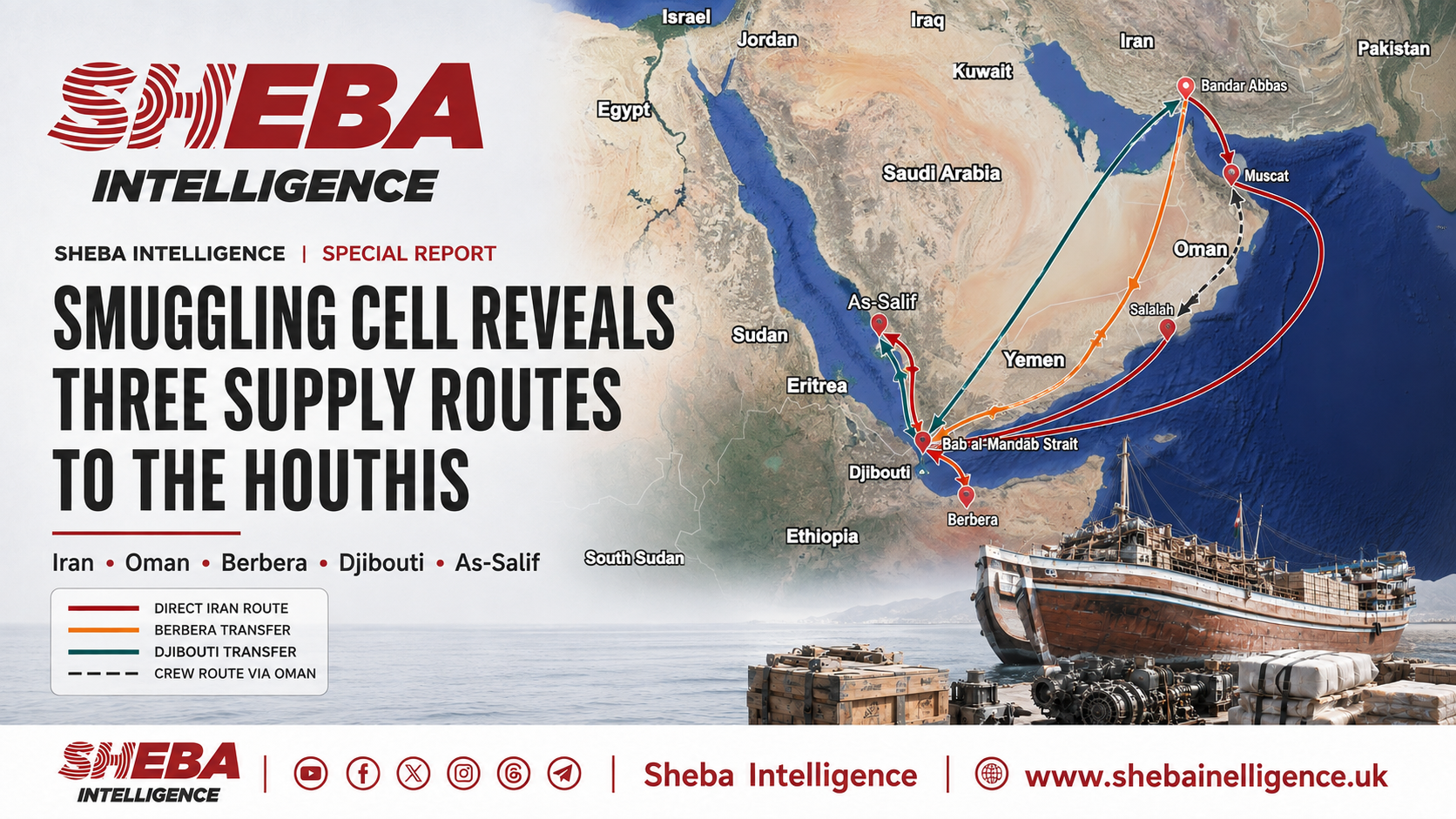
Seven Yemeni sailors describe repeated voyages to Al-Salif and shipments concealed inside industrial equipment and refrigerated containers
Videotaped statements by seven Yemeni sailors have revealed details of a multi-route smuggling network that allegedly transported shipments from Iran, Somalia and Djibouti to the Houthi-controlled port of Al-Salif in northern Hodeidah.
In a 38-minute recording broadcast by Al Joumhouriya TV and released by the National Resistance’s military media, members of the cell said they had participated in repeated voyages since 2021, using wooden boats and commercially disguised cargo to transport equipment and materials whose actual contents were often concealed from the crews.
Sheba Intelligence could not independently verify the circumstances under which the statements were recorded or confirm every allegation they contained. However, the separate accounts overlap on the names of alleged coordinators, travel routes, loading ports, maritime transfer points and concealment methods.
Three Routes to Al-Salif
The statements identify three principal routes used to deliver shipments to Houthi-controlled territory.
The first ran directly from Iranian ports, particularly Bandar Abbas and Jask, to Al-Salif. One sailor, identified as Ali Ahmed Abdu Qasir, said he had travelled to Iran five times and participated in several voyages to Yemen.
The second route involved transferring cargo from a larger Iranian vessel to smaller Yemeni boats off the Somali coast. The sailors said these transfers took place at night near a location they called “Ras Kri,” or a similar name, with the vessels operating without lights.
Some cargo was presented to the sailors as food products, including boxes of pasta. One cell member said he opened a package and found material that did not resemble ordinary pasta. According to his account, a sample reacted unusually when exposed to fire.
The third route originated in Djibouti under commercial cover. Cell members described as many as 12 voyages from Djibouti to Al-Salif. The declared cargo included generators, electrical transformers, air compressors, batteries, hydraulic cylinders, medicines, fertiliser and household appliances.
The sailors said they only discovered after their interception—when the equipment was dismantled—that some items allegedly concealed missile components, drones and other military equipment.
Two Routes Used to Move Crews to Iran
The statements also described two routes used to transport Yemeni sailors to Iran before assigning them to smuggling vessels.
One sailor said he left Sanaa for Jordan during Ramadan 2023 and then flew to Lebanon. He said an elderly Lebanese man received the group and accommodated them for three or four days before they were driven to Syria and flown from there to Tehran.
According to his testimony, Iranians and individuals linked to the Houthis received the sailors in Tehran and took them to a location he described as a Houthi facility. They were later flown to Bandar Abbas.
The statement indicates the involvement of an intermediary in Lebanon but does not directly identify him as a Hezbollah member. The claim that Hezbollah facilitated this stage appeared in the television introduction rather than in the sailor’s recorded account.
Another sailor described an alternative route from Hodeidah through Al-Mahra and across the land border into Oman. The group was driven to Salalah, remained there for several days, flew to Muscat and then continued to Bandar Abbas.
The accounts suggest that the network used several routes to move crews, reducing its dependence on a single corridor and complicating efforts to track its personnel.
Somali Crews and Coordinators Inside Iran
Cell members said they encountered Somali crews in Bandar Abbas. One account estimated that a group included between 12 and 13 Somali sailors. Yemeni and Somali personnel were then divided between different vessels.
Two names appeared repeatedly in the statements: Mohammed Al-Talibi, sometimes identified as Mohammed Jafar Al-Talibi, and Mustafa Al-Burj. The sailors described them as coordinators involved in receiving and housing the crews, assigning personnel to vessels and communicating with them during voyages.
Sheba Intelligence has not independently established the identities or organisational affiliations of the two men.
One sailor said Iranian personnel confiscated the crew’s mobile phones and prevented them from inspecting sealed compartments. In another incident, Iranians reportedly took control of a boat and sailed it into a location the witness described as resembling a military compound. The sailors were ordered to remain inside the cabin while the cargo was replaced.
Refrigerated Cargo and Sealed Containers
Several cell members described transporting refrigerated boxes and containers that they were told contained cancer medication. The crews received instructions to keep the cargo at specific temperatures.
One sailor said a voyage carried between 30 and 35 refrigerated boxes from Iran to Al-Salif. Another shipment allegedly included around 60 refrigerated containers that were maintained at five or six degrees Celsius above zero.
The statements also referred to approximately 50 black drums, each holding about 180 litres, which the crew was told contained silicone.
The sailors’ descriptions are insufficient to establish the actual composition of the materials. Substances including hydrazine and liquid nitrogen were mentioned by the television report as an interpretation of the cargo, not directly identified by the sailors. Confirming the contents would require cargo documentation or laboratory analysis.
Crossing Bab Al-Mandab at Night
Cell members also described the route used to evade maritime patrols in Bab Al-Mandab.
Amer Ahmed Yahya Musawa said the boats crossed the strait at night and travelled west of the internationally recognised shipping lane, closer to Eritrea and Djibouti, before turning north toward Al-Salif.
During the final voyage, the vessel was allegedly loaded so heavily that its captain struggled to control it. The sailors said they followed their usual route away from West Coast patrols but were intercepted by National Resistance boats.
The accounts illustrate how smuggling networks can exploit fishing and coastal trade traffic, as well as the wide maritime space between Yemen, Djibouti and Eritrea, to conceal illicit voyages within routine commercial activity.
From Fuel Smuggling to Weapons Shipments
Most of the sailors said they were recruited because of economic hardship. Some initially smuggled diesel from Somalia to Hodeidah before being assigned to more sensitive voyages.
They also described attending ideological courses in Hodeidah, Saada and Sanaa. Some were instructed to obtain passports and seafarers’ documents before travelling to Iran.
Several alleged Houthi coordinators were repeatedly named, including Hussein Al-Attas, Ibrahim Al-Muayyad, Yahya “Juniya,” Faisal Al-Hamzi and Iyad Al-Atini. According to the sailors, these individuals were involved in recruitment, organising travel and receiving the vessels and passports when the crews arrived at Al-Salif.
The statements portray a logistical structure extending beyond a single intercepted shipment. It allegedly began with recruiting and preparing sailors, continued through their transfer to Iran and assignment to different vessels, and culminated in the movement of disguised cargo through multiple maritime routes to Al-Salif.
If corroborated, the voyages would indicate that the intercepted vessel was part of a supply network that operated regularly for several years, using multiple routes, intermediaries and commercial cover to circumvent maritime surveillance.