
Yemeni Warplanes Strike Houthi Camps Hours After Sheba Intelligence Warning
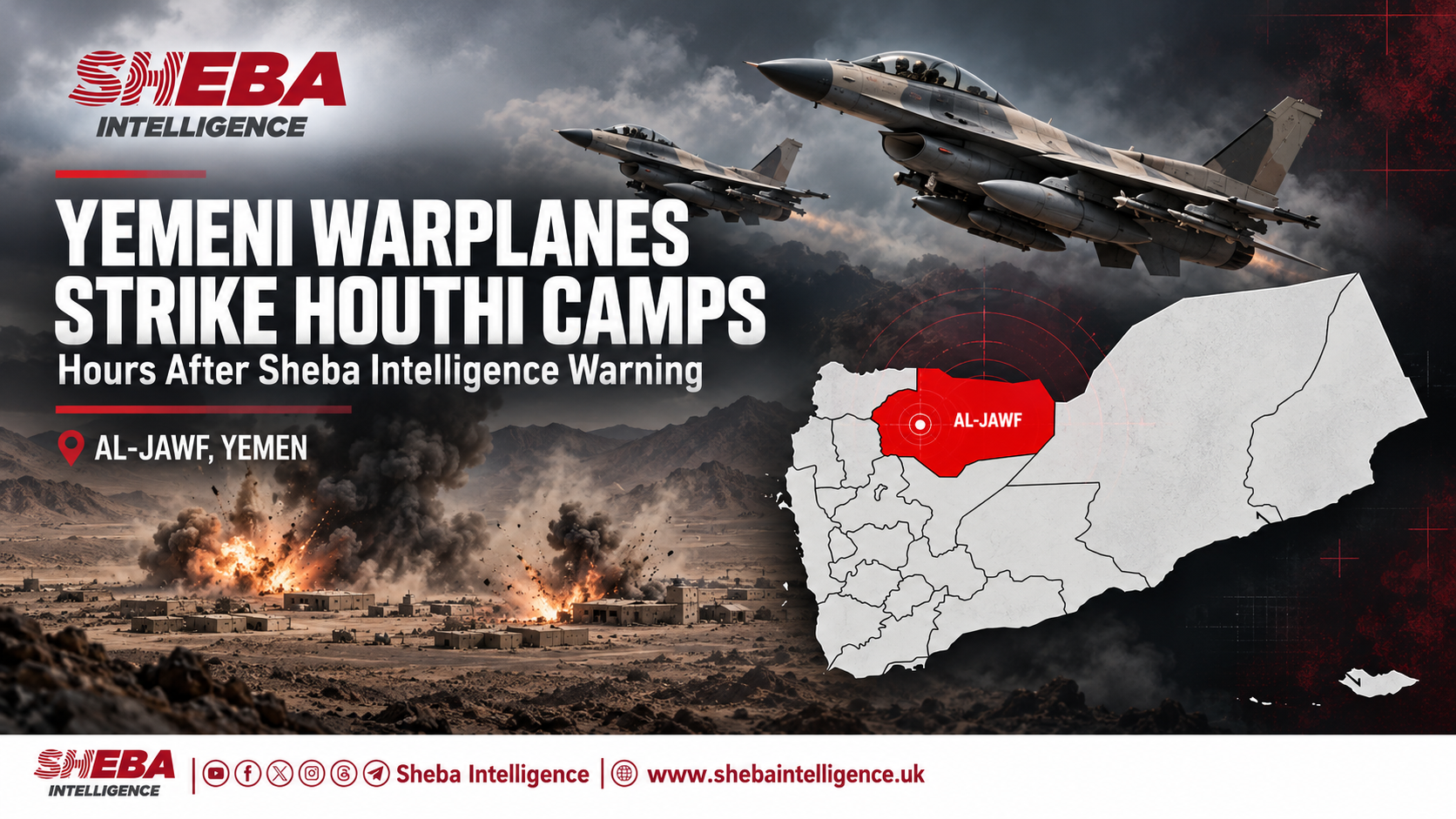
Warplanes operated by Yemen’s internationally recognised government carried out multiple strikes on Houthi-controlled military positions in Al-Jawf province, local sources told Sheba Intelligence.
The strikes targeted the Al-Labnat and Al-Khanjar military camps, as well as Houthi reinforcements and troop concentrations east of Al-Hazm, the provincial capital, the sources said.
The air operation came little more than five hours after Sheba Intelligence published details of Houthi reinforcements and preparations for a new offensive in Al-Jawf, including military activity around the camps subsequently targeted.
No independently confirmed information was immediately available on casualties or the extent of the damage caused by the strikes.
Government Expands Pre-Emptive Operations
The latest strikes appear to be part of an expanding campaign by government forces to disrupt Houthi movements before they develop into a broader ground offensive.
Military units in Yemen’s Sixth Military Region had earlier launched a series of pre-emptive attacks against Houthi positions, weapons stores, launch sites and movements across several parts of Al-Jawf.
Government forces also struck Houthi positions and fortifications inside Al-Labnat camp using rocket artillery, according to military statements. The new airstrikes broaden the operation to include Al-Khanjar camp and reinforcements east of Al-Hazm.
The use of combat aircraft in Al-Jawf follows air operations against Houthi positions in Taiz and Hodeidah, where government warplanes recently targeted military sites, vehicles and troop concentrations amid escalating fighting along the western front.
Camps Named in Earlier Intelligence
In its earlier report, Sheba Intelligence said the Houthis were moving reinforcements and preparing military positions in Al-Jawf as part of plans to activate the front.
Al-Labnat, east of Al-Hazm, has repeatedly served as a forward military position for operations around the provincial capital and the desert routes leading towards Marib.
Al-Khanjar, in the northern part of the province, is also strategically significant because of its proximity to routes connecting Al-Jawf’s interior with Al-Yatmah and areas near the Saudi border.
Targeting both camps could disrupt Houthi command positions, supply routes and the movement of forces between the northern and eastern sectors of the province. However, the operational impact of the strikes remains unclear.
The timing of the attacks gives additional significance to the field indicators documented by Sheba Intelligence. There is no evidence, however, that the strikes were carried out in response to the publication itself.
Al-Jawf’s Strategic Importance
Al-Jawf is a critical military corridor linking Houthi-held territory in Saada and Sanaa with Marib and Yemen’s border with Saudi Arabia.
Control of the province gives the Houthis access to wide desert routes that can be used to move personnel, weapons, drones and missile systems while reducing their exposure to monitoring along established roads.
The province is also important to any renewed Houthi effort against Marib. Positions east and southeast of Al-Hazm could support pressure on government forces in northern Marib, while the northern axis provides access towards the Saudi border.
The Al-Rayan area remains particularly important because of its location along routes connecting Al-Jawf with Marib. Increased Houthi activity there could threaten government defensive lines and place additional pressure on forces protecting Marib’s northern approaches.
Possible Expansion Beyond Taiz
The renewed activity in Al-Jawf comes as the Houthis face resistance to their attempts to advance through western and southwestern Taiz towards areas leading to Yemen’s western coast and Bab al-Mandab.
Field developments indicate that the group may be seeking to widen the confrontation rather than concentrate its forces on a single front. Al-Jawf could serve as one of several pressure points intended to stretch government forces and force them to redistribute troops and equipment.
The Houthi preparations do not necessarily mean that a major offensive is imminent. However, the movement of reinforcements, activation of military camps and government pre-emptive strikes point to a growing risk of escalation.
Further airstrikes or ground operations around Al-Hazm, Al-Labnat, Al-Khanjar and Al-Rayan would indicate that Al-Jawf is moving from a preparatory phase towards a broader confrontation.