
Saudi-Made SKYWASP Enters Combat for First Time in Strikes Around Sana’a
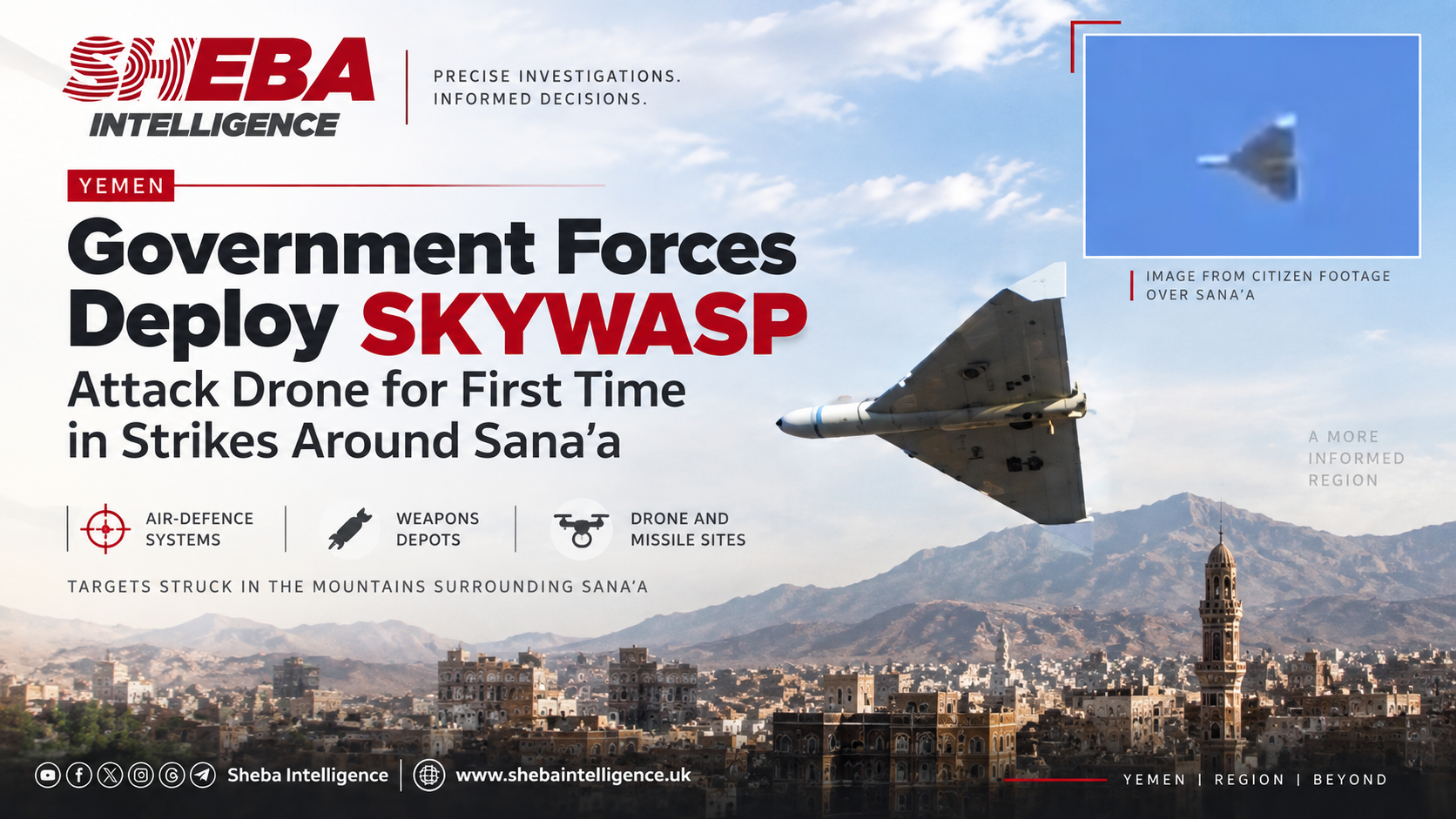
Government forces have used the long-range SKYWASP one-way attack drone for the first time in combat, striking air-defence systems, weapons depots and drone and missile facilities in the mountains surrounding Sana’a, according to a military source and an analysis of footage by Sheba Intelligence.
A military source told Sheba Intelligence that government-operated drones carried out a series of strikes on Houthi military positions around Sana’a on Friday, targeting what the source described as modern air-defence systems, weapons storage facilities and sites associated with the Houthis’ drone and missile capabilities.
The drone operations began before dawn and continued through Friday, the source said.
Neither the Yemeni government nor the Houthis had issued an official statement on the strikes at the time of publication. Residents in Sana’a, however, reported hearing what appeared to be air-defence fire as drones operated over and around the capital.
The nature of the operation became clearer after an attacking drone was seen in daylight and filmed by residents over Sana’a.
Sheba Intelligence Identifies SKYWASP
After examining the footage, a Sheba Intelligence analyst identified the aircraft as the SKYWASP, a Saudi-made long-range one-way attack UAV developed under a Saudi-US defence partnership and previously identified by the platform in an investigation into the Yemeni government's emerging long-range drone capability.
If confirmed, Friday's operation would mark the first documented combat use of the SKYWASP by Yemeni government forces.
The analyst said the aircraft seen in the footage was not a reconnaissance drone but an attack platform designed to strike targets at extended ranges.
According to the military source, drones involved in Friday's operation struck precision targets in the mountains surrounding Sana’a, including positions around AYBAN and NUQUM, two prominent mountainous areas overlooking the capital.
The locations carry additional significance.
Yemen's defence minister previously displayed drones identified publicly as “Ayban” and “Nuqum.” A subsequent Sheba Intelligence investigation identified the aircraft as belonging to the SKYWASP family of long-range attack UAVs.
Drone Flies Over Sana’a
Footage showing one of the drones flying visibly over Sana’a also raised questions about the effectiveness of Houthi air defences around one of the group's most heavily protected areas.
A Sheba Intelligence expert assessed that the flight path may have served an operational purpose beyond reaching the intended target, potentially allowing government forces to observe Houthi air-defence reactions and identify vulnerabilities in detection and interception capabilities.
The expert said the visible flight over Sana’a could also carry a psychological and military message: that government forces are now capable of sending attack drones into the airspace above the Houthi-held capital.
The assessment does not establish that the flight was deliberately intended as a demonstration, however.
Sheba Intelligence has not independently verified the extent of damage caused by Friday's strikes or the specific air-defence systems and weapons facilities reported to have been hit.
A One-Way Attack Drone That Can Be Recovered
A Sheba Intelligence expert said the SKYWASP also has an unusual feature for an aircraft classified as a one-way attack drone: the mission can be aborted and the aircraft recovered before it conducts its terminal attack.
According to the expert, if the target disappears, the engagement is cancelled or operational conditions change, the operator can terminate the strike and direct the aircraft back toward a recovery area instead of committing it to the target.
This provides the operator with greater flexibility than conventional loitering or one-way attack systems whose missions normally end with the destruction of the aircraft.
The expert stressed that this capability does not change the SKYWASP's primary role as an attack platform. Rather, it gives its operator the option to preserve the aircraft when conditions for completing the strike are no longer met.
Strikes May Have Had a Pre-emptive Dimension
Friday’s strikes may also have had a pre-emptive dimension, coming amid indications of Houthi movements involving missile, drone and training facilities in Al-Bayda Governorate.
Earlier on Friday, Sheba Intelligence reported information from sources indicating activity at three Houthi military sites in Al-Bayda: a drone base in Al-Thurayya, along the Al-Harir–Al-Sawma’ah road; the movement of ballistic missiles at a missile base in Al-Juroub, in the Afar area; and troop movements and reinforcements from a training camp in Al-Amer, Hawran.
The destination and purpose of those movements remain unclear. Sheba Intelligence reported that they could be linked to several possible operational directions, including reinforcing Houthi forces toward southern Marib via Bayhan in Shabwa, supporting operations around Bab al-Mandab, or preparations for drone and missile strikes against targets across Taiz, the western coast, Lahj, Aden, Shabwa, Al-Dhalea or Marib. There is currently no evidence establishing that launch orders had been issued or identifying specific intended targets.
Against that backdrop, the government drone campaign around Sana’a could represent part of a broader effort to disrupt Houthi missile and UAV capabilities before they can be deployed in new attacks. However, Sheba Intelligence has not established a direct operational link between the reported movements in Al-Bayda and Friday’s strikes around Sana’a.
From Military Display to Combat Operations
A previous Sheba Intelligence investigation published on August 17 examined Yemen's emerging long-range UAV capability and identified the aircraft displayed under the names AYBAN and NUQUM as SKYWASP long-range attack drones.
The investigation found that the aircraft had entered the Yemeni government's inventory but, at that point, had not yet been observed in combat operations.
According to specifications reviewed in that investigation, the SKYWASP is a long-range attack UAV associated with Vector2SR, a Saudi-US defence partnership. Available specifications indicated a range of up to approximately 1,500 kilometres, speeds of around 150–200 kilometres per hour, and a warhead estimated at roughly 30–50 kilograms.
The investigation noted that the acquisition represented a potentially significant expansion of government forces' UAV capabilities, moving beyond reconnaissance, artillery correction and short-range tactical strikes toward the ability to conduct long-range precision attacks deep inside Houthi-controlled territory.
Friday's strikes around Sana’a therefore appear to mark a potentially important transition.
If the aircraft identification is confirmed, the SKYWASP has moved from display and deterrence into active combat operations for the first time, giving Yemeni government forces a long-range strike capability capable of reaching high-value military targets deep inside Houthi-held territory.