
Yemen’s Nation Shield Forces Reveal Emerging Tactical Drone Capability
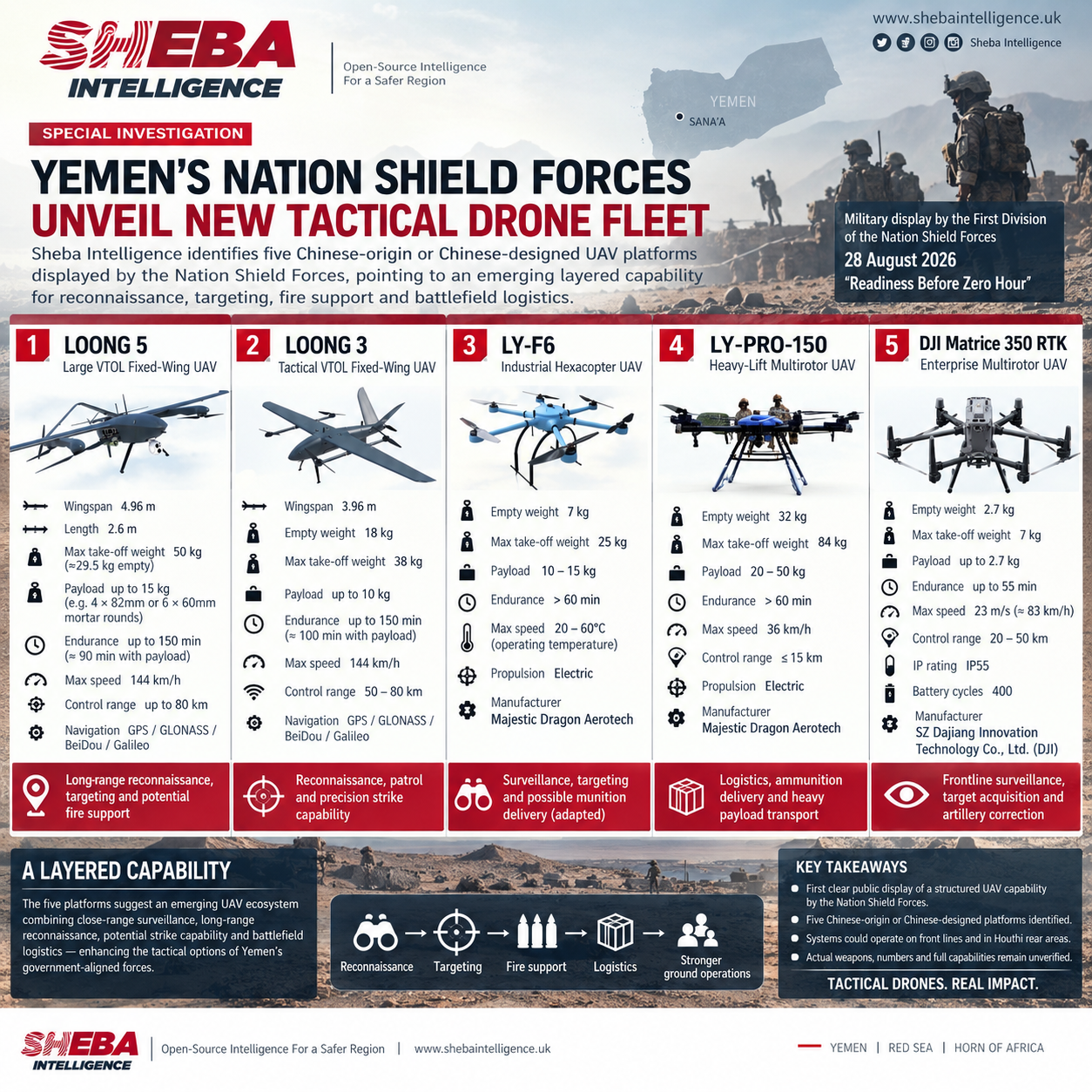
Sheba Intelligence identifies five Chinese-origin or Chinese-designed UAV platforms displayed by Yemen’s Nation Shield Forces, pointing to an emerging layered capability for reconnaissance, targeting, fire support and battlefield logistics.
Sheba Intelligence | Investigation
A military display by the First Division of Yemen’s Nation Shield Forces has provided one of the clearest public indications yet that government-aligned forces are developing a more structured tactical drone capability.
An investigation by Sheba Intelligence, based on frame-by-frame analysis of footage released from the display and comparison with manufacturer imagery and published technical specifications, identified five UAV platforms appearing in the event.
They include two fixed-wing vertical take-off and landing aircraft believed to belong to the Chinese LOONG family, alongside three multirotor platforms identified or assessed as the LY-F6, LY-PRO-150, and DJI Matrice 350 RTK.
Taken together, the aircraft suggest something more significant than the acquisition of isolated commercial drones. They point to an emerging layered unmanned capability combining battlefield surveillance, target acquisition, fire support, payload transport and operations behind Houthi front lines.
The findings do not establish how many aircraft are operational, what weapons have actually been acquired, or whether every platform carries the full sensor and communications packages advertised by manufacturers.
But their appearance offers a rare window into how unmanned systems are beginning to reshape the tactical capabilities of forces fighting the Houthis.
The Display That Revealed the Fleet
On August 28, 2026, the First Division of the Nation Shield Forces released footage of military manoeuvres under the slogan “Readiness Before Zero Hour.”
The footage showed drones operating above participating units during simulated reconnaissance, aerial surveillance and target-identification missions, as well as scenarios involving strikes against hostile positions.
Sheba Intelligence examined the available footage frame by frame, comparing airframe geometry, wings and tail assemblies, motor numbers and positions, landing systems, multirotor arms and visible sensor payloads with imagery and specifications published by manufacturers.
Four platforms produced a high degree of visual correspondence. The fifth was assessed with strong confidence, although limited camera angles prevented an equally definitive identification.
The investigation therefore distinguishes between what can be established visually and what remains an assessment.
The matches do not demonstrate that the aircraft operated by the Nation Shield Forces carry every sensor, weapon or communications package marketed for the respective platforms. Manufacturer figures for range, payload and endurance also represent advertised performance under specified or ideal conditions and may differ substantially in combat.
LOONG 5: The Heaviest Platform in the Display
The largest aircraft visible during the display was a fixed-wing UAV featuring a twin-tail configuration, four vertically mounted motors for take-off and landing, and a rear propulsion motor for horizontal flight.
Its configuration strongly corresponds with the LOONG 5, produced by China’s Loong UAV.
The aircraft also resembles a platform previously displayed in Saudi Arabia under the name Asef-3, suggesting a possible common design lineage. Publicly available information, however, is insufficient to establish that the aircraft displayed by the Nation Shield Forces was manufactured in Saudi Arabia or officially carries the same designation.
According to published specifications reviewed for this investigation, the LOONG 5 has a wingspan of approximately 4.96 metres and an airframe length of around 2.6 metres.
Its basic airframe weighs approximately 29.5 kilograms, rising to roughly 50 kilograms after installation of standard equipment, while additional payload capacity can reach around 15 kilograms.
Advertised endurance reaches approximately 150 minutes without payload and around 90 minutes at maximum payload. Maximum speed is listed at approximately 144 kilometres per hour, while its line-of-sight control link can theoretically extend to around 80 kilometres under optimal conditions.
The aircraft can be configured with daylight or thermal cameras and equipment for reconnaissance or communications relay.
Material associated with the platform also shows configurations capable of carrying four 82mm mortar rounds or six 60mm rounds.
If similarly configured, such a platform could give Nation Shield units the ability to observe terrain beyond immediate front lines, detect troop movements, artillery positions and supply routes, generate targeting coordinates and potentially provide direct fire support.
The footage, however, does not establish which munitions — if any — have actually been acquired for the aircraft or how many operational platforms are available.
LOONG 3: Reconnaissance and Potential Precision Strike
A second, smaller fixed-wing VTOL aircraft was identified by Sheba Intelligence as strongly corresponding with the LOONG 3.
The assessment was based on the shape of its nose, wings and tail, together with the positioning of its vertical-lift motors and rear propulsion system.
Manufacturer material describes the LOONG 3 as a tactical platform designed for reconnaissance, patrol, target acquisition and precision-strike missions.
Its wingspan is approximately 3.96 metres. The bare airframe weighs about 18 kilograms, while maximum operational weight can reach approximately 38 kilograms.
The aircraft can carry around 10 kilograms of sensors or other payloads.
Advertised endurance reaches approximately 150 minutes without payload and around 100 minutes at maximum load. Its control range is listed between approximately 50 and 80 kilometres, with maximum speeds reaching around 144 kilometres per hour.
The platform supports satellite navigation systems including GPS, GLONASS, BeiDou and Galileo and uses an encrypted data link.
The combination of endurance, range and vertical take-off capability is particularly relevant to Yemen’s battlefield.
Because the aircraft does not require a runway, it can theoretically operate from relatively small forward positions in mountainous terrain. Its range would allow reconnaissance and target tracking beyond immediate contact lines, including the monitoring of vehicles, reinforcements and supply movements inside Houthi-controlled territory.
LY-F6: A Civilian Platform Adapted for Military Use?
Another aircraft visible in the footage is a six-rotor platform corresponding with the LY-F6, produced by the Chinese company Majestic Dragon AeroTech, previously known as LYUAV.
The aircraft was originally designed for industrial applications including surveying, inspection, surveillance and search-and-rescue operations.
Published specifications place its weight without battery at around seven kilograms, with a maximum take-off weight of approximately 25 kilograms and advertised payload capacity ranging between 10 and 15 kilograms depending on configuration.
Its endurance can exceed 60 minutes, and the aircraft can carry cameras, surveillance equipment or other payloads.
The military display raises another possibility.
Objects resembling small munitions appeared beside the aircraft during the Nation Shield presentation, suggesting that the platform may have been adapted for offensive missions or munition-dropping rather than being used solely in its original industrial configuration.
The footage is not sufficiently detailed to identify the objects conclusively, determine their release mechanism or establish that such a configuration has undergone combat testing.
That distinction is important: the imagery indicates a possible weaponisation pathway, but does not by itself prove an operational strike capability.
LY-PRO-150: A Battlefield Cargo Drone
Sheba Intelligence also identified a large multirotor aircraft assessed as likely belonging to the Chinese LY-PRO-150family.
Unlike conventional surveillance drones, the platform was originally designed around heavy payload transport, including industrial, emergency and firefighting missions.
Specifications reviewed during the investigation indicate an empty weight of approximately 32 kilograms and a maximum take-off weight potentially reaching around 84 kilograms.
Published commercial sources differ on maximum payload, with figures ranging from approximately 20 to 50 kilograms depending on configuration.
The footage does not provide enough detail to determine the precise version operated by the Nation Shield Forces.
Its size nevertheless gives the platform potential military utility well beyond conventional aerial observation.
It could transport ammunition and supplies to forward positions, carry heavier communications or electronic equipment, deploy sensors, or potentially deliver payloads beyond the capacity of smaller commercial drones.
In difficult terrain, such a capability could also reduce reliance on exposed ground supply routes for small but urgently needed battlefield loads.
DJI Matrice 350 RTK: An Eye for Ground Forces
The fifth platform identified in the investigation is the Chinese-made DJI Matrice 350 RTK.
The aircraft was displayed mounted on a military vehicle, suggesting a mobile surveillance configuration intended to accompany ground formations.
The Matrice 350 can remain airborne for up to approximately 55 minutes and carry payloads weighing around 2.7 kilograms. Compatible equipment includes daylight and thermal cameras as well as laser range-finding systems.
In its standard configuration, it is not an attack drone.
Its military value instead lies in close reconnaissance, detecting movement, establishing coordinates, supporting artillery correction and conducting battle-damage assessment.
Deployed rapidly above front-line formations, such an aircraft could provide commanders with a live view of terrain and hostile movements — particularly important in Yemen’s mountainous areas, where ridgelines and complex terrain frequently obstruct ground observation.
A Layered Drone System
The significance of the five aircraft becomes clearer when they are examined as a system rather than individually.
The Matrice 350 and LY-F6 can provide relatively close surveillance over front lines. The LY-PRO-150 offers a potential logistics and heavy-payload layer. The LOONG 3 and LOONG 5 provide greater endurance and the ability to operate farther behind the immediate battlefield.
This creates the foundations of a tactical drone architecture in which different platforms perform different roles.
The potentially most consequential element is their integration with artillery, intelligence and command-and-control systems.
A drone can detect a target, establish or refine its coordinates, track its movement and transmit targeting information to ground fire-support units. Depending on configuration, some platforms could potentially engage targets directly.
Such systems are particularly useful against positions concealed behind terrain, weapons emplacements masked by ridgelines, moving vehicles and troop concentrations that are difficult to engage using direct-fire weapons.
These drones do not replace artillery or rocket systems in either range or destructive power.
They can, however, make existing ground fire considerably more responsive by shortening the chain between detection and engagement while providing relatively flexible and lower-cost options against specific tactical targets.
Tactical, Not Strategic
The aircraft displayed by the Nation Shield Forces should not be confused with larger strategic unmanned aircraft.
Based on their size, payloads, endurance and advertised ranges, they fall broadly within small and tactical UAV categories.
There is no universally accepted international classification based solely on aircraft weight. Classification also depends on operating range, endurance, payload, mission and the command level employing the system.
Strategic UAVs generally operate across substantially greater distances and can carry far heavier sensor and weapons payloads.
The systems identified in the Nation Shield display are instead oriented primarily toward supporting ground formations and operating across front lines and the nearby operational depth.
A New Capability — But Major Questions Remain
For years, Yemeni government forces have faced a Houthi movement that has extensively employed unmanned aircraft for reconnaissance and attack.
The Nation Shield display suggests that at least some government-aligned formations are moving beyond isolated commercial drones and limited local initiatives toward more organised UAV units combining surveillance, reconnaissance, target acquisition, battlefield support and potentially strike functions.
But the footage reveals hardware — not the full capability behind it.
It does not establish the total number of aircraft available, the size of the ammunition stockpile, the number and proficiency of trained crews, or the systems’ ability to operate under electronic warfare and communications jamming.
Their battlefield effectiveness will ultimately depend on operator training, maintenance and spare-parts availability, battery supply, secure communications and, critically, the ability to integrate drone-derived intelligence with artillery, intelligence units and command-and-control networks.
Even with those caveats, the appearance of two fixed-wing VTOL platforms with advertised control ranges reaching up to approximately 80 kilometres, supported by surveillance and heavy-payload multirotors, represents a notable development in the unmanned capabilities of Yemen’s government-aligned forces.
If deployed at scale and effectively integrated with ground formations, the system could improve battlefield awareness, extend surveillance behind Houthi lines and narrow a capability gap that has influenced the conflict for years.