
Tracing Iran’s Technology: New Houthi Anti-Aircraft Weapon May Be a Hybrid Loitering System
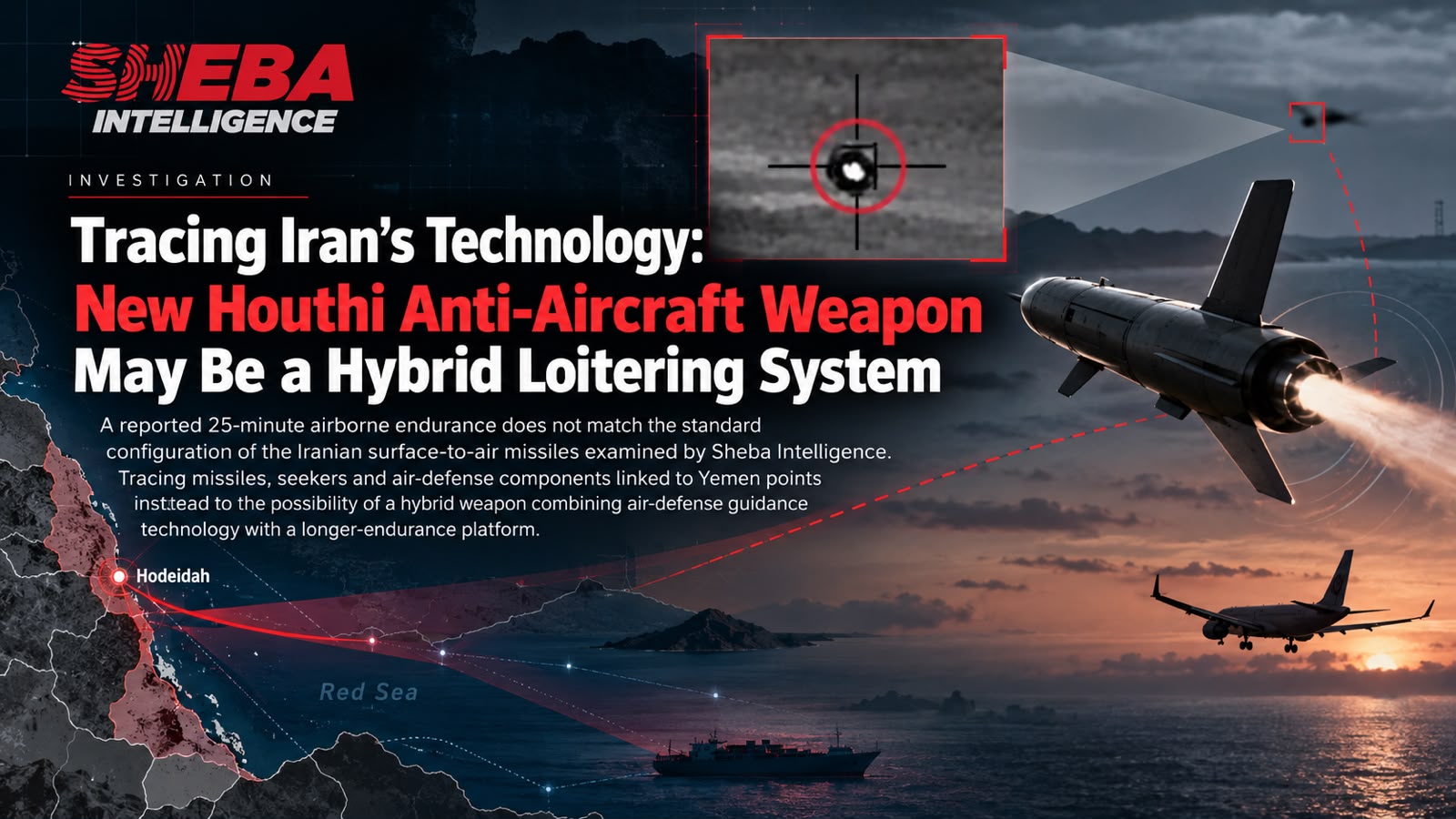
A reported 25-minute airborne endurance does not match the standard configuration of the Iranian surface-to-air missiles examined by Sheba Intelligence. Tracing missiles, seekers and air-defense components linked to Yemen points instead to the possibility of a hybrid weapon combining air-defense guidance technology with a longer-endurance platform.
Sheba Intelligence | Investigation
A Yemeni military warning that the Houthis are using modified Iranian air-defense technology in a weapon capable of loitering while searching for aircraft has raised questions over a potentially new capability operating near international flight routes over the southern Red Sea.
Col. Majid Abdullah al-Nuzaili, spokesman for the Yemeni Armed Forces, said on September 26 that Houthi forces had begun using Iranian air-defense weapons modified with assistance from specialists from Iran’s Islamic Revolutionary Guard Corps.
According to the military statement, the weapons are launched from Hodeidah toward international air routes over the southern Red Sea and can remain airborne for up to 25 minutes while using a heat-seeking system to search for and track thermal sources.
The military warned that the capability could pose a threat to civilian aircraft, including flights operated by the United Nations and humanitarian organizations.
The statement did not identify the missile or the air-defense system from which the technology originated.
That missing identification is central to the investigation. The combination of a heat-seeking capability and a reported 25-minute endurance does not provide an obvious match with the standard configuration of the principal Iranian surface-to-air missiles examined by Sheba Intelligence.
Instead, it raises a different possibility: that the weapon is a hybrid system combining air-defense guidance technology with a propulsion, control or airframe architecture designed to remain airborne far longer than a conventional surface-to-air missile.
Tracing the Technology, Not Just the Missile
Sheba Intelligence examined the capability by mapping Iran’s air-defense arsenal, isolating systems using relevant infrared and electro-optical technologies, tracing missiles and components previously linked to Yemen, and comparing those findings with the Houthis’ documented history of modifying existing weapons.
Several trails emerge.
They include Iranian infrared-guided missiles previously associated with Yemen; a Sayyad-family surface-to-air missile intercepted on a smuggling route toward Houthi-controlled territory; short-range Iranian air-defense technologies; and a separate Chinese-origin trail emerging from missile wreckage examined by Yemeni military specialists in Marib.
The investigation also examined major weapons shipments intercepted before reaching Houthi-controlled areas, particularly the presence of missile seekers, guidance components, radar equipment and other subsystems that could be incorporated into weapons assembled or modified inside Yemen.
The result is a narrower technological picture than Iran’s much larger air-defense inventory.
Iran’s Air-Defense Arsenal
Iran operates a layered air-defense network combining Russian systems, foreign-origin technologies adapted domestically and a growing range of Iranian-designed missiles, radars and launch systems.
At the long-range level, Iran operates the Russian S-300PMU2 and the domestically developed Bavar-373. The latter is associated with several members of the Sayyad missile family.
Its medium-range network includes Mersad, an Iranian development of the U.S.-origin HAWK system, as well as Raad, Tabas, 3rd Khordad, 15th Khordad and systems associated with the Taer and Sayyad missile families.
Iran’s short-range layer includes the Russian Tor-M1 and Iranian systems such as Majid, Ya Zahra and Shahab Thaqeb.
Not all are relevant to the weapon reported in Yemen.
Most larger Iranian systems depend heavily on radar-based detection, tracking and engagement architectures. There is also no evidence that complete Bavar-373, S-300PMU2, Mersad, Tabas, Khordad, Tor-M1 or Pantsir-S1 batteries have reached the Houthis.
The more important trail lies in individual missiles, seekers, guidance technologies and components.
Misagh: The Infrared Trail
Iran’s Misagh family provides the clearest starting point for tracing heat-seeking technology.
Misagh-1 and Misagh-2 are man-portable surface-to-air missiles designed to engage aircraft using infrared guidance. Their small size and heat-seeking architecture distinguish them from Iran’s larger radar-guided systems.
A standard Misagh missile does not explain a weapon reportedly capable of remaining airborne for 25 minutes.
Its significance lies elsewhere: Iranian heat-seeking air-defense technology of this class has already been associated with the Houthi arsenal.
That establishes one of the technological building blocks necessary for the weapon described by the Yemeni military — an infrared seeker capable of detecting and pursuing an aircraft's thermal signature.
Sayyad: The Smuggling Trail
The Sayyad family provides a more substantial physical trail connecting Iranian air-defense technology to Yemen.
In 2018, the Saudi-led coalition displayed a missile body intercepted while allegedly being smuggled to the Houthis. The missile carried markings and Farsi stenciling associated with an Iranian Sayyad-2C surface-to-air missile.
Its forward guidance section, fins and some control surfaces were missing, preventing a complete assessment of its final configuration.
The interception nevertheless demonstrated that a missile from the Sayyad technological family had entered the weapons supply route toward Houthi-controlled Yemen.
The distinction between different Sayyad variants is important.
Iran has said that Sayyad-3C can employ infrared as well as active and semi-active radar homing, while infrared capability has also been attributed to a Sayyad-1 variant. The exact guidance configuration of the Sayyad-2C intercepted en route to Yemen was not publicly established.
There is no evidence that the Houthis operate complete Bavar-373 or 15th Khordad batteries associated with later Sayyad missiles.
For this investigation, the significance of Sayyad lies instead in the movement of missile technology and components toward Yemen.
Ya Zahra and the Chinese Trail
Information obtained by Sheba Intelligence also points to Ya Zahra among the air-defense systems believed to have reached the Houthis.
Another trail emerged from Marib.
A source familiar with an assessment by Yemeni military specialists who physically examined missile wreckage recovered there told Sheba Intelligence that the remains were identified as belonging to a Chinese HQ-6-series air-defense weapon.
The assessment is significant because the identification followed a technical examination of the wreckage rather than an assessment based solely on photographs or video.
Information available to Sheba Intelligence also raises the possibility of a Chinese supply channel, although the available evidence does not establish a direct transfer by China.
The HQ-6 finding is separate from the better-established technological connection between China and Iran’s Shahab Thaqeb.
Iran previously acquired the Chinese FM-80 export version of the HQ-7 and subsequently developed Shahab Thaqeb, illustrating Tehran’s long record of absorbing foreign air-defense technology and developing domestic derivatives.
The Marib wreckage therefore broadens the technological trail. The Houthi air-defense inventory cannot be examined solely through Iranian-manufactured systems; it may contain technologies and components originating from several weapons families and supply networks.
The Components Trail
A major weapons interception in July 2025 provides another important piece of the picture.
Yemeni National Resistance Forces intercepted more than 750 tons of weapons and military equipment that U.S. Central Command said were destined for the Houthis.
The shipment contained hundreds of cruise, anti-ship and anti-aircraft missiles, as well as warheads, missile seekers, components, air-defense equipment and radar systems. CENTCOM said Farsi-language manuals were recovered and that many of the systems were manufactured by a company affiliated with Iran’s Ministry of Defense.
For tracing the latest weapon, the presence of missile seekers and separate components is particularly important.
The supply network into Yemen has not been limited to complete weapons. It has also carried the subsystems needed to guide, assemble, repair or potentially modify weapons.
That creates the possibility of technologies originating in one weapons system being incorporated into another platform.
The Houthi Adaptation Record
There is already precedent for such adaptation.
After taking control of much of the former Yemeni military arsenal, the Houthis converted surviving SA-2 surface-to-air missiles into Qaher-series surface-to-surface weapons.
They have also employed modified heat-seeking air-to-air missiles from ground launchers for air defense.
The significance is not simply that the Houthis possess different missile types. It is that their weapons development has repeatedly involved changing the original role or launch architecture of existing missiles.
The September 26 warning may point to another stage in that process.
If an Iranian-origin seeker or air-defense guidance package has been integrated with another airframe and propulsion system, identifying the weapon solely by searching Iran’s catalogue of conventional surface-to-air missiles would be unlikely to produce a direct match.
The 25-Minute Clue
The reported 25-minute airborne endurance is the strongest clue.
None of the principal Iranian surface-to-air missiles examined by Sheba Intelligence, in their publicly known standard configurations, provides an obvious match for a weapon launched into an area, remaining airborne for that length of time and searching for a thermal target.
Conventional surface-to-air missiles are designed to intercept targets during comparatively short engagements. They are not normally intended to patrol an area for extended periods while searching autonomously for aircraft.
If the 25-minute figure reflects the weapon’s actual operating profile, the propulsion and flight-control architecture becomes as important as the seeker.
This points away from the straightforward transfer of a complete Iranian surface-to-air missile operating in its original configuration.
Instead, the weapon may combine technologies that originated in different systems.
An infrared seeker or guidance package derived from an air-defense missile could be integrated into a longer-endurance airframe equipped with a different propulsion and control system. Such a configuration would effectively transform air-defense technology into a loitering anti-aircraft weapon.
The Hybrid Weapon Hypothesis
Three technological trails stand out.
Misagh establishes an Iranian infrared-guidance trail already associated with Yemen.
Sayyad provides the strongest documented physical trail of a larger Iranian air-defense missile family entering a supply route toward Houthi-controlled territory.
Ya Zahra and the HQ-6-series wreckage examined in Marib broaden the picture to additional short-range and Chinese-origin air-defense technologies.
None, however, independently explains the weapon described on September 26.
That is the central finding of the investigation.
Rather than pointing convincingly to one known Iranian surface-to-air missile, the available evidence points toward the possibility of a hybrid loitering anti-aircraft system built around technologies or components originally developed for air defense.
Its final architecture could combine an infrared seeker with a different propulsion system, airframe and flight-control package capable of providing the reported endurance.
Determining exactly what is operating from Yemen’s Red Sea coast will therefore depend less on finding the name of a single Iranian missile than on identifying three technological signatures: the seeker that searches for the aircraft, the propulsion system that keeps the weapon airborne for the reported 25 minutes, and the guidance method that brings it into the target area before terminal homing begins.
Those signatures could reveal not only the identity of the weapon, but how Iranian air-defense technology is being transferred, adapted and transformed inside the Houthi arsenal.