
Saudi Crown Prince Reaffirms Support for Yemen as Riyadh Advances Defense Alliances and Red Sea Security
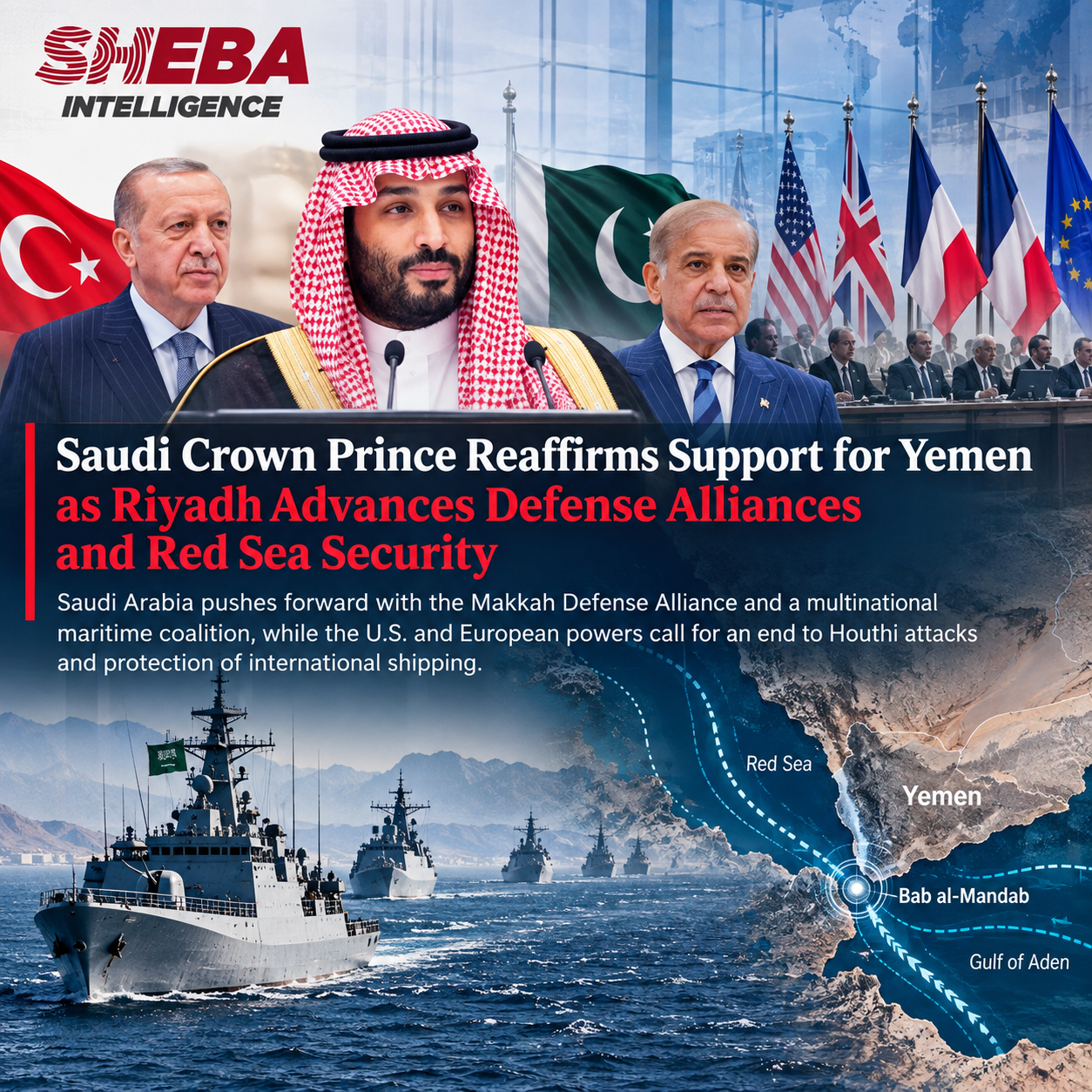
Saudi Arabia moves forward with the Makkah Defense Alliance and a multinational maritime coalition, while the United States and European powers call for an end to Houthi attacks and protection of international shipping.
Saudi Crown Prince Mohammed bin Salman reaffirmed the Kingdom’s support for Yemen’s internationally recognized government and its commitment to protecting international shipping routes in his annual address to the Shura Council on Wednesday, as Riyadh advances two major defense initiatives amid escalating regional tensions.
The Crown Prince’s address followed a Saudi Cabinet meeting on Tuesday that emphasized freedom of navigation in the Red Sea, Bab al-Mandab, Gulf of Aden and Strait of Hormuz, rejecting the use of strategic waterways for political or economic coercion.
The Cabinet also welcomed a UN Security Council statement condemning Houthi attacks against Saudi Arabia and commercial shipping, while calling for an end to threats against maritime security and renewed efforts to achieve peace in Yemen.
Makkah Defense Alliance: Saudi Arabia, Türkiye and Pakistan
Saudi Arabia, Türkiye and Pakistan are moving forward with the implementation of the Makkah Joint Defense Agreement, following diplomatic and military meetings in September.
The Saudi Cabinet welcomed progress in establishing the agreement’s secretariat and specialized committees. The three countries previously agreed to locate the secretariat in Saudi Arabia, with Pakistan holding the secretary-general position during its initial three-year term.
Turkish Foreign Minister Hakan Fidan said on September 19 that Ankara was prepared to meet Saudi Arabia’s military requirements, particularly in technical fields, expressing solidarity with the Kingdom following Houthi attacks on its territory.
Pakistan’s Defense Minister Khawaja Muhammad Asif likewise reaffirmed Islamabad’s commitment to defending Saudi Arabia under the agreement, without confirming any Pakistani participation in military strikes against the Houthis.
On September 25, Turkish Parliament Speaker Numan Kurtulmuş said the alliance could eventually expand to include other Muslim countries, potentially including Iran. He stressed that the agreement was not directed against any particular state.
The three countries have also discussed intelligence sharing, defense-industrial cooperation and joint military capabilities, with further institutional arrangements under development.
Multinational Maritime Coalition Begins Operations
Alongside the Makkah Defense Alliance, Saudi Arabia is advancing a separate multinational maritime coalition established on July 30 to protect international shipping, commercial trade and energy supplies across the Red Sea, Bab al-Mandab and Gulf of Aden.
The coalition entered its operational phase on September 2 under Saudi Rear Admiral Abdullah Al-Shehri, with Pakistani Commodore Rashid Sheikh serving as deputy commander.
During a subsequent planning meeting in Jeddah, the coalition announced that it had achieved initial operational capability, enabling participating countries to coordinate their naval assets and prepare for joint maritime missions. Representatives from 41 countries and the European Union attended the meeting.
Western Powers Call for Red Sea Security
The United States, Britain, France, Germany, Italy, Canada and Japan, together with the European Union, issued a joint G7 statement on September 22 condemning Houthi attacks against Saudi Arabia and commercial shipping.
The foreign ministers called on the Houthis to halt military operations and threats against civilian vessels, while urging Iran to stop supplying weapons and providing support to the group in violation of UN Security Council resolutions.
They emphasized the need to safeguard navigation in the Red Sea and Bab al-Mandab, warning that continued disruption could threaten global supply chains, particularly energy, food and fertilizer shipments. They also reaffirmed support for Yemen’s sovereignty and UN-led efforts to reach a political settlement.
France subsequently announced plans on September 24 to deploy military personnel, radar systems and defensive equipment to Saudi Arabia to help protect energy facilities in Yanbu, on the Red Sea, against missile attacks. President Emmanuel Macron described the deployment as defensive and said it was not intended to involve French forces in the ongoing conflict.
Meanwhile, the European Union has reportedly held discussions with Saudi Arabia on coordinating their maritime security operations. The EU already maintains a naval mission operating in the Red Sea, Gulf of Aden and Bab al-Mandab, although no formal agreement to integrate its operations with the Saudi-led coalition has been announced.
The diplomatic and military developments come amid continued fighting in Yemen, Houthi activity along the country’s western coast and mounting international concerns over the security of Bab al-Mandab, one of the world’s principal maritime trade routes.