
Houthis Launch Major Taiz Offensive Seeking to Secure Strategic Heights and Protect Coastal Gains
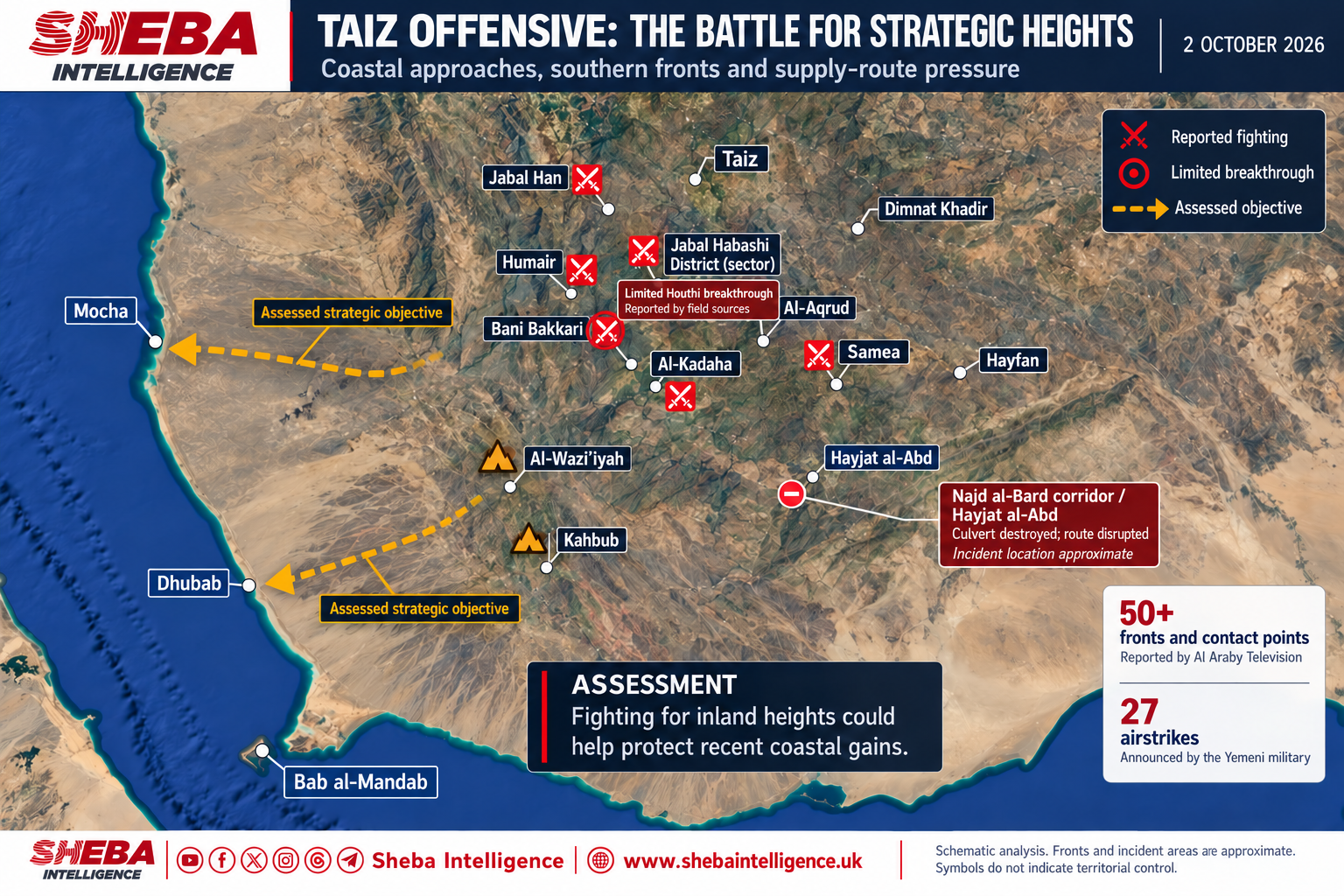
A limited Houthi breakthrough in Bani Bakkari came amid fighting across more than 50 fronts and contact points in Taiz. Sheba Intelligence assesses that the offensive seeks to secure mountainous approaches toward the western coast while stretching government defenses and threatening southern supply routes.
The Houthis have launched a large-scale offensive across Taiz, with fighting opening or intensifying on more than 50 fronts and contact points over the past 24 hours.
Sheba Intelligence assesses that the attacks are aimed primarily at securing key heights and routes that could help protect the group’s recent gains around Mocha and Bab al-Mandab.
Fighting has extended across Bani Bakkari in Jabal Habashi, Humair in Maqbanah, Al-Kadaha, Jabal Han, Al-Aqrud, Samea, and the northern and eastern approaches to Taiz city. Government statements and media reporting indicate concurrent fighting across multiple sectors, with varying intensity and outcomes.
The offensive combines pressure on the western highlands controlling inland approaches toward the coast with attacks farther south and east that stretch government forces and threaten Taiz’s connections with Lahj and Aden.
Limited Breakthrough in Bani Bakkari
Field sources told Sheba Intelligence that Houthi forces achieved a limited breakthrough in Bani Bakkari, advancing into one village in Jabal Habashi district.
Fighting has focused on commanding elevations, including positions around Tallet al-Aryal, while Houthi forces have also pressed toward Jabal Han and other elevated positions west of Taiz.
Bani Bakkari and the wider Jabal Habashi sector are important to the mountainous routes connecting western Taiz with Al-Kadaha in Al-Maafir district and neighboring sectors toward Maqbanah and the coast. Recent battlefield reporting has identified these areas as part of the contest over roads and high ground linking Taiz’s interior with the western coastal theater.
Holding additional elevations in this sector could strengthen Houthi observation of local movement corridors and increase pressure on routes used by government forces. The significance of the breakthrough therefore depends on whether the Houthis can retain their foothold and expand onto surrounding heights.
Government military statements, meanwhile, say attacks across several Taiz fronts were repelled. These broader claims do not establish whether the reported advance in Bani Bakkari was subsequently reversed.
Strategic Heights and Coastal Defensive Depth
The western and southwestern highlands form an important part of the inland approaches toward Mocha and the coastal plain. Positions across Jabal Habashi, Al-Kadaha, Maqbanah and Al-Wazi’iyah have different local functions, but together influence movement between the Taiz interior and the western coast.
Farther south, the Kahbub heights, in the adjoining Lahj theater near the Taiz boundary, have a more direct relationship with the approaches toward Dhubab and Bab al-Mandab.
These sectors should be understood as linked parts of a wider battlefield rather than a single uninterrupted mountain line. Their military value lies in controlling particular heights, roads and passes through which government forces could threaten Houthi coastal positions.
Sheba Intelligence assesses that the offensive seeks to expand the Houthis’ defensive depth inland, reducing the vulnerability of their recent coastal gains to counterattacks from the mountains.
Sources told Sheba Intelligence that the Houthis are also reinforcing coastal positions with trenches, fortifications and construction materials in areas extending toward Mocha and Bab al-Mandab. The coastal construction and inland attacks appear complementary: strengthening positions along the coast while seeking to control the approaches behind them.
Samea and Al-Aqrud: Pressure on Southern Taiz
The reopening of the Samea front southeast of Taiz marks another significant development after years of relative calm.
Houthi forces advanced from the direction of Dimnat Khadir toward Shurai and Al-Salaf, triggering fighting with government forces and local Popular Resistance units.
Government military sources said their forces pushed the attackers back toward Dimnat Khadir, captured around 20 fighters and seized military vehicles. These are government-reported results.
Samea does not directly overlook the western coast. Its importance lies in broadening the southern battlefield and increasing pressure on the approaches to Al-Hujariah. The district borders Khadir to the north and Al-Misrakh to the northwest.
Heavy fighting also erupted on the Al-Aqrud front in Al-Misrakh district, southeast of Taiz city. The Taiz Military Axis Media Center reported 30 Houthi fighters killed and 50 wounded; those figures could not be independently verified.
Sheba Intelligence sources reported substantial Houthi concentrations and military vehicles moving into the sector. Together, the attacks in Samea and Al-Aqrud force government troops to defend geographically separated positions, potentially limiting their ability to reinforce the western fronts.
Threat to the Taiz–Aden Supply Route
Local sources reported that Houthi fighters infiltrated Najd al-Bard below the Hayjat al-Abd road, in Al-Maqatirah district of Lahj, and destroyed a key culvert, temporarily disrupting a principal route linking Taiz with Lahj and Aden.
The incident adds a logistical dimension to the offensive. While attacks in western Taiz contest the mountainous approaches toward the coast, pressure farther south threatens the roads sustaining government-held areas in the highlands.
Firepower, Reinforcements and Concealment
Field sources told Sheba Intelligence that the offensive involved heavy artillery, mortar, missile and drone fire against government positions and command points. Tanks were also used around Bani Bakkari and other western fronts.
Sources reported that civilian buses transported some fighters and reinforcements into Al-Hawban and Hayfan to reduce their visibility during movement. They also described modified fuel and gas tankers being used to conceal military equipment, including missiles. Sheba Intelligence has not independently verified all details of these movements.
The sources additionally reported activity in the Al-Hawban–Hayfan sector by terrorist groups they said were led by Amjad Khaled, whom they described as wanted by Yemeni judicial authorities, alongside attempts to exploit local networks in Al-Hujariah. The groups’ precise operational role remains under assessment.
Yemeni Military Announces 27 Airstrikes
The Yemeni Armed Forces spokesman announced 27 airstrikes across the Taiz fronts as ground fighting intensified.
According to the statement, the strikes targeted a missile storage facility, command-and-control centers, forward supply and weapons points, Houthi concentrations and military vehicles.
Reported target areas included 60th Street north of Taiz city, Bani Omar, Humair, eastern Al-Wazi’iyah, Al-Ahkum, Al-Athawir, Al-Kadaha, Jabal Nu’man, Al-Kurayfat, Aqabat Munif, Al-Tashrifat, Al-Aqrud, Samea and Al-Shaqab.
Separate government reporting confirmed intense fighting in Bani Bakkari, Humair, Al-Aqrud, Al-Kadaha, Jabal Han, and the northern and eastern fronts of Taiz.
Sheba Intelligence Assessment
The offensive appears to combine a central objective—protecting recent coastal gains by securing key inland heights and approaches—with supporting pressure on government defenses and supply routes across southern and eastern Taiz.
Its initial results remain mixed. Field sources report a limited Houthi advance in Bani Bakkari, while government forces say they have repelled attacks and inflicted substantial losses elsewhere.
The main indicators to watch are whether the Houthis retain their Bani Bakkari foothold, capture additional commanding positions in the western sectors, and make gains on the approaches connecting Al-Wazi’iyah and the adjoining Kahbub theater with the coast.
Sustained advances across those sectors could provide greater protection for Houthi positions around Mocha and Bab al-Mandab. Continued government control of key heights and passes would preserve opportunities to pressure those positions from inland.