
Coalition Destroys 136 Houthi Military Targets as Yemeni Army Conducts Over 2,750 Strikes in 24 Hours
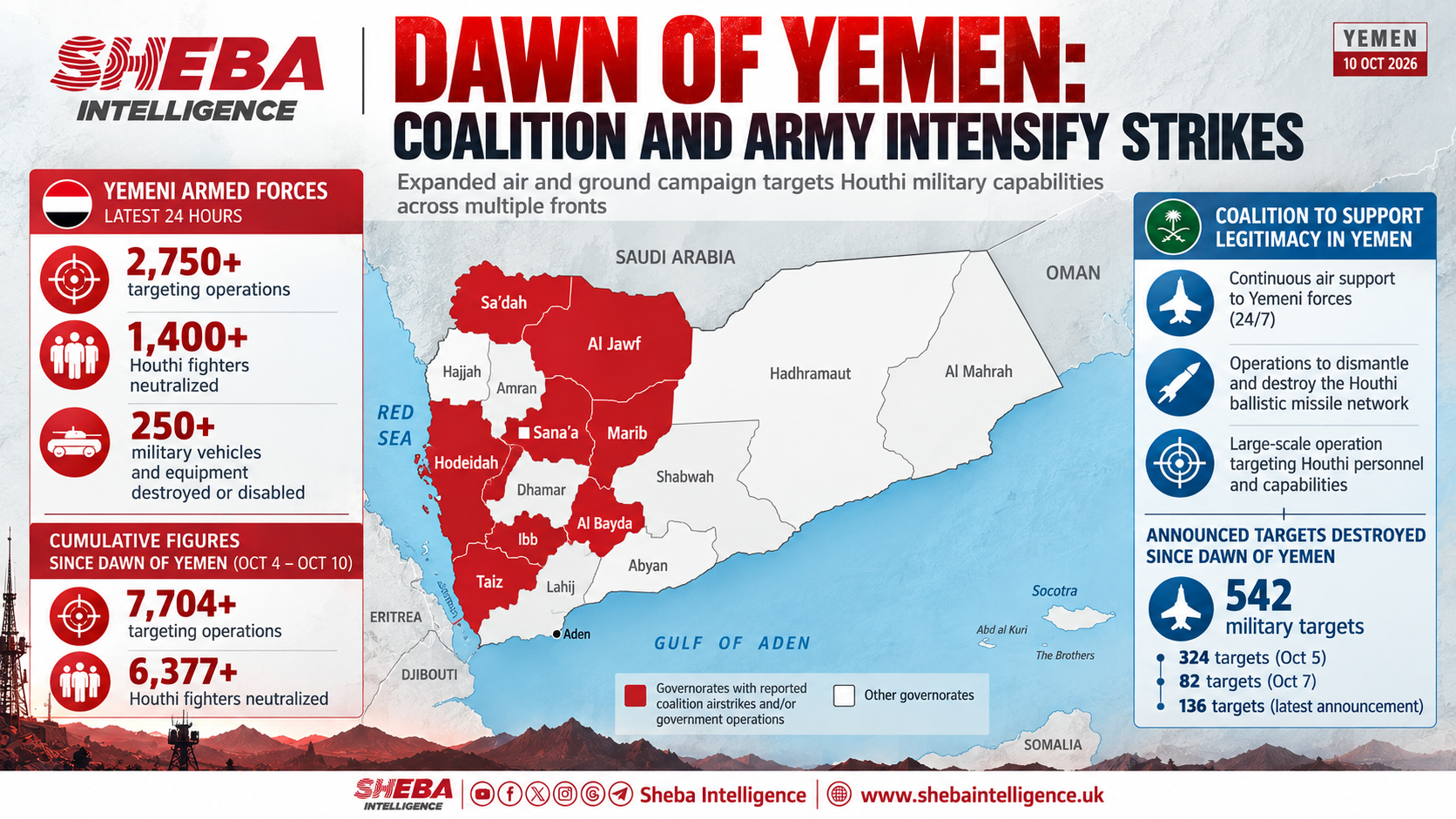
The Saudi-led Coalition to Support Legitimacy in Yemen announced a large-scale military operation targeting Houthi personnel and military capabilities, destroying 136 military targets in Houthi-controlled areas, as Yemeni government forces reported conducting more than 2,750 precision targeting operations over the past 24 hours under the ongoing Operation Dawn of Yemen.
The coalition said it was providing round-the-clock air support to Yemeni government forces while continuing operations to dismantle and destroy the Houthis’ ballistic missile network.
The announcements come amid intensified fighting across multiple fronts in Yemen and continued Houthi ballistic missile attacks against Saudi Arabia.
Successive military statements indicate an expanding air and ground campaign, with increasing emphasis on missile systems, command-and-control facilities, supply networks, military fortifications and high-value targets deep inside Houthi-held territory.
Yemeni Army Reports More Than 2,750 Operations in 24 Hours
In parallel with coalition operations, the Yemeni Armed Forces announced that they had carried out more than 2,750 precision targeting operations over the previous 24 hours across multiple fronts as part of Operation Dawn of Yemen.
According to the military statement, the operations targeted Houthi fortifications, defensive positions, advanced observation and reconnaissance posts, field artillery positions, weapons and ammunition depots, logistics warehouses and military reinforcements.
The operations also struck legitimate high-value military targets deep inside Houthi-controlled territory, extending beyond frontline positions.
The Armed Forces reported that the strikes neutralized more than 1,400 Houthi fighters and destroyed or disabled over 250 military vehicles, combat systems and pieces of equipment.
According to preliminary battlefield assessments cited in the statement, the operations weakened the Houthis’ ability to maneuver, provide fire support and sustain combat activities.
Meanwhile, government ground forces reportedly breached Houthi defensive lines and fortified positions, recaptured strategically significant terrain and consolidated their gains while continuing offensive operations under approved military plans.
Government Targeting Operations Exceed 7,700 Since Dawn of Yemen Began
According to a review of previously announced military figures by Sheba Intelligence, Yemeni government forces had reported conducting 4,954 targeting operations since the launch of Operation Dawn of Yemen, resulting in the neutralization of 4,977 Houthi fighters.
A previous Sheba Intelligence report highlighted the military's announcement that advanced weapons had been deployed during the campaign, although their types and technical specifications were not disclosed.
Adding the latest 24-hour figures brings the reported cumulative total to more than 7,704 targeting operations and 6,377 Houthi fighters neutralized, assuming the statements cover separate operational periods without overlap.
Including the 2,725 targeting operations announced before the formal launch of Dawn of Yemen, the combined reported total across the two phases rises to more than 10,429 targeting operations.
These figures reflect the government's successive military announcements rather than an independently consolidated battlefield assessment.
Coalition's Announced Military Targets Reach a Combined 542
A review of coalition statements issued since the launch of Operation Dawn of Yemen identifies three major announcements containing specific figures for destroyed military targets.
|
Announcement |
Targets destroyed |
|---|---|
|
October 5 — Initial phase of the operation |
324 |
|
October 7 — Operations across four governorates |
82 |
|
Latest coalition announcement |
136 |
|
Combined announced total |
542 |
At the launch of the operation, the coalition announced that 100 fighter aircraft had participated in the initial air campaign, destroying 324 high-value military targets.
On October 7, coalition spokesperson Major General Turki Al-Maliki announced the destruction of 82 military targets across Saada, Hodeidah, Al-Jawf and Marib governorates.
The targets reportedly included 11 ballistic missile storage facilities in mountainous areas of Saada, as well as command-and-control centers, communications systems, weapons depots and military headquarters.
The latest announcement of 136 destroyed military targets brings the arithmetic sum of the three reported figures to 542 targets.
However, this figure does not include other coalition operations for which no specific target count was released, including strikes against ballistic missile launchers in Sana'a and Houthi naval capabilities in Hodeidah.
The total should therefore be treated as a combined figure from separate announcements, rather than an officially verified cumulative tally. Potential overlap between the reported target counts cannot be ruled out.
Coalition Expands Air Campaign Against Houthi Ballistic Missile Network
The latest operations follow an escalation in Houthi ballistic missile attacks against Saudi Arabia, including strikes directed toward Riyadh and Khamis Mushait.
The coalition previously announced the interception and destruction of three ballistic missiles launched by the Houthis toward the two cities.
At the same time, coalition aircraft conducted extensive strikes against military positions, missile launch facilities, weapons depots and fortified positions across several Yemeni governorates.
According to an earlier Sheba Intelligence report, the air campaign included targets in Marib, Al-Jawf, Al-Bayda, Taiz, Ibb, Hodeidah and Raymah.
The coalition's latest declaration that it is working to dismantle the Houthi ballistic missile network suggests an operational focus extending beyond missile launchers to the infrastructure supporting missile storage, command, coordination and deployment.
This approach appears intended to disrupt the network as a whole rather than relying exclusively on the interception of missiles after launch.
Military Implications
The latest developments highlight three interconnected dimensions of Operation Dawn of Yemen: continuous coalition air support for government forces, strikes against Houthi missile infrastructure deep inside their territory, and expanding ground operations across multiple fronts.
The sustained targeting of command-and-control facilities, communications networks and supply depots indicates an effort to degrade the Houthis' ability to coordinate military operations, deploy reinforcements and maintain logistical support.
Meanwhile, the Yemeni Armed Forces' announcement that advanced weapons are being used suggests an evolution in the capabilities deployed during the campaign.
The simultaneous use of precision strikes and ground offensives also indicates an increasingly integrated operational approach, combining attacks against rear-area military infrastructure with attempts to breach defensive positions and secure strategically important terrain.
Nevertheless, the operational impact of the campaign will ultimately depend on whether Houthi forces retain the ability to launch ballistic missiles, reinforce threatened fronts and maintain control of key defensive positions.
The latest statements suggest that Operation Dawn of Yemen has entered a phase characterized by sustained, large-scale air operations coordinated with ground offensives, while ballistic missile systems, command structures and military supply networks remain central targets.