
US Anti-Tank Missile System Reverse-Engineered by Iran Appears in Houthi Footage
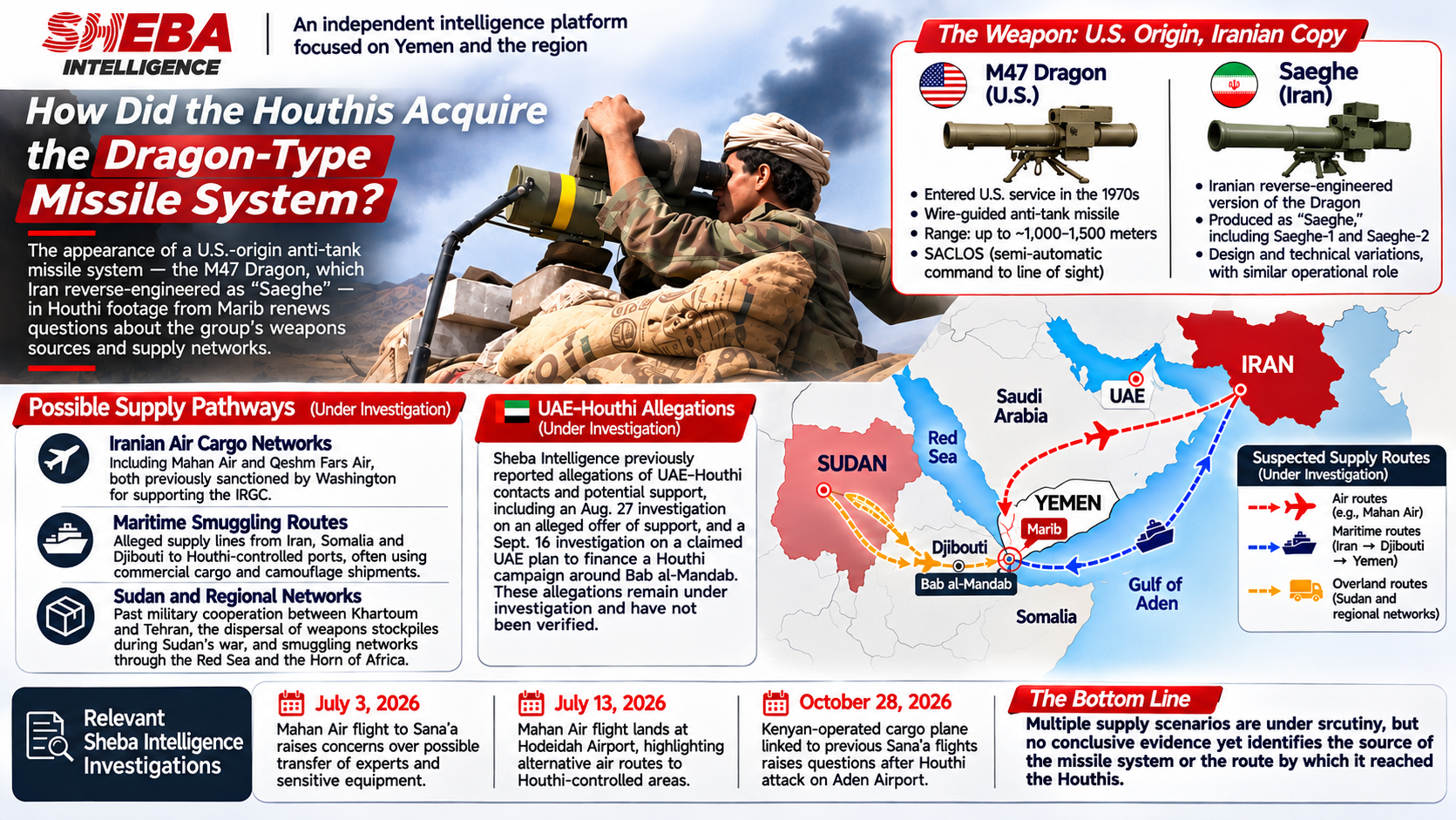
New footage from Yemen's Marib front shows a guided missile system resembling the US-made M47 Dragon, which Iran reverse-engineered as Saeghe, raising questions about Houthi weapons supplies and regional arms-smuggling networks amid the ongoing Dawn of Yemen offensive.
Footage released by the Houthi group's military media on Saturday, October 31, shows a fighter operating a guided anti-tank missile system resembling the US-made M47 Dragon, which Iran reverse-engineered and produced under the name Saeghe.
The video shows a missile being launched towards a mountainous position on the Marib front, according to information accompanying the footage. Sheba Intelligence could not independently verify when the footage was recorded, its precise location or whether the missile struck its intended target.
The system's appearance during the ongoing Dawn of Yemen offensive raises questions about the origins of Houthi weaponry, including whether the group is deploying older American or Iranian missile stocks or has acquired additional weapons through Iranian-linked supply networks, regional trafficking routes or other sources.
An American Weapon Reverse-Engineered by Iran
The M47 Dragon entered US Army service in the 1970s as a wire-guided anti-tank missile system designed to engage tanks, armoured vehicles and fortified positions.
The original version has a maximum range of approximately 1,000 metres, while some upgraded variants can reach 1,500 metres. It uses semi-automatic command-to-line-of-sight (SACLOS) guidance, requiring the operator to maintain visual contact with the target during the missile's flight.
Iran subsequently reverse-engineered the system under the name Saeghe, developing variants known as Saeghe-1 and Saeghe-2 with differences in warhead design and technical capabilities.
US military reference material identifies Saeghe as an Iranian-produced derivative of Dragon, publicly displayed internationally in 2002, and indicates that versions of the weapon reached Lebanon's Hezbollah.
Although based on an older design, the system remains capable of engaging armoured vehicles and fortified positions with guided missiles, distinguishing it from conventional unguided anti-armour rockets.
However, the close resemblance between the American Dragon and its Iranian counterpart makes it difficult to determine the manufacturer of the weapon shown in the Houthi footage without additional identifying evidence.
Iranian Air Cargo Networks Under Scrutiny
The appearance of the Dragon-type missile system renews questions about transport networks previously associated with Iranian military shipments, including civilian airlines and cargo operators sanctioned by Washington for supporting the Islamic Revolutionary Guard Corps (IRGC).
In January 2019, the US Treasury Department sanctioned Qeshm Fars Air, an Iranian cargo airline linked to Mahan Air and the IRGC's Quds Force.
According to the Treasury Department, the company operated two Boeing 747 aircraft, registered EP-FAA and EP-FAB, which transported cargo to Syria, including weapons and military equipment for the Quds Force.
Washington has also accused Mahan Air of transporting personnel, weapons, equipment and funds in support of Iranian military operations abroad.
Sheba Intelligence previously reported on July 3, 2026 that equipment was unloaded from a Mahan Air aircraft at Sana’a International Airport and transferred onto trucks, while dozens of Iranian specialists reportedly entered Yemen. The investigation raised concerns that the flight may have carried sensitive equipment and technical personnel to the Houthis, although the nature of the cargo could not be independently verified.
A subsequent Sheba Intelligence investigation published on July 13 documented another Mahan Air aircraft landing at Hodeidah Airport, highlighting the availability of alternative air routes into Houthi-controlled territory.
More recently, an October 28 investigation examined a Kenyan-operated cargo aircraft linked to previous flights to Houthi-controlled Sana’a, following allegations surrounding a cargo flight and the Houthi missile attack on Aden International Airport.
Taken together, these reports raise questions about the movement of personnel and potentially sensitive cargo into Houthi-controlled territory through civilian aviation networks. However, none establishes that the aircraft transported the Dragon-type missile system shown in the latest footage, or identifies when and how the Houthis acquired it.
Sudan, the Horn of Africa and Regional Arms Networks
Sudan represents another potential avenue for investigation because of its historical military cooperation with Iran, particularly in defence manufacturing associated with the Yarmouk Military Industrial Complex.
Military relations between Khartoum and Tehran contributed to the circulation of Iranian-origin and Iranian-designed weapons before Sudan's civil war erupted in April 2023.
The subsequent seizure of military bases and weapons depots by competing armed factions, including the Rapid Support Forces (RSF), raises questions about whether weapons from older military stockpiles could have entered regional trafficking networks.
In June 2026, Sheba Intelligence reported, citing intelligence sources, that Houthi-linked networks had transferred Iranian military technology, including missile and drone-related capabilities, to armed groups in Sudan.
The investigation described alleged contacts between armed actors in Yemen and Sudan and the use of networks operating across the Red Sea and Horn of Africa.
The reported activity illustrates the potential for military technology to circulate between regional conflicts. It does not, however, establish that Saeghe missiles were held by Sudanese factions or transferred from Sudan to the Houthis.
Maritime Smuggling and Overland Routes
Beyond Sudan, established maritime and overland smuggling networks provide additional possible channels for weapons entering Houthi-controlled territory.
A September 2026 Sheba Intelligence investigation documented statements by seven detained Yemeni sailors describing alleged weapons-smuggling routes from Iran, Somalia and Djibouti to the Houthi-controlled port of Al-Salif.
According to the recorded statements, the network used wooden vessels, commercial cargo cover and transfers between larger ships and smaller boats. The sailors also described shipments concealed within industrial equipment and refrigerated containers.
Sheba Intelligence could not independently verify every allegation in the statements or the circumstances under which they were recorded.
The broader pattern is consistent with previous international investigations. UN experts have documented maritime arms-smuggling operations involving Iran and Yemen, while a 2024 US Defense Intelligence Agency assessment identified Iranian-origin weapons and components intercepted while allegedly being transported to the Houthis, including anti-tank guided missiles.
Regional trafficking investigations have also described maritime transfers through the Horn of Africa and overland smuggling through eastern Yemen, including areas near the Omani border.
These findings establish the existence of multiple trafficking channels but do not identify the route through which the Dragon-type system in the latest footage reached Houthi forces.
Regional Political Rivalries
The fragmented political and military landscape in Yemen adds another dimension to the investigation.
Growing tensions among regional actors, particularly Saudi Arabia and the United Arab Emirates, have generated allegations concerning the role of competing local allies and the potential indirect benefits to the Houthis.
Sheba Intelligence has previously investigated allegations of direct contacts and potential support between the UAE and the Houthis. An August 27 investigation reported, citing a source familiar with the discussions, that Emirati intelligence officers had offered the Houthis various forms of support in exchange for distancing themselves from Iran.
A subsequent September 16 investigation cited a source alleging that Abu Dhabi had agreed to finance a Houthi military campaign around Bab al-Mandab under an arrangement negotiated with Iran.
These allegations remain subjects of investigation and further verification, particularly amid growing scrutiny of regional arms supply networks and political rivalries. Neither report, however, establishes a connection between the alleged arrangements and the Dragon-type missile system recently shown in Marib.
Weapon Appears During the Dawn of Yemen Offensive
The footage was released as Yemeni government forces, supported by the Saudi-led coalition, continued military operations against the Houthis following the launch of the Dawn of Yemen offensive in early October.
In recent weeks, the coalition has announced strikes against Houthi military facilities, missile storage sites and launch platforms, alongside fighting across multiple fronts and intensified missile attacks against government-held areas in Yemen and targets in Saudi Arabia.
The timing of the footage gives the weapon's appearance additional significance, as the Houthis seek to demonstrate that they retain operational capabilities despite sustained airstrikes and ground offensives.
The development also comes amid heightened tensions around Bab al-Mandab.
On October 25, Sheba Intelligence reported, citing intelligence sources, on an alleged Iranian plan for renewed Houthi operations aimed at regaining control of areas overlooking the strategic strait. The reported plan involved coordinated maritime and ground operations, although its implementation and timetable could not be independently verified.
The latest footage adds to questions surrounding the military equipment available to the Houthis during the current offensive. Its publication, however, does not establish that the missile system was recently delivered or that it was used for the first time during the fighting.
The footage provides a newly released visual indication of the Houthis' use of a Dragon-type guided anti-tank missile system. Its manufacturer, acquisition date and supply route remain unverified, leaving open the central question of whether the weapon came from older military stocks or more recent external supplies.