
Lebanese Leaders Reject Interference in Yemen as Hezbollah Denies Allegations Over Military Experts
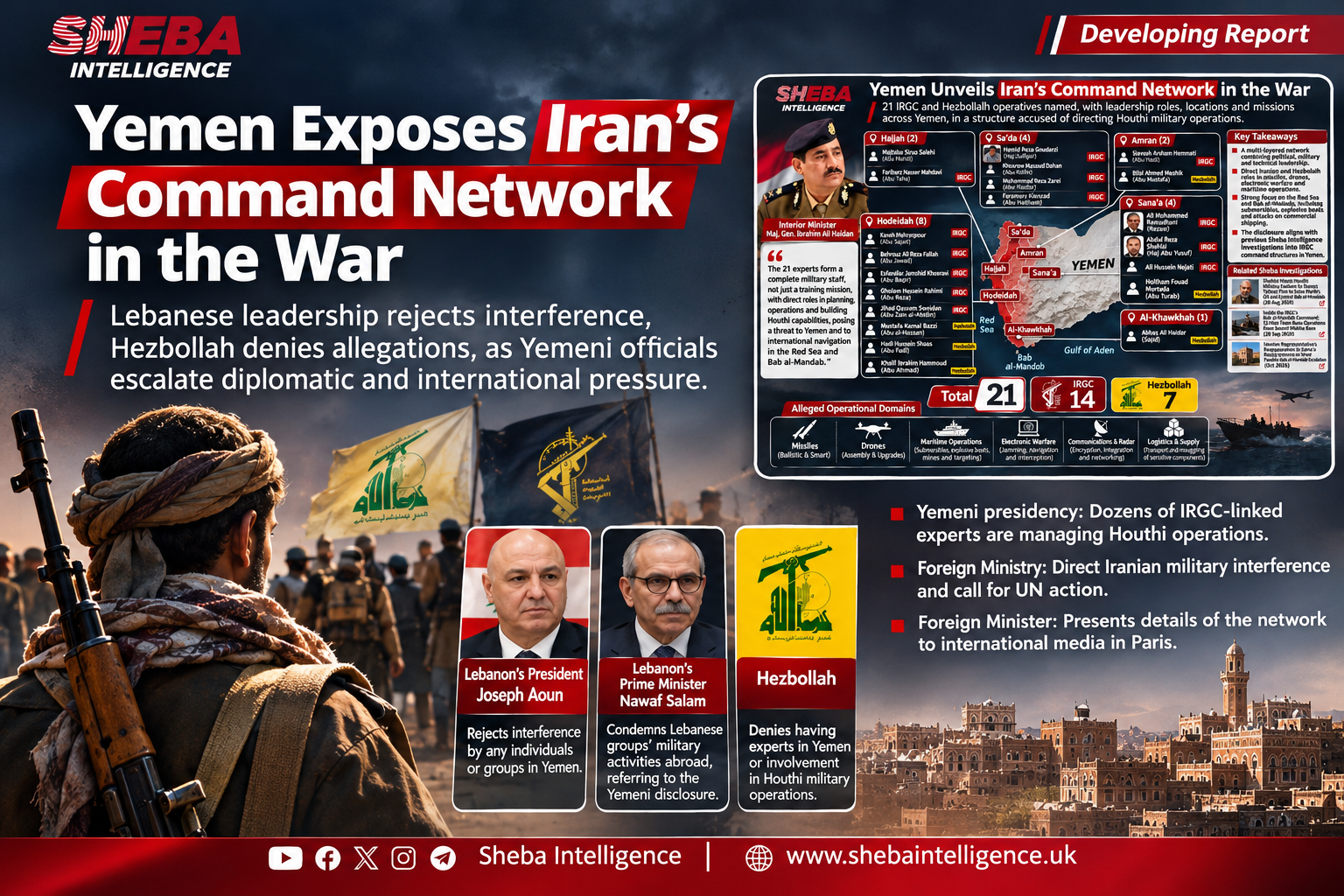
President Joseph Aoun contacts Yemen’s leadership, Prime Minister Nawaf Salam condemns Lebanese groups’ military activities abroad, and Yemeni officials intensify diplomatic efforts following the disclosure of 21 alleged IRGC and Hezbollah operatives.
Lebanon’s president and prime minister have rejected interference by Lebanese individuals or groups in Yemen following allegations by the Yemeni Interior Ministry that 21 experts from Iran’s Islamic Revolutionary Guard Corps (IRGC) and Hezbollah are directly involved in managing Houthi military operations.
The Lebanese statements came as Hezbollah denied having military experts in Yemen, while Yemeni officials intensified diplomatic efforts to draw international attention to the alleged network.
The developments have turned an initial Yemeni security disclosure into a diplomatic issue involving the governments of Yemen and Lebanon, amid growing international media coverage.
Lebanese President Contacts Yemen’s Leadership
Lebanese President Joseph Aoun held a telephone conversation on Wednesday with Yemen’s Presidential Leadership Council Chairman Rashad al-Alimi, reaffirming Lebanon’s support for Yemen’s sovereignty, security and stability.
According to the Yemeni presidency, the two leaders discussed bilateral relations and agreed to strengthen coordination on regional challenges.
Aoun affirmed Lebanon’s support for Yemen’s efforts to restore state institutions, while al-Alimi expressed support for the Lebanese government’s efforts to extend state authority and ensure that weapons remain under the control of legitimate institutions.
The Lebanese presidency also affirmed its rejection of interference by individuals or groups in Yemen’s internal affairs or activities threatening the country’s stability.
Lebanese Prime Minister Condemns Military Interference
In a more explicit response to the Yemeni allegations, Lebanese Prime Minister Nawaf Salam condemned interference by Lebanese individuals or groups in the internal affairs of Arab countries, particularly through military activities.
Speaking after meeting President Aoun in Beirut, Salam specifically referred to the activities recently announced by the Yemeni government, warning that such involvement would harm Lebanon and its national interests.
He stressed that decisions concerning war and peace must remain exclusively under the authority of the Lebanese state and its constitutional institutions.
His remarks directly linked Lebanon’s position on unauthorized military activities abroad to the Yemeni Interior Ministry’s disclosure.
Hezbollah Rejects Yemen’s Allegations
Hezbollah, meanwhile, denied on Wednesday that its experts were present in Yemen or involved in directing Houthi military operations.
The group described the accusations made by Yemeni Interior Minister Ibrahim Haidan as baseless, insisting that Yemenis possess the military capabilities and expertise needed to defend themselves without outside intervention.
Hezbollah also called for dialogue among Yemenis to resolve the conflict and preserve the country’s unity and sovereignty.
The denial followed the Interior Ministry’s identification of seven alleged Hezbollah operatives among the 21 foreign experts. Hezbollah’s reported statement did not individually address the names disclosed by Yemeni authorities.
The contrasting statements highlight the difference between the Lebanese government’s rejection of military interference abroad and Hezbollah’s denial of the specific allegations.
Yemeni Presidency and Foreign Ministry Escalate the Issue
Yemen’s Presidential Leadership Council Chairman Rashad al-Alimi warned during a meeting with a senior German Foreign Ministry official in Riyadh that dozens of IRGC-linked experts were directly participating in planning and managing Houthi military operations.
He accused Tehran of seeking to compensate for the declining influence of its regional allies by intensifying its military support for the Houthis, including the development of missiles and drones and activities threatening international shipping.
Separately, Yemen’s Foreign Ministry condemned the alleged direct military involvement of the IRGC and Hezbollah, explicitly citing the Interior Ministry’s disclosure.
The ministry called on the United Nations Security Council to take measures to halt the transfer of weapons and military expertise to the Houthis and hold those responsible accountable.
Yemen’s Foreign Minister Raises the Issue in Paris
Yemen’s Foreign Minister Afrah al-Zouba brought the allegations to international media attention during a press briefing in Paris on Wednesday.
She said Yemeni security agencies had identified 21 foreign experts working directly with the Houthis, including 14 IRGC members and seven Hezbollah operatives.
According to al-Zouba, the identified individuals represent only part of a broader foreign network supporting Houthi military operations.
She linked their alleged involvement to attacks on civilians, displacement and threats to international maritime security, urging international action against arms transfers and networks supporting the Houthis.
Background: Interior Ministry Reveals Alleged Foreign Command Network
On November 3, Yemen’s Interior Ministry announced that it had identified 21 foreign military experts allegedly working alongside the Houthis.
According to Interior Minister Ibrahim Haidan, the group includes 14 IRGC members and seven Hezbollah operatives operating in Sanaa, Saada, Amran, Hajjah, Hodeidah and the coastal area of Al-Khawkhah.
The ministry accused the individuals of overseeing military planning, command and control, missile and drone development, electronic warfare, weapons-smuggling networks and maritime operations, including the selection of commercial vessels as potential targets.
Haidan said their alleged involvement went beyond financing, arming and training to direct participation in planning and managing Houthi military operations.
The announcement attracted coverage from international outlets including Al Jazeera, Arab News, The National and L’Orient Today.
Sheba Intelligence previously published a detailed report examining the names, locations and alleged responsibilities of individuals identified by Yemeni authorities:
From Security Disclosure to Diplomatic Dispute
Within two days, the Interior Ministry’s announcement prompted official statements from Yemen’s presidency and Foreign Ministry, a diplomatic exchange between the Yemeni and Lebanese presidents, an explicit condemnation of foreign military interference by Lebanon’s prime minister, and a denial from Hezbollah.
The developments have broadened the issue from allegations concerning individual military experts to questions of state sovereignty, regional security and the role of foreign armed groups in Yemen’s conflict.
However, neither the Lebanese president nor prime minister explicitly confirmed the identities or involvement of the seven alleged Hezbollah operatives.
As of November 4, no new international sanctions specifically targeting the individuals identified by Yemen’s Interior Ministry had been announced. The allegations concerning their identities, locations and operational responsibilities have not been independently verified in full.