
Reports of Iran–Houthi Coordination to Target Undersea Internet Cables in Event of US Strikes
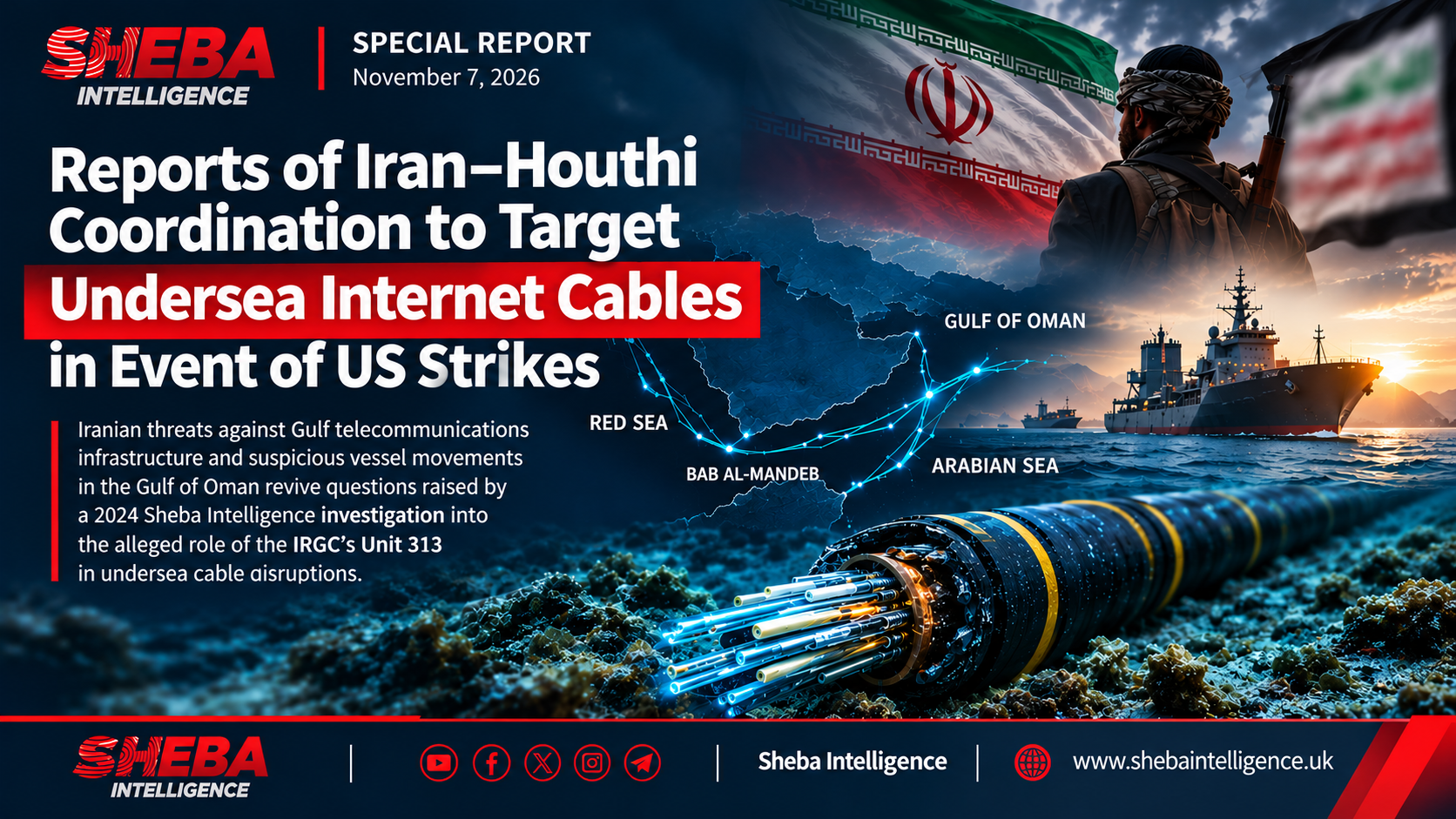
Iranian threats against Gulf telecommunications infrastructure and suspicious vessel movements in the Gulf of Oman revive questions raised by a 2024 Sheba Intelligence investigation into the alleged role of the IRGC’s Unit 313 in undersea cable disruptions.
Reports of possible coordination between Iran and Yemen’s Houthis to target undersea internet cables in the Red Sea and Arabian Sea have raised concerns that Tehran could seek to expand its retaliation beyond the Gulf if it comes under renewed US military strikes.
The reported scenario involves potential Iranian operations against submarine telecommunications cables in the Persian Gulf and Gulf of Oman, accompanied by similar actions in waters surrounding Yemen. Such a development could disrupt international data traffic and digital services connecting Asia, Europe and Africa.
Sheba Intelligence has not independently verified whether Iran has issued new instructions to the Houthis or approved a coordinated operation. However, recent Iranian threats, international reporting on contingency plans targeting submarine cables, and unusual maritime activity have brought renewed attention to the possibility of a wider campaign against regional telecommunications infrastructure.
Reuters reported on October 23, citing senior Iranian security officials, that Tehran had prepared detailed plans to target undersea communications cables in the Gulf should the United States and Israel resume military strikes against Iran. The reported measures could also involve obstructing repair operations to prolong telecommunications disruptions.
The disclosure followed warnings by Iranian officials, including Yadollah Javani, a senior political official in the Islamic Revolutionary Guard Corps (IRGC), about the possibility of targeting internet cables in the Strait of Hormuz.
Iranian officials have also warned that data centres and digital infrastructure associated with US technology companies in Gulf states could become targets in a renewed confrontation.
The prospect of Houthi involvement has also revived a March 2024 investigation by Sheba Intelligence into the alleged role of Unit 313 of Iran’s Islamic Revolutionary Guard Corps in disrupting submarine telecommunications cables.
According to the investigation, intelligence obtained by Sheba Intelligence indicated that a Houthi military commander had been tasked as early as mid-2022 with developing a plan involving undersea cables running along Yemen’s coastline.
The investigation also alleged that Unit 313, working alongside the Ansar Cyber Unit, was involved in operations targeting submarine cables in the Red Sea and the Gulf during February and March 2024.
The findings were published after the February 18, 2024, Houthi attack on the cargo vessel Rubymar, which subsequently sank on March 2. Technical assessments attributed damage to several Red Sea cables to the vessel’s dragging anchor, although the investigation presented a different account of possible Iranian involvement. The allegations concerning Unit 313 have not been independently substantiated.
The earlier investigation has gained renewed relevance following a November 6 report by the Financial Times, which identified unusual movements by at least four Iran-linked vessels near submarine cable corridors in the Gulf of Oman.
Citing maritime intelligence company Windward, the newspaper reported that three US-sanctioned tankers and an Iranian fishing vessel had slowed, circled, lingered or intermittently disabled their tracking signals near telecommunications infrastructure. Experts cautioned that the movements did not establish evidence of sabotage preparations and could have alternative explanations.
The Red Sea is particularly significant because of its role in connecting telecommunications networks across Europe, Asia and East Africa. According to TeleGeography estimates cited by Reuters, approximately 10% of international data traffic between world regions passes through the Red Sea, compared with less than 1% of global international bandwidth through the Strait of Hormuz.
Reuters noted that the Red Sea could present a more consequential target for telecommunications disruption, particularly if Iran were supported by its Houthi allies in Yemen. However, Tehran has made no public announcement of plans to attack cables in the Red Sea.
Simultaneous damage to cables in the Gulf and Red Sea could disrupt internet connectivity, financial transactions, cloud computing and international business operations. The severity would depend on the number of cables affected, the availability of alternative routes and the time required for repairs.
The emerging concerns come amid broader allegations of Iranian involvement in Houthi military operations. Yemen’s internationally recognised government recently accused Iranian Revolutionary Guard and Hezbollah personnel of directly supporting Houthi operations, allegations denied by Tehran and Hezbollah.
While the reported Iran–Houthi cable coordination remains unverified, the combination of Iranian contingency plans, unusual maritime movements and earlier allegations documented by Sheba Intelligence has brought the security of undersea communications infrastructure back into focus as tensions between Tehran and Washington persist.