
Yemen Calls on Iran to Stop Arming Houthis, Rejects Portrayal of War as Saudi-Yemeni Conflict
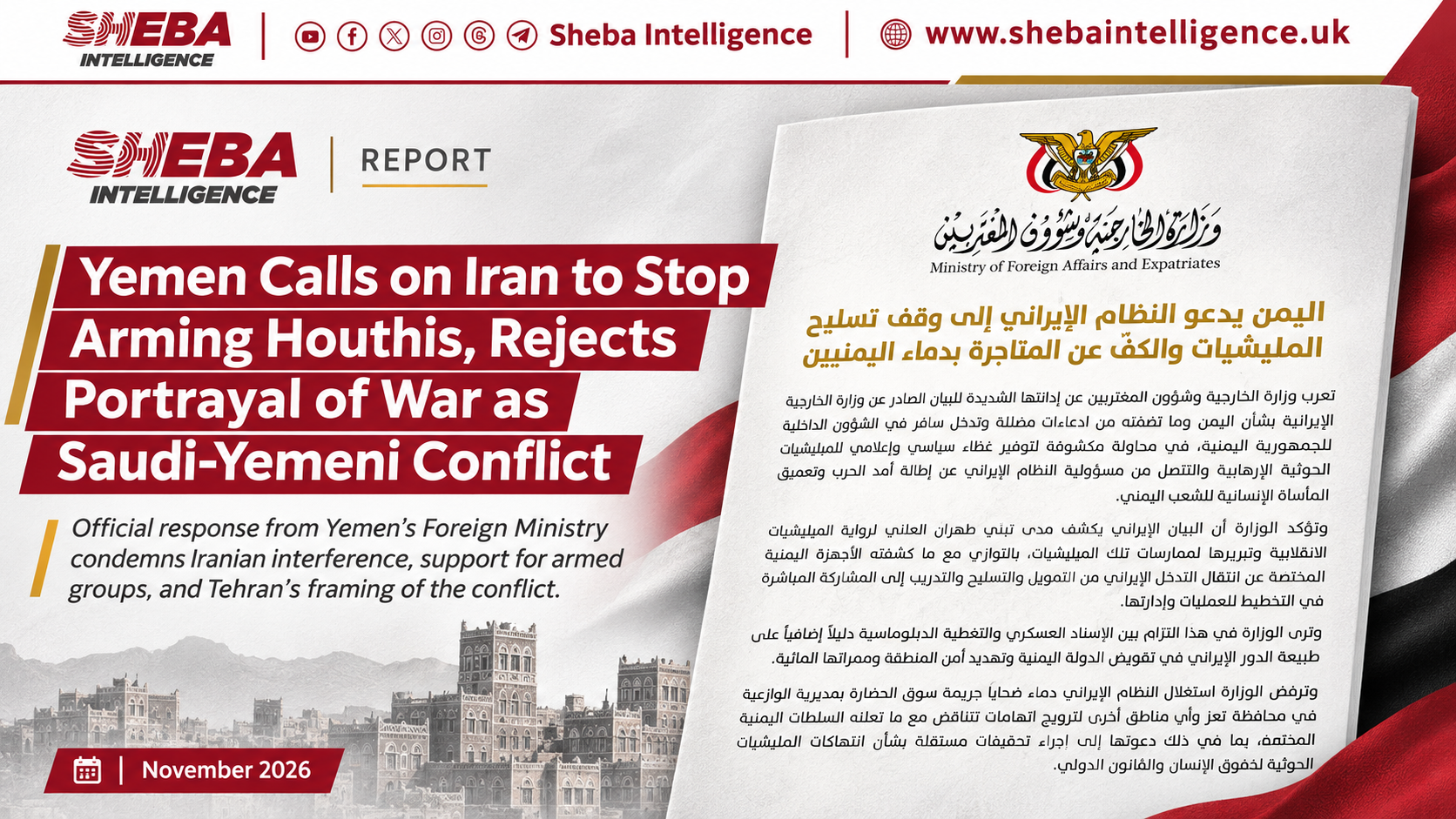
Responding to an Iranian statement accusing Saudi Arabia of targeting civilians, Yemen’s Foreign Ministry said Tehran’s interference and support for armed groups undermine Yemeni sovereignty and threaten regional security.
The Yemeni government has condemned Iran’s continued interference in Yemen and its military support for the Houthi armed group, rejecting Tehran’s portrayal of the conflict as a war between Yemen and Saudi Arabia.
In a statement issued on Sunday, November 8, Yemen’s Ministry of Foreign Affairs and Expatriates called on Iran to stop supplying the Houthis with weapons, withdraw its military experts, and refrain from interfering in Yemen’s internal affairs.
The statement followed an Iranian Foreign Ministry condemnation of alleged Saudi airstrikes on civilian areas in Yemen, particularly Al-Hadhara market in Al-Wazi'iyah district of Taiz governorate and Al-Shariyah village in Bani Hushaysh district of Sanaa governorate.
According to Iran's Tasnim News Agency, Tehran accused Saudi Arabia of carrying out attacks that killed dozens of civilians, including women and children, describing the incidents as violations of international humanitarian law.
The Iranian statement claimed that an attack on Al-Hadhara market on November 6 killed 33 civilians, including 13 children, while another 33 people were reportedly killed in Bani Hushaysh. It also condemned an alleged attack on media personnel working for the Houthi-affiliated Al-Masirah television channel.
Tehran called for an immediate cessation of military operations, an end to the blockade, and a return to the political roadmap for ending what it described as the conflict between Saudi Arabia and Yemen.
Yemen Rejects Iranian Accusations
In its response, Yemen's Foreign Ministry accused Tehran of adopting the Houthi narrative and providing political and diplomatic cover for the armed group while disregarding its responsibility for prolonging the conflict and worsening the humanitarian crisis.
The ministry rejected Iran's accusations regarding the Al-Hadhara market incident, arguing that Tehran was exploiting civilian casualties to promote allegations inconsistent with information released by the Yemeni authorities.
Local authorities in Taiz have accused the Houthis of shelling the market, citing preliminary operational reports indicating that no airstrikes were conducted in the district on the day of the incident.
The Houthis, however, have blamed the Saudi-led coalition for the attack.
Yemeni officials have called for independent investigations, including forensic examination of physical evidence, to establish the type of munition used and identify those responsible.
No publicly available independent forensic investigation has conclusively established responsibility for the incident.
Yemen Accuses Iran of Direct Military Involvement
The Yemeni Foreign Ministry said Iranian interference extends beyond political support, weapons supplies, and military training to direct involvement in planning and managing Houthi military operations.
The ministry referred to recent findings announced by Yemen's Interior Ministry concerning the presence of 21 foreign military experts working with the Houthis, including 14 members of Iran's Islamic Revolutionary Guard Corps (IRGC) and seven Hezbollah operatives.
According to the Yemeni authorities, their responsibilities include military command and control, operational planning, ballistic missile programs, unmanned aerial vehicles, electronic warfare, and the smuggling of military equipment and components.
The experts were also accused of coordinating maritime operations and selecting commercial vessels for attacks in the Red Sea.
Yemeni officials argued that these activities constitute an integrated military command structure rather than conventional technical assistance or advisory support.
Iran has denied having military experts in Yemen.
On November 5, Iranian Foreign Ministry spokesperson Esmail Baghaei dismissed accusations of Iranian military involvement, describing them as fabricated allegations intended to divert attention from military attacks and the humanitarian situation in Yemen.
The competing statements underscore the dispute over the extent of Iran's involvement in the conflict.
Dispute Over the Nature of the War
Beyond the immediate controversy surrounding civilian casualties, the diplomatic exchange highlights a fundamental disagreement over how the conflict in Yemen should be characterized.
Iran's statement called for an end to the conflict between Saudi Arabia and Yemen through dialogue and a return to an agreed political roadmap.
The Yemeni government rejected that characterization, emphasizing that the conflict cannot be reduced to a confrontation between Yemen and Saudi Arabia while overlooking the Houthis' armed challenge to the internationally recognized government.
The Foreign Ministry stressed that Yemen's sovereignty requires respect for the authority of legitimate state institutions and their exclusive right to control military force and decisions concerning war and peace.
It accused Iran of supporting armed groups that challenge the state's constitutional and legal authority, thereby undermining prospects for restoring security and stability.
The ministry also referred to United Nations Security Council Resolution 2216 (2015) and Resolution 2624 (2022), which expanded the arms embargo measures to cover the Houthis as an entity.
It urged Tehran to comply with international restrictions on the transfer of weapons, military equipment, and related technical and financial assistance.
Regional Security and Maritime Threats
Yemen's Foreign Ministry also accused Iran of enabling Houthi attacks against Saudi territory and threatening international shipping in the Red Sea and Bab al-Mandab Strait.
According to the ministry, Iranian military and technical support has strengthened the Houthis' ability to conduct cross-border attacks, target civilian infrastructure, and threaten commercial vessels.
The ministry contrasted Iran's alleged military support for the Houthis with Saudi Arabia's humanitarian and development assistance to Yemen.
It argued that continued weapons deliveries and the deployment of foreign military experts contribute to prolonging the war and deepening the suffering of Yemeni civilians.
The Yemeni government further urged Iran to direct its resources toward improving the living conditions of its own population rather than supporting armed groups abroad.
In closing, the Foreign Ministry reiterated that respecting Yemen's sovereignty requires Tehran to halt arms supplies to the Houthis, withdraw foreign military personnel, and end interference in Yemen's national decision-making.
The diplomatic confrontation comes amid continuing military operations in Yemen and renewed disagreements over responsibility for civilian casualties, the role of foreign military actors, and the framework for a future political settlement.