
New Documents Reveal Military Equipment Smuggling Networks Supplying Houthis via Oman and Djibouti
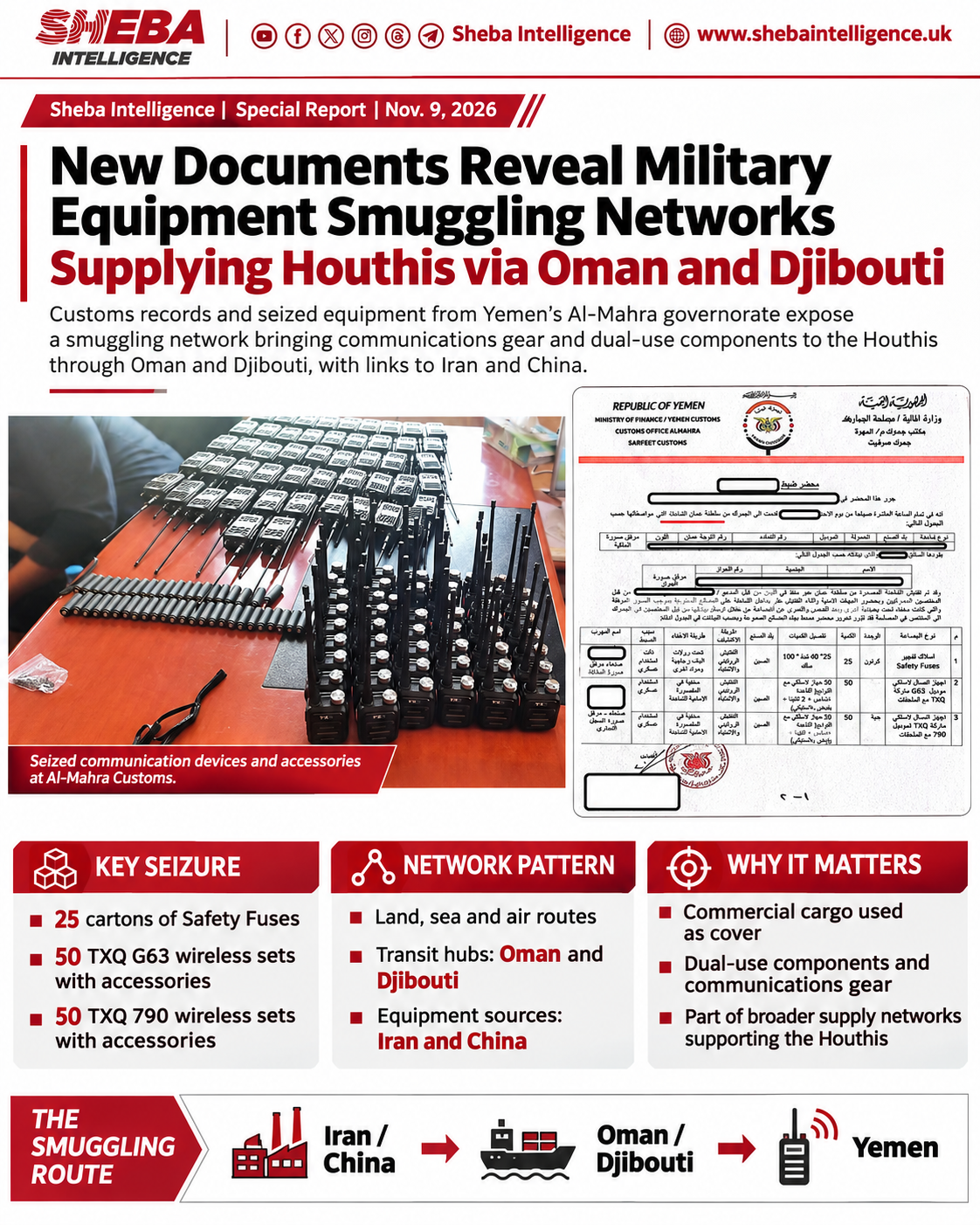
A shipment intercepted at the Omani border renews scrutiny of supply networks, as UN reports and US sanctions expose the role of commercial intermediaries in transferring weapons and dual-use technologies from Iran and China to Yemen.
A newly disclosed shipment of equipment destined for Yemen’s Houthi movement has renewed scrutiny of international supply networks operating through Oman, Djibouti and other commercial transit points, with components originating primarily from Iran and China.
Yemeni researcher Dr. Abdulqader Al-Kharraz revealed documents relating to a shipment intercepted at the border with Oman, saying commercial companies are used to import equipment before transferring it overland into Houthi-controlled territory.
Al-Kharraz said the supply networks operate through land, sea and air routes, while investigations have expanded beyond border seizures to tracking shipments back to their suppliers, identifying commercial intermediaries and examining weaknesses in international inspection mechanisms.
His latest disclosures add to earlier seizures documented by Yemeni authorities and United Nations investigators, revealing the use of commercial cargo to transport weapons, drone components and dual-use technologies.
Anti-Tank Missiles Hidden in Electric Generators
One of the clearest documented cases occurred in March 2022, when Yemeni customs authorities intercepted 52 anti-tank guided missiles concealed inside four modified electric generators at the Shahn border crossing in Al-Mahra governorate.
A subsequent report by the United Nations Office on Drugs and Crime documented the seizure, identifying a warehouse in Oman's Al-Mazyunah Free Zone as a point from which the shipment had been transported.
The case demonstrated how ordinary commercial shipments could be used to conceal military weapons moving across international borders.
UN Records Trace Drone Components Through Border Crossings
A 2025 report by the UN Panel of Experts on Yemen documented further seizures of military-related and dual-use equipment at border crossings with Oman.
According to the report's seizure records, Yemeni authorities intercepted 40 drone servo motors and 1,357 spare parts at Shahn on March 1, 2024.
Four days later, authorities seized 600 wireless communication devices and 15,133 telecommunications components.
Additional seizures at Sarfait included 78 drone controllers in April 2024, followed by GPS devices, electronic sensors and other components in May.
These findings illustrate the growing significance of individual electronic and mechanical components in sustaining drone production, maintenance and military capabilities.
Chinese Suppliers and US Sanctions
The United States has also identified commercial networks involved in supplying military and dual-use equipment to the Houthis.
In July and October 2024, the US Treasury Department imposed sanctions on companies and individuals accused of facilitating the movement of weapons-related materials and electronic components.
Among those designated was Yemen-based Al-Shahari United Corporation Ltd., which US authorities linked to procurement and logistics operations involving suppliers in China.
The Treasury also targeted Chinese firms, including Shenzhen Jinghon Electronics Limited and Shenzhen Rion Technology Co., Ltd., over their alleged roles in supplying electronic components and technologies associated with Houthi drones and missile guidance systems.
These designations highlighted the international character of Houthi procurement operations, extending from manufacturers and commercial suppliers to shipping intermediaries and logistics companies.
Djibouti and International Inspection Gaps
Al-Kharraz's disclosures also raised concerns about gaps in international cargo inspections, particularly those associated with Djibouti and vessels carrying relatively small shipments.
The United Nations Verification and Inspection Mechanism for Yemen (UNVIM), established in 2016, verifies commercial shipping bound for Yemeni ports outside government control, including Hodeidah and Saleef.
Earlier procedural documents identified a vessel-tonnage threshold of 100 metric tonnes within the mechanism's scope. That threshold concerns vessels rather than automatically exempting individual cargo shipments from inspection.
The issue has renewed attention to how shipping documentation, vessel classifications and risk-based inspection procedures affect enforcement of the arms embargo.
A Supply Chain Extending Beyond Conventional Weapons
Taken together, the border seizures, UN findings, US sanctions and Al-Kharraz's disclosures reveal the scale and complexity of international supply channels associated with the Houthis.
The documented shipments range from complete anti-tank weapons to drone motors, navigation equipment, communications devices and industrial components.
The growing reliance on dual-use technology makes monitoring these shipments increasingly challenging, as commercially available products can be incorporated into military systems after reaching their destination.
The latest disclosure places renewed attention on the role of commercial intermediaries, the movement of goods through regional transit hubs and the effectiveness of international measures intended to prevent military supplies from reaching Houthi-controlled territory.