
Yemeni Government Forces Reportedly Down Ukrainian-Made Reconnaissance Drone in Lahj, Raising Questions Over Its Origin
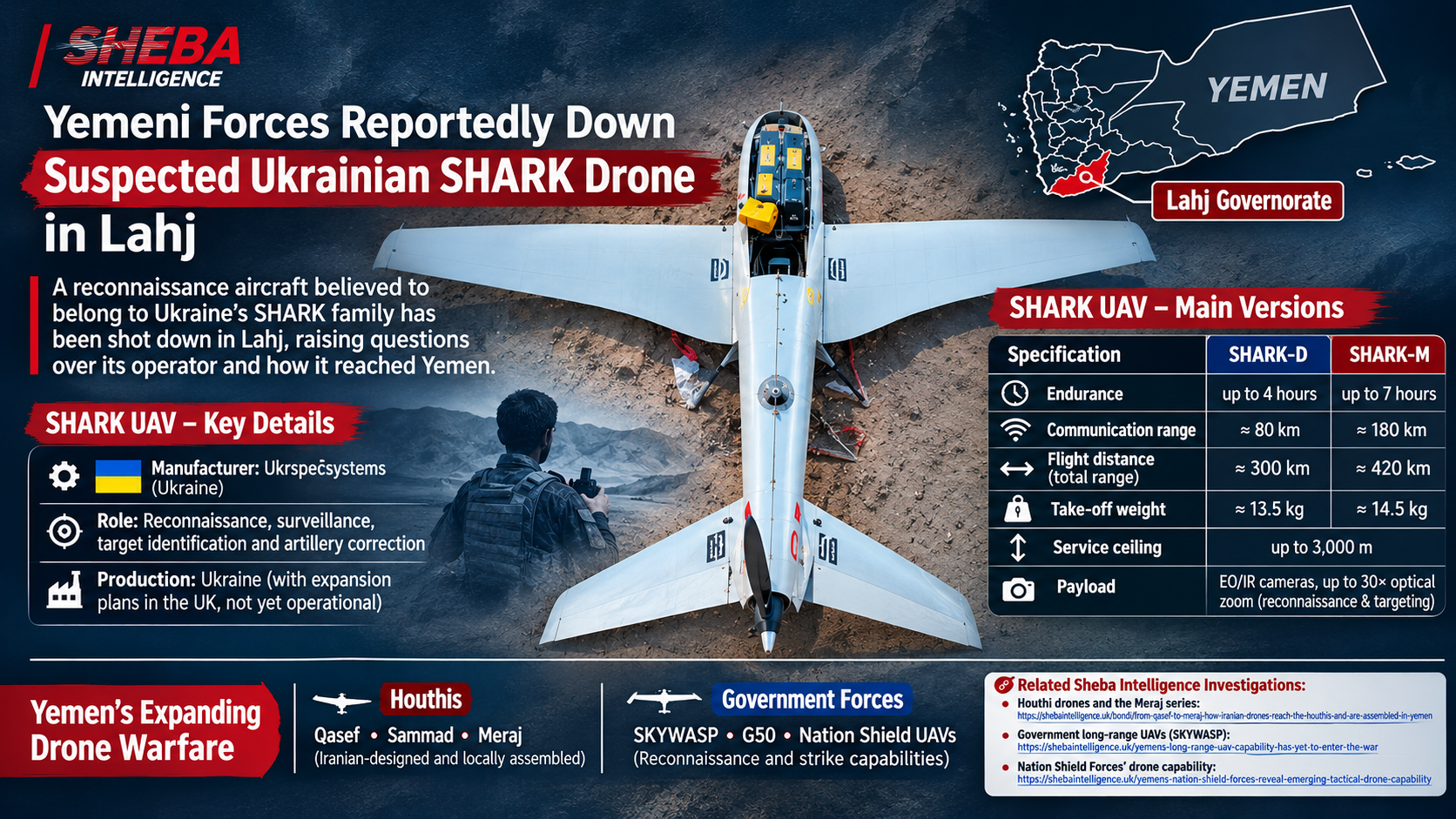
The aircraft is believed to belong to Ukraine's SHARK reconnaissance drone family, raising questions about whether it was operated by the Houthis or government-aligned forces and how it reached Yemen.
Yemeni government forces have reportedly shot down a reconnaissance drone believed to belong to the Ukrainian-made SHARK family in Lahj governorate, southern Yemen, raising questions about the aircraft's operator and the circumstances surrounding its arrival in the country.
A photograph obtained by Sheba Intelligence shows the aircraft following its reported downing, with much of its fuselage, wings and tail apparently intact. An open compartment reveals internal components.
Field information indicates that the drone was recovered in an area controlled by government forces. Its presence has raised the possibility that the Houthis were operating the aircraft to conduct reconnaissance over government military positions.
However, the drone's operator has not been independently identified, and its precise model remains unconfirmed.
Advanced Ukrainian Reconnaissance Technology
The SHARK family is manufactured by Ukrainian defence company Ukrspecsystems and designed for battlefield reconnaissance, surveillance, target identification and artillery fire correction.
The SHARK-D variant can remain airborne for up to four hours, with a communication range of approximately 80 kilometres.
The upgraded SHARK-M offers substantially greater capabilities, including endurance of up to seven hours, a communication range reaching 180 kilometres and a total flight route of approximately 420 kilometres.
The advanced variant features electro-optical and thermal imaging systems, improved resistance to electronic warfare and enhanced long-range surveillance capabilities.
These features allow military operators to monitor battlefield movements, identify potential targets and provide information supporting artillery operations.
Limited International Distribution and British Manufacturing Plans
Ukraine is the principal confirmed military operator of SHARK reconnaissance drones, while the manufacturer has expanded its international industrial activities, including arrangements involving Poland.
European countries such as the Czech Republic, Slovakia and Germany have been associated with broader Ukrainian drone cooperation and defence assistance, although publicly available evidence does not conclusively establish that their armed forces operate SHARK aircraft.
In February 2026, Ukrspecsystems opened a manufacturing facility in Suffolk, United Kingdom, as part of plans to expand production of SHARK and PD-2 reconnaissance drones.
However, company officials subsequently disclosed that production had not begun as of July because the facility lacked the necessary Ukrainian authorisations for transferring manufacturing technology.
The British facility's opening therefore does not establish that the aircraft recovered in Yemen was manufactured in the United Kingdom.
How Did the Drone Reach Yemen?
The reported appearance of a SHARK-type reconnaissance aircraft in Lahj raises two possible explanations.
The first is that the Houthis acquired the drone through a third party, an undisclosed transfer arrangement or another supply channel.
This possibility has attracted attention because the aircraft was reportedly recovered in territory controlled by government forces following an alleged interception.
However, its recovery location alone cannot establish that the Houthis were operating it.
The second possibility is that the aircraft belonged to Yemeni government forces or an allied formation and entered the country through external military assistance, potentially involving Saudi Arabia or another intermediary.
Neither scenario has been independently verified, and no publicly available documentation has established how a SHARK aircraft may have entered Yemen.
Drone Warfare Expands Between Houthis and Yemeni Government Forces
The incident comes amid the rapid expansion of unmanned aerial warfare between the Houthis and Yemen's internationally recognised government, with both sides increasingly deploying drones for reconnaissance, surveillance, artillery correction and battlefield strikes.
A November 5 Sheba Intelligence investigation documented the Houthis' expanding drone arsenal, including Iranian-designed Qasef and Sammad systems and the reported acquisition of Meraj-532 and Meraj-521 aircraft.
The investigation highlighted the group's dependence on imported electronic components, Iranian technical expertise and locally assembled airframes. Military sources indicated that the two Meraj models had reached Houthi inventories but had not yet been deployed in combat.
Meanwhile, Yemeni government forces have expanded their own drone capabilities, incorporating reconnaissance aircraft, FPV systems and heavier unmanned platforms into battlefield operations.
An earlier Sheba Intelligence investigation, published on August 17, identified SKYWASP long-range attack drones reportedly supplied to government forces through Saudi-led coalition military assistance.
The investigation found that these aircraft, previously presented under the names Aiban and Nuqm, had not entered combat at the time of publication.
The same report documented the growing use of smaller tactical drones and modified G50 aircraft by government forces for surveillance, target acquisition, artillery correction and battlefield strikes.
A separate Sheba Intelligence investigation, published on September 18, documented the emergence of a more structured tactical drone capability within Yemen's government-aligned Nation Shield Forces.
The investigation identified five Chinese-origin or Chinese-designed UAV platforms displayed during military exercises, including the LOONG 3 and LOONG 5 fixed-wing aircraft, alongside LY-F6, LY-PRO-150 and DJI Matrice 350 RTK multirotor systems.
The aircraft demonstrated an emerging capability spanning battlefield reconnaissance, target acquisition, artillery support and logistics, with some platforms potentially capable of carrying munitions. However, the investigation could not establish the number of operational aircraft or whether all advertised capabilities had been deployed in combat.
The reported downing of a suspected Ukrainian SHARK drone in Lahj introduces another unanswered question into Yemen's expanding drone warfare: whether the aircraft was operated by the Houthis or government-aligned forces, and through which supply channel it entered the country.
Identifying the aircraft's exact model, operator and origin will require further technical examination, including manufacturing markings, serial numbers and any available procurement records.