
UN Security Council Extends Yemen Sanctions, Condemns Houthi Escalation Amid Intensified Government Diplomatic Efforts
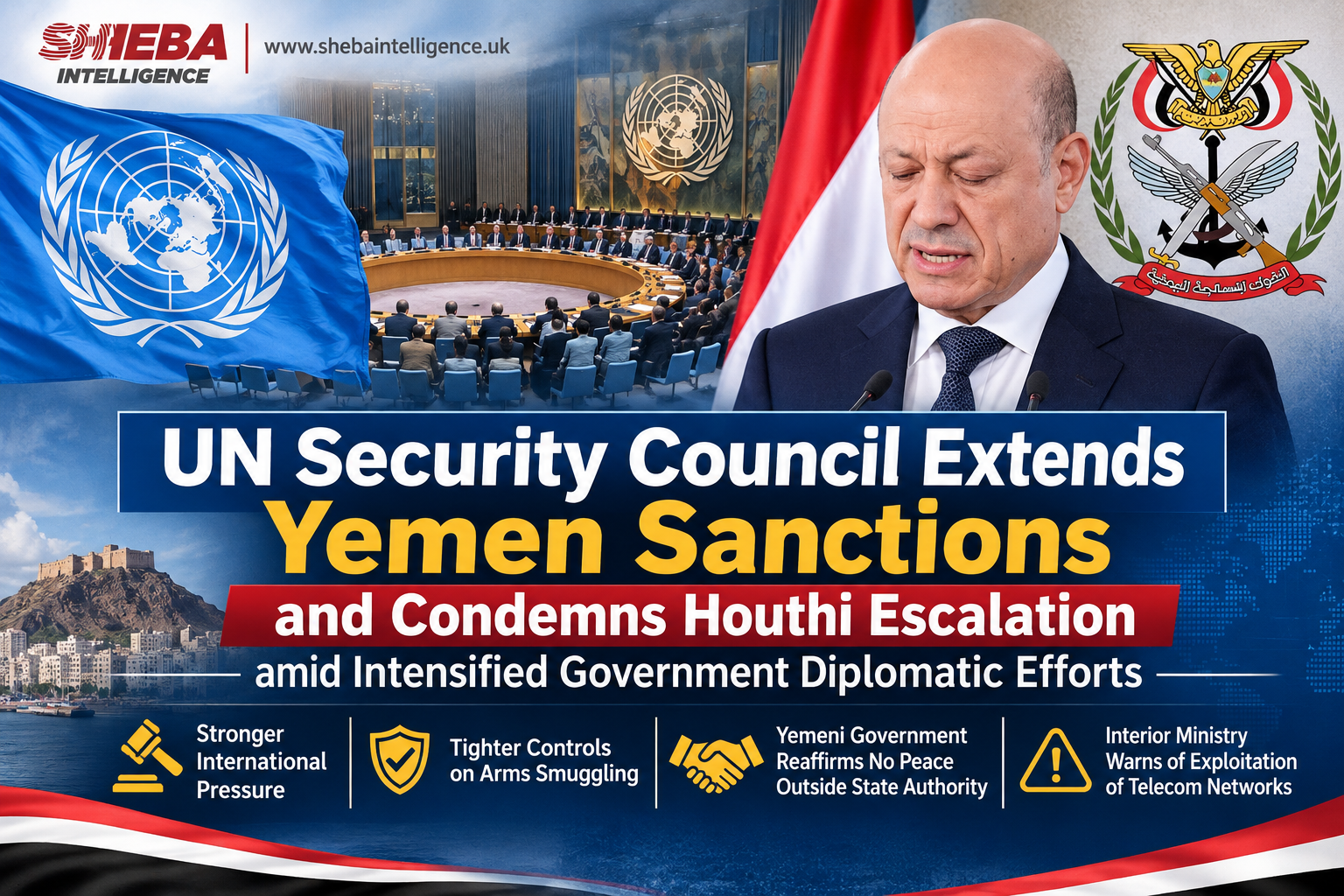
The UN resolution strengthens oversight of arms smuggling and dual-use materials, while President Al-Alimi rejects peace outside state authority, Yemen seeks a terrorist designation for the Houthis, and the Interior Ministry warns of the exploitation of telecommunications networks.
The United Nations Security Council unanimously adopted a new resolution on Thursday extending the Yemen sanctions regime and renewing the mandate of the Panel of Experts, while condemning Houthi military escalation and attacks against civilians, civilian infrastructure, and commercial shipping.
The decision comes amid intensified political, diplomatic, and security efforts by the Yemeni government to increase international pressure on the Houthis.
The resolution extends asset freezes and travel bans for another year and strengthens mechanisms for enforcing the arms embargo, with particular emphasis on preventing the smuggling of dual-use components and chemical precursors that could be used to manufacture weapons, missiles, and drones.
The United Kingdom, which led negotiations on the resolution, said the measures were intended to restrict the Houthis’ ability to manufacture weapons domestically and carry out cross-border attacks. London reaffirmed its solidarity with Yemen and Saudi Arabia and their right to protect their security and sovereignty in accordance with international law.
In Riyadh, Presidential Leadership Council Chairman Rashad Al-Alimi, during a meeting with China’s Special Envoy for Middle East Affairs, Zhai Jun, said the fundamental dispute with the Houthis was not about power-sharing but the group’s insistence on retaining weapons outside state institutions and claiming a divine right to rule.
Al-Alimi accused Iran of using the Houthis as an instrument of regional pressure, citing the involvement of Iranian, Lebanese, and Iraqi experts in supporting the group. He stressed that any sustainable peace must be based on restoring state institutions and ensuring that the state maintains exclusive control over weapons.
On the diplomatic front, Yemeni Foreign Minister Afrah Al-Zouba urged the European Union, during meetings in Brussels, to designate the Houthis as a terrorist organization, allowing tougher measures against networks involved in financing and arming the group.
During talks with EU foreign policy chief Kaja Kallas, Al-Zouba discussed the military escalation, the siege of Taiz, and threats to maritime navigation in the Red Sea and Bab al-Mandab Strait. The European side reaffirmed its continued support for the Yemeni government and efforts to strengthen internal security and coast guard capabilities.
Separately, Yemen’s Foreign Ministry welcomed a statement by the Group of Seven (G7) condemning Houthi attacks inside Yemen and against Saudi Arabia and calling on Iran to stop supplying weapons to the group.
The ministry urged the international community to translate its positions into concrete measures to enforce the arms embargo and disrupt the Houthis’ financial networks.
On the security front, Yemen’s Interior Ministry renewed its warning on Friday to residents of government-held governorates, particularly the interim capital Aden, about text messages allegedly circulated by the Houthis through the Yemen Mobile and YOU telecommunications networks.
The ministry said the messages were intended to spread disinformation and lure civilians into cooperating with the group. It warned that individuals involved in exploiting telecommunications networks to plan missile and drone attacks against civilians and civilian infrastructure would face legal prosecution.
These developments come amid continuing military confrontations and growing concerns over maritime security and cross-border threats, as the Yemeni government’s diplomatic initiatives converge with tighter international scrutiny of arms supplies and financing.
However, the new Security Council resolution stops short of formally designating the Houthis as a terrorist organization.
Taken together, the developments indicate mounting political, diplomatic, and security pressure on the Houthis, while international divisions persist over the group’s terrorist designation and the future of a political settlement in Yemen.