
Houthi Offensive in Lahj Aims to Retake Control of Bab al-Mandab
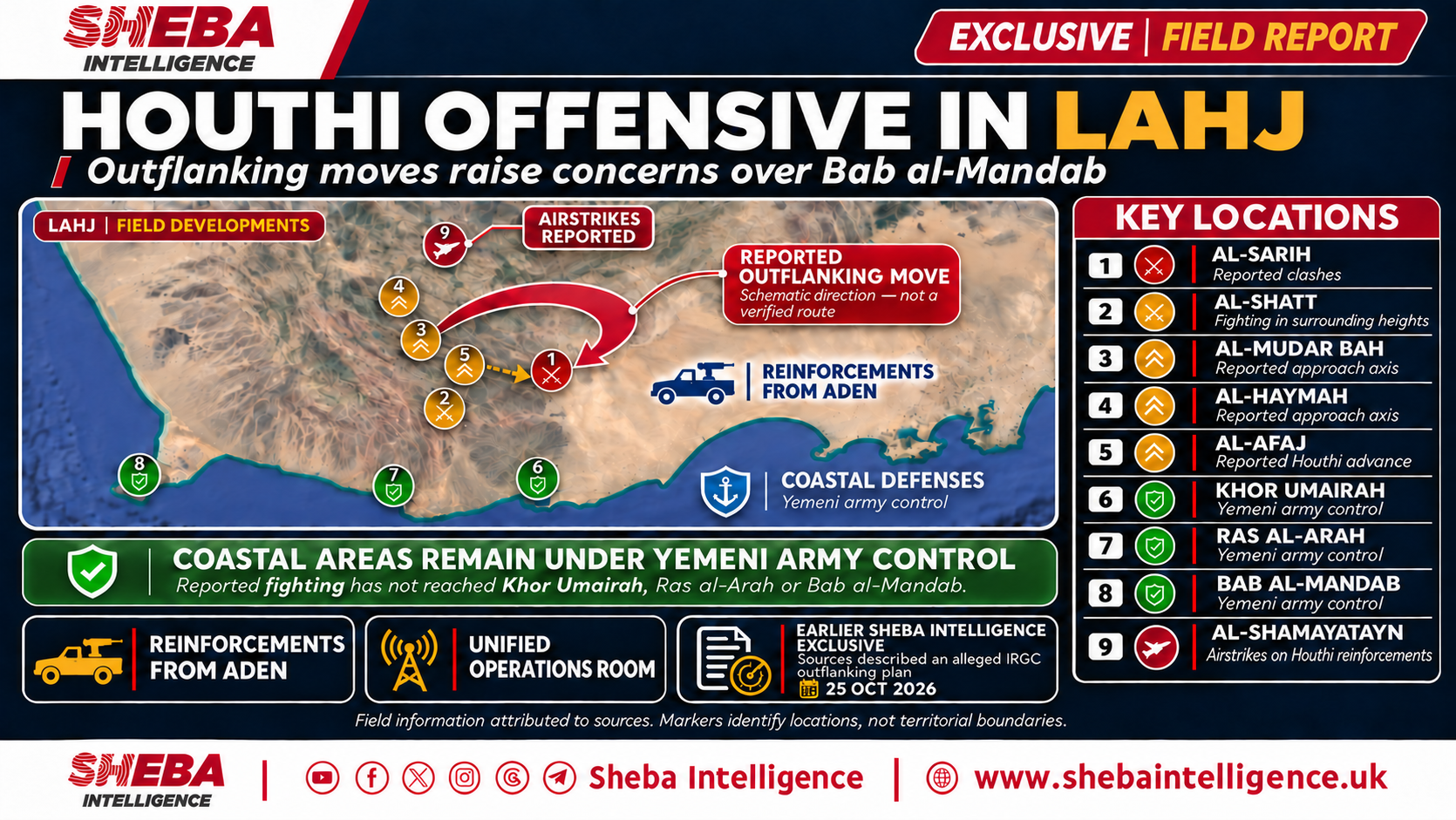
Earlier Sheba Intelligence reporting warned of an IRGC plan to retake the strait, as Yemen’s army reinforces Lahj under a unified operations room
Government forces have dispatched military reinforcements from Aden to Lahj governorate, alongside the appointment of a command to oversee a unified operations room, following Houthi advances in Al-Mudaribah and Al-Arah district and intensified fighting toward Al-Sarih and Al-Shatt, the district’s administrative center.
The outflanking movements described by sources overlap with part of a scenario previously disclosed by Sheba Intelligence involving a plan attributed to Iran’s Islamic Revolutionary Guard Corps (IRGC) to encircle forces in parts of Lahj and the Taiz coastline, paving the way for an attempt to seize Bab al-Mandab.
However, sources stressed that Khor Umairah, Ras al-Arah and the coastal stretch extending to Bab al-Mandab remain under Yemeni army control, and that the reported fighting has not reached those coastal areas.
Advances From Two Directions and Fighting at Al-Sarih
A field source said Houthi forces entered Al-Majzaa, Al-Sarih and Al-Afaj following the withdrawal of troops stationed there, before fighting became concentrated at Al-Sarih junction and beyond the Huwayrib camp.
The source explained that the offensive developed along two axes: one from Al-Hajjaj and Al-Afaj, and the other from Al-Mudaribah through Al-Haymah toward Al-Sarih junction, in an attempt to outflank defending forces.
Sources reported intensifying clashes at several positions in Al-Sarih, with fighting extending into the mountain ranges surrounding Al-Shatt.
Reinforcements From Aden and Airstrikes on Houthi Forces
Sources said reinforcements from the Support and Reinforcement Forces and other military units in Aden had arrived in Lahj to participate in operations against the Houthis in Al-Mudaribah and Al-Arah district, following the appointment of a new command to oversee a unified operations room in the operational area.
Sources also reported airstrikes targeting Houthi forces in Al-Shamayatayn district in rural Taiz as they moved toward Al-Mudaribah and Al-Arah in Lahj.
Earlier Intelligence Reporting on an Outflanking Plan Through Lahj
Sheba Intelligence previously published a report titled “Iran Plans Military Offensive to Retake and Close Bab al-Mandab Amid Fears of US Strikes”, citing intelligence sources who described a plan attributed to the IRGC to carry out three simultaneous operations through Houthi forces.
National Resistance Source Describes a Reduction in Force Strength
The developments coincided with the circulation of videos accusing the National Resistance, led by Presidential Leadership Council member Tariq Saleh, of abandoning positions and withdrawing from areas subsequently entered by the Houthis. A source within the National Resistance offered Sheba Intelligence a different account, linking its reduced deployment to a broad redistribution of personnel and weapons among other formations.
The source said the National Resistance previously comprised five infantry divisions, each consisting of five brigades, alongside four Tihama naval brigades and coast guard, public security and military police formations. He estimated its former total strength at approximately 70,000 personnel, including affiliated formations.
He explained that two infantry divisions were transferred to the Tihama Resistance, together with the naval brigades and their weapons and equipment, under what he described as “higher-level directives.” Personnel from Tihama serving in the remaining three divisions were also transferred to the Tihama Resistance, reducing some brigades from approximately 1,600 personnel to around 500.
According to the source, the remaining brigades were subsequently merged, leaving each division with three brigades and approximately 3,000 fighters, for a combined force of slightly more than 9,000 still fighting under the National Resistance name.
These figures are the source’s estimates. No independent personnel records were available to verify the previous total or the details of the transfers and mergers.
Reduced Equipment and Complaints About the Absence of Field Command
The source said the redistribution also involved vehicles and weapons. A brigade that previously possessed approximately 130 military pickup trucks and 80 armored vehicles now had, in some cases, around 20 pickups and three armored vehicles, he said.
He attributed part of the reduction to the transfer of weapons and vehicles to the Giants Brigades under higher-level directives and arrangements within the Fourth Military Region.
The source stressed that the remaining troops “are actively fighting with determination under the National Resistance name,” but, according to his account, lack an operational command present on the ground to direct the battle.
He added that fighters received instructions he described as “strange” to paint their military pickups black and transfer them to the Giants Brigades. They refused, he said, insisting on continuing to fight under the National Resistance name. No response from the relevant authorities was available regarding these instructions or the details of the force redistribution.
The appointment of a new command for the unified operations room comes amid these complaints and battlefield developments. There is not yet sufficient information to assess its impact on coordination among units or efforts to halt the Houthi advance.
Concerns have also been raised about possible intervention by the United Arab Emirates through forces it trained, potentially complicating the military situation following the refusal of some units to fight beyond the former North–South boundary, amid efforts to secure southern secession.