
Yemeni Parliament Approves Law Designating Houthis a Terrorist Organization and Criminalizing Their Activities and Financing
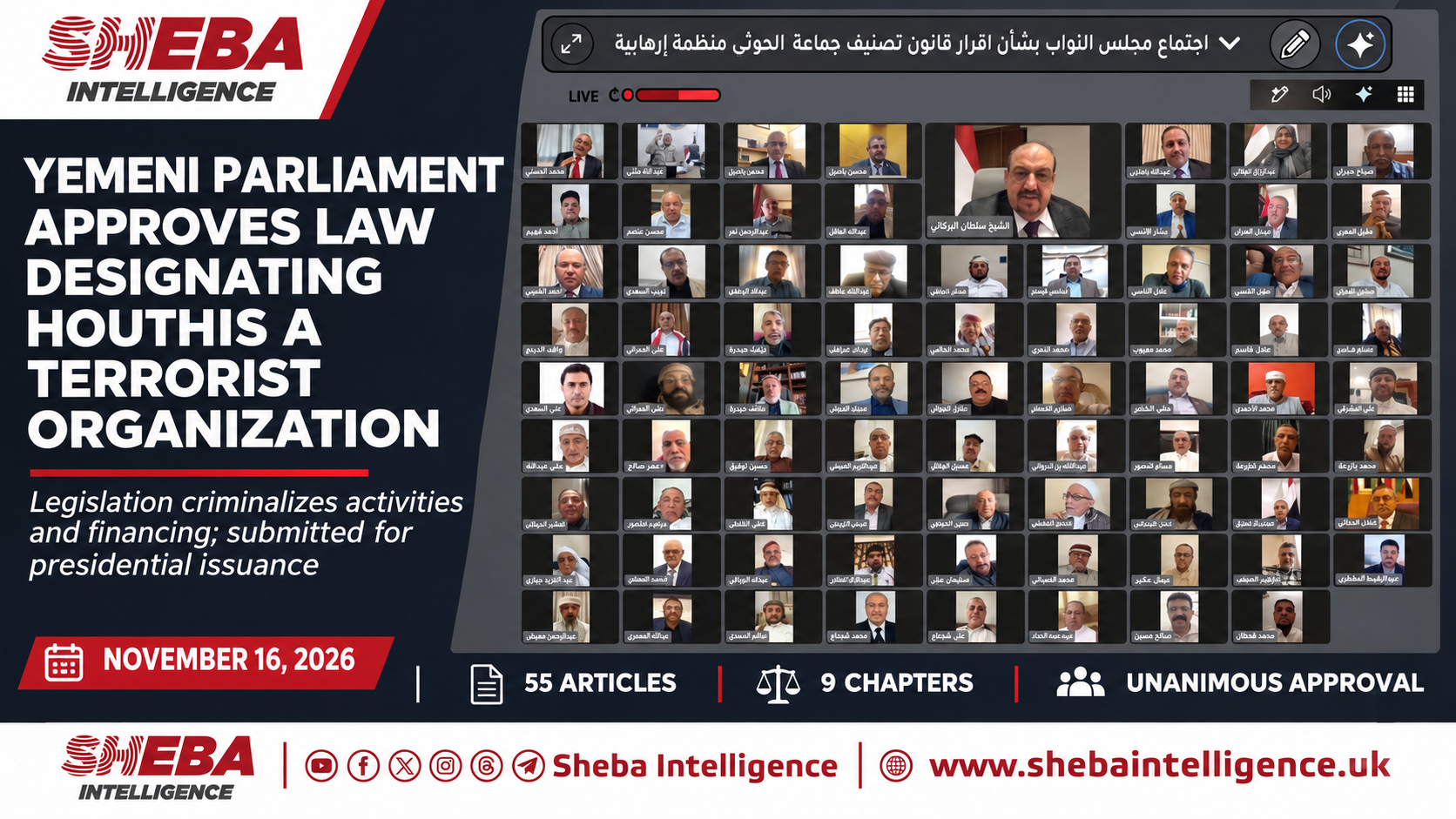
The 55-article law will be submitted to the Presidential Leadership Council chairman for issuance, as army chief stresses the priority of lifting the siege of Taiz and confronting attacks in Lahj and on the western coast.
Yemen’s House of Representatives unanimously approved a bill designating the Houthi group a terrorist organization and criminalizing its activities and financing on Monday, November 16, 2026. The final text will be submitted to Presidential Leadership Council Chairman Rashad Al-Alimi for issuance, according to a parliamentary statement.
The legislation was approved during a meeting held by videoconference and chaired by Speaker Sultan Al-Barakani, following an article-by-article debate and a review of a report prepared by a special parliamentary committee headed by Deputy Speaker Mohsen Basurrah, with government representatives participating.
The law comprises 55 articles across nine chapters. It designates the Houthi group, including all its political, military and civilian formations, as a terrorist organization, criminalizes its activities, financing and arms supplies, and establishes the associated penalties and legal measures.
According to the statement, the law criminalizes the promotion of ideologies of hereditary and sectarian supremacy. It also imposes tougher penalties for seizing state powers, besieging cities, starving civilians, targeting civilians, planting landmines, and attacking international shipping and essential services. Penalties include capital punishment in cases specified by the law.
The legislation also regulates the tracing, seizure, freezing and confiscation of funds and assets linked to the group and its affiliated entities, in accordance with the law. Crimes committed before its issuance will be punishable under Sharia or existing legislation, whichever provides the harsher penalty. The law stipulates that it takes effect upon issuance and publication in the Official Gazette.
Parliament called on the international community to take practical measures to cut off the group’s financing and arms supplies and protect regional security and international navigation. It stressed that grave crimes against Yemenis would not be subject to a statute of limitations.
During the meeting, Chief of the General Staff Lieutenant General Sagheer bin Aziz briefed lawmakers on battlefield developments, emphasizing the need to unify military formations, strengthen public support and overcome internal differences.
Bin Aziz said that lifting the siege of Taiz must remain a top priority. He pledged to confront Houthi attacks on the outskirts of Lahj and along the western coast, as well as in Marib and Al-Jawf, stressing that defending Yemeni territory is a shared national responsibility.