
Raed Al-Kahlani: The Captain Mourned by Yemen’s Leaders and Thousands in Taiz
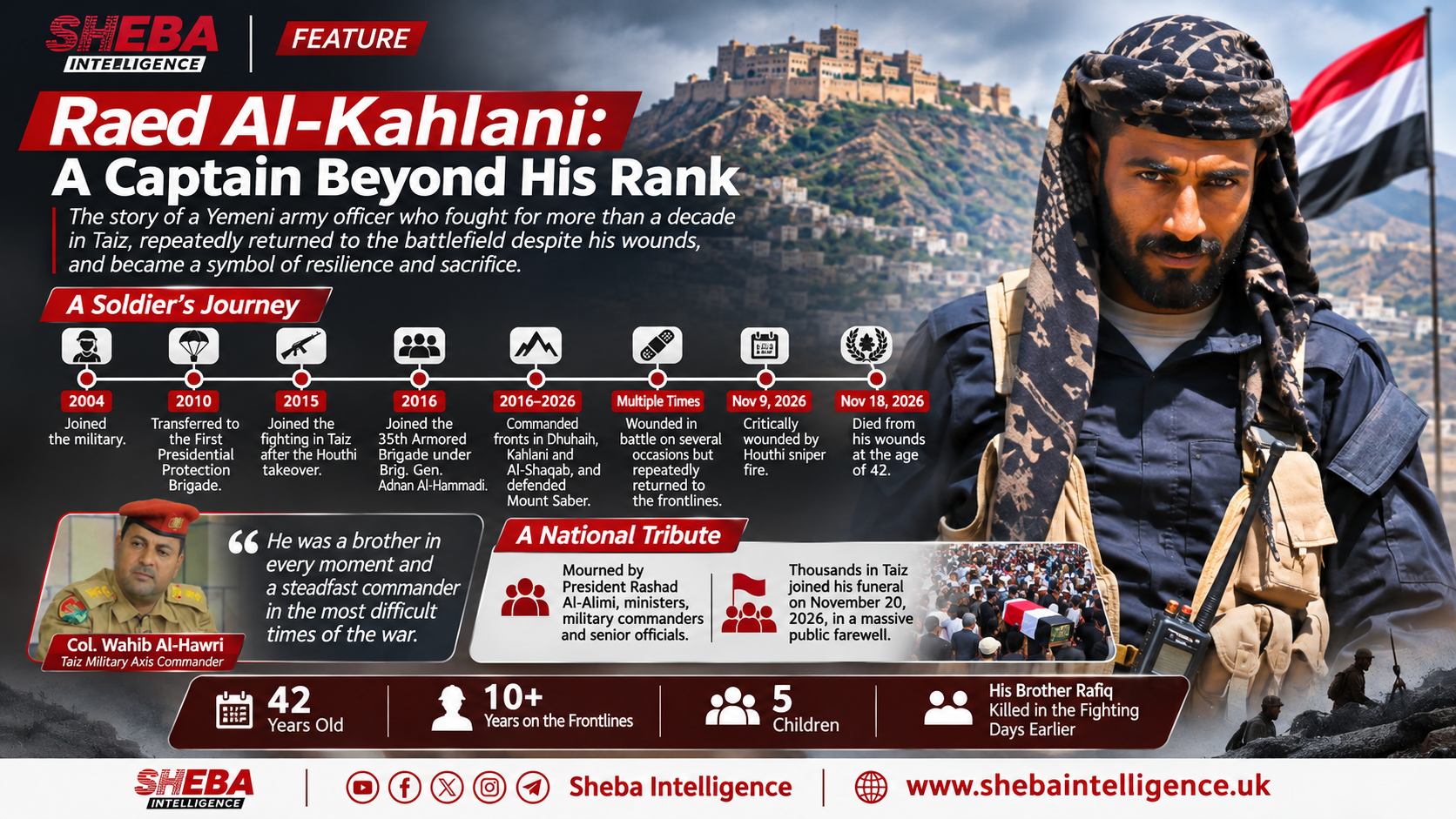
From the frontlines of Mount Saber to a mass funeral, the story of a Yemeni army officer who fought for more than a decade, repeatedly returned to battle despite his wounds, and became a symbol of resilience far beyond his military rank.
Thousands of mourners filled the streets of Taiz on November 20, 2026, to bid farewell to Captain Raed Ahmed Mohammed Saif Al-Kahlani, a frontline commander whose death after more than a decade of fighting against the Houthis prompted tributes from Yemen’s highest political and military leadership.
Al-Kahlani, a commander in the 35th Armored Brigade, died on November 18 after suffering a severe gunshot wound to the head during fighting on the Mount Saber front, overlooking Taiz.
His funeral brought together government officials, military commanders, fellow soldiers and civilians, reflecting a level of public recognition rarely associated with an officer of his relatively junior rank.
President Rashad Al-Alimi, chairman of Yemen’s Presidential Leadership Council, was among those who mourned him, describing Al-Kahlani as a devoted defender of Mount Saber.
His death came just days after his brother, Rafiq Al-Kahlani, was killed in the fighting, leaving their family grieving two losses in quick succession.
From a Rural Village to the Frontlines
Born on April 4, 1984, in the village of Kahlani in Taiz governorate, Al-Kahlani joined the military in 2004.
He initially served in the Republican Guard, receiving specialized training in commando and airborne operations, before transferring to the First Presidential Protection Brigade in 2010.
His military career took a decisive turn in 2015, when fighting intensified in Taiz following the Houthi takeover of large parts of Yemen.
According to a biography released by the 35th Armored Brigade, Al-Kahlani was visiting his home village when he joined the fighting on Mount Jarrah. He later assumed command of the Dhuhaih front.
In March 2016, he joined the 35th Armored Brigade, then commanded by Brigadier General Adnan Al-Hammadi, a prominent military figure who was assassinated in 2019.
Al-Kahlani subsequently commanded the Dhuhaih-Kahlani and Al-Shaqab fronts and served as chief of staff of the brigade’s Sixth Sector.
Over the following decade, his name became closely associated with the defense of Mount Saber, a strategic highland overlooking Taiz.
A Commander Who Repeatedly Returned to Battle
Al-Kahlani survived multiple battlefield injuries during his years on the frontlines.
According to the brigade’s account, he sustained wounds to different parts of his body but repeatedly returned to his positions after treatment.
On October 10, 2026, he was wounded in the abdomen and thigh. Four days later, he reportedly returned to the front despite his injuries.
For fellow soldiers, his determination became a defining feature of his military career.
Colonel Wahib Al-Hawri, a field commander in the Taiz Military Axis who served alongside Al-Kahlani, mourned him as a brother in difficult times and a commander who remained steadfast during the most demanding moments of the war.
Al-Hawri’s tribute reflected the bonds forged among officers who spent years fighting on the same fronts, often under difficult conditions and with limited resources.
Such accounts offer a picture of Al-Kahlani that goes beyond his formal military responsibilities: a commander whose reputation was shaped by his continued presence alongside his soldiers.
The Final Battle
On November 9, 2026, Al-Kahlani was struck in the head by what the 35th Armored Brigade described as Houthi sniper fire while serving on the Kahlani front.
He was hospitalized in critical condition and remained unconscious until his death was announced on November 18.
He was 42.
His death followed the killing of his brother Rafiq, adding another tragedy to a family already deeply affected by the conflict.
Al-Kahlani left behind five children.
For those who had followed his military career, the circumstances of his death reflected a pattern that had defined his years in uniform: returning to frontline positions despite repeated injuries.
Why Yemen’s Leaders Mourned a Captain
Al-Kahlani’s death drew tributes from senior political figures across Yemen’s internationally recognized government.
Presidential Leadership Council Chairman Rashad Al-Alimi offered condolences to his family and praised his contribution to defending Taiz and Mount Saber.
Foreign Minister Afrah Al-Zouba also paid tribute, highlighting his repeated return to the battlefield despite his wounds.
She described the large crowds attending his funeral as a public expression of recognition for those who had defended Taiz.
Abdulmalik Al-Mekhlafi, an adviser to the Presidential Leadership Council, invoked the legacy of the late Brigadier General Adnan Al-Hammadi when mourning Al-Kahlani.
Other tributes came from Taiz Governor Nabil Shamsan, government officials, parliamentarians, diplomats and military commanders.
Although their messages varied, many emphasized the same contrast: Al-Kahlani held the rank of captain, yet had spent years commanding frontline positions in one of Yemen’s most prolonged battle zones.
His death also renewed discussion about the recognition accorded to officers whose responsibilities and battlefield experience extend beyond their formal rank.
A City Comes Out to Say Goodbye
On November 20, crowds gathered in Taiz for Al-Kahlani’s funeral, attended by Governor Nabil Shamsan and senior military and security officials.
Images from the procession showed large numbers of mourners accompanying his coffin through the city.
The funeral became more than a military farewell.
For many participants, it was an occasion to remember the soldiers and local fighters who had spent years defending Taiz amid prolonged conflict, repeated attacks and severe humanitarian hardship.
The public response also highlighted the significance of Mount Saber, where Al-Kahlani had spent much of his military career.
The highland has remained a strategically important area in the struggle for control of Taiz, making the defense of its positions central to the city’s security.
Beyond the Rank of Captain
Al-Kahlani’s story illustrates a less visible dimension of Yemen’s war: the experience of mid-ranking officers who assumed prolonged combat responsibilities while remaining largely outside the national political spotlight.
Unlike senior military leaders whose names frequently appear in official statements, Al-Kahlani spent much of his career commanding positions on the ground.
His reputation was built through years of fighting, repeated injuries and relationships with fellow soldiers.
The tributes following his death suggest that his influence extended beyond the chain of command and the military sector in which he served.
Yet the most enduring consequences of his death are personal.
Five children have lost their father, a family has lost two sons within days, and soldiers who served alongside him have lost a commander whose career was closely tied to their own experience of the war.
For Taiz, his funeral became a reminder of the human cost of a conflict that has continued for more than a decade.
Raed Al-Kahlani never rose to the highest ranks of Yemen’s military. But the crowds that gathered to mourn him, and the leaders who paid tribute, demonstrated how a frontline captain could earn recognition far beyond his rank.