
The Instrumentalization of Terrorism: From Yemen’s Saleh Regime to Houthi Transnational Networks
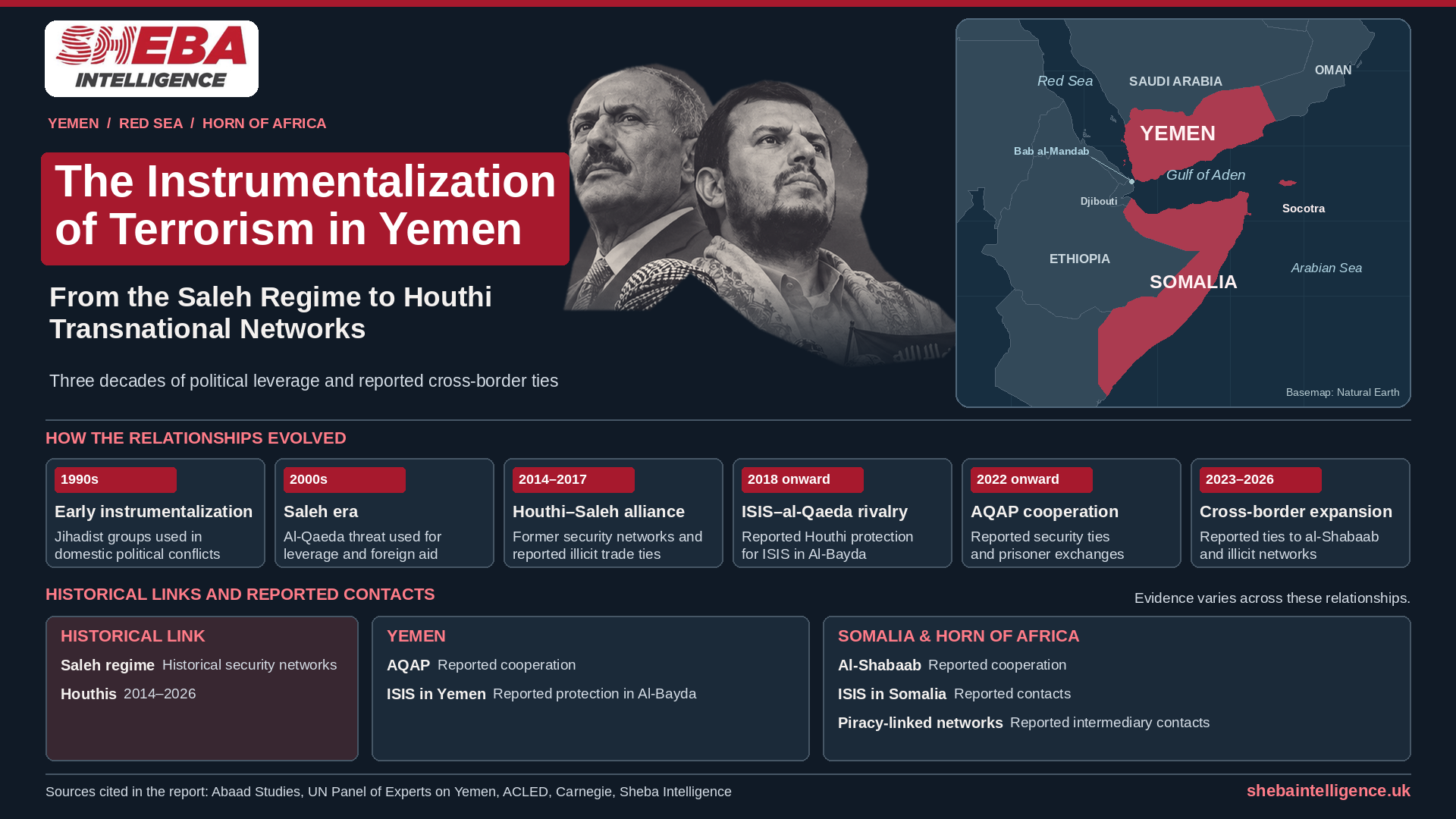
From exploiting al-Qaeda as a source of political leverage and international funding to manipulating jihadist rivalries and developing ties with Somalia’s al-Shabaab, three decades of security developments in Yemen reveal an evolving network of pragmatic relationships that increasingly threatens the Red Sea and the Horn of Africa.
A review by Sheba Intelligence of studies conducted by the Abaad Studies and Research Center, UN Panel of Experts reports, international research, and its own previous intelligence reporting reveals an evolving pattern in the instrumentalization of terrorist organizations in Yemen.
What initially served as a means of managing domestic political conflicts and securing international assistance appears to have developed into a broader network of security, military, and economic relationships extending beyond Yemen’s borders.
The Saleh Regime: Exploiting the Terrorist Threat
The instrumentalization of jihadist groups in Yemen’s political conflicts dates back to the 1990s. However, its significance increased after 2000, as counterterrorism became an international priority.
An August 2017 study by the Abaad Studies and Research Center, Terrorism in Yemen: From Al-Qaeda to ISIS, suggests that the regime of former President Ali Abdullah Saleh benefited politically and financially from the persistence of the al-Qaeda threat.
The study cited former Minister of Religious Endowments Hamoud al-Hitar, who led government-sponsored dialogue with al-Qaeda members and accused Saleh of exploiting the organization to secure additional international financial assistance.
It also documented renewed al-Qaeda activity coinciding with the September 2006 presidential election, raising questions about the political exploitation of terrorism during electoral periods and domestic power struggles.
The Houthis and the Inheritance of Security Networks
Following the September 2014 coup and the Houthi takeover of state institutions and intelligence agencies, indications emerged that some of the former regime’s networks associated with terrorist organizations were being repurposed.
In a report submitted to the UN Security Council in 2021, the Yemeni government accused the Houthis of exploiting intelligence obtained from state security agencies to establish relationships with members of terrorist organizations and release some detainees in exchange for cooperation.
Within this context, accounts of the emergence of individuals affiliated with al-Qaeda in Arhab district in 2014 raise questions about whether their presence was exploited to justify Houthi military expansion under the pretext of counterterrorism. The circumstances surrounding this episode require further independent documentation.
Smuggling and Mutual Benefit: The Early Foundations of Cooperation
An unpublished field study conducted by the Abaad Studies and Research Center during the Houthi-Saleh alliance, before Saleh was killed in December 2017, identified indications of mutually beneficial arrangements between al-Qaeda and networks associated with the alliance in Hadramawt governorate.
According to the study, networks affiliated with the Houthi-Saleh alliance benefited from protection provided by al-Qaeda elements to illicit trafficking activities involving weapons and narcotics.
The findings suggest that shared economic and security interests associated with the illicit economy constituted an early foundation for pragmatic cooperation, despite ideological hostility and armed confrontations between the two sides.
These previously unpublished findings acquire additional significance in light of subsequent UN reports and international research documenting the expansion of Houthi-AQAP cooperation from 2022 onward.
They suggest that 2022 may have marked the consolidation and expansion of existing relationships rather than their initial emergence.
Exploiting ISIS Against Al-Qaeda
Beginning in 2018, relations between the Houthis and jihadist organizations entered a new phase as confrontations between al-Qaeda and the Islamic State (ISIS) intensified in Al-Bayda governorate.
Abaad’s study, The Growing Brutality of Terrorism in Yemen (III): The Islamic State and the Search for the Land of the Caliphate, examined these developments through field research and interviews with tribal and military figures.
Another Abaad study, Tribes and Oil in Yemen’s War: The Last Battle for Marib, published in 2020, identified indications that ISIS benefited from Houthi protection during its confrontation with al-Qaeda.
The study also cited tribal testimony pointing to coordination between the Houthis and ISIS against tribal resistance groups and government forces in the Qayfa region of Al-Bayda.
These findings suggest that the Houthis sought to exploit rivalry between jihadist organizations to advance their own military and political interests.
2022: Expanding Cooperation with Al-Qaeda
By 2022, indications emerged that relations between the Houthis and al-Qaeda in the Arabian Peninsula (AQAP) were moving beyond armed confrontation and limited prisoner exchanges toward broader arrangements.
A study by ACLED identified an expansion of tacit cooperation between the two sides from 2022 onward, encompassing non-aggression arrangements and connections to illicit economic networks extending to Somalia’s al-Shabaab.
In its 2024 report, the UN Panel of Experts on Yemen reported security and intelligence cooperation between the Houthis and AQAP, alongside prisoner exchanges, the provision of safe havens, and reported military assistance.
These findings reinforce the assessment that the relationship has increasingly been shaped by mutual economic and security interests, although they do not necessarily establish the existence of a permanent organizational or strategic alliance.
From Al-Qaeda in Yemen to Al-Shabaab in Somalia
The Houthis’ reported relationships with terrorist organizations are no longer confined to Yemen. Growing evidence points to their expansion into the Horn of Africa, particularly through contacts with al-Shabaab, al-Qaeda’s Somali affiliate.
In September 30, 2023, Sheba Intelligence reported early indications of Houthi reliance on African maritime networks for logistical support.
In subsequent reporting during 2026, the platform highlighted intelligence indicating growing cooperation between the Houthis and al-Shabaab, encompassing illicit economic activities, logistical assistance, and reported exchanges of military expertise.
These findings are consistent with the 2025 report of the UN Panel of Experts on Yemen, which highlighted growing cooperation between the Houthis and al-Shabaab, drawing on information and investigations provided by Somali authorities.
The emerging relationship appears to extend beyond commercial and financial interests, potentially contributing to the Houthis’ efforts to expand their regional influence across the Red Sea and the Gulf of Aden.
For al-Shabaab, such relationships may offer additional financial resources and access to external support, illustrating how mutual interests can override significant ideological differences.
ISIS, Piracy and Transnational Organized Crime
Available evidence suggests that the Houthis’ emerging network of relationships may extend beyond AQAP and al-Shabaab.
A 2025 study by the Carnegie Endowment for International Peace, Dhows, Drones, and Dollars: Ansar Allah’s Expansion Into Somalia, examined indications of Houthi contacts with both al-Shabaab and the Islamic State in Somalia, despite profound ideological differences.
The 2025 UN Panel of Experts report also cited information from Somali officials concerning Houthi contacts with both organizations, although the strength of the available evidence varies considerably.
In September 2026, a Sheba Intelligence investigation reported indications of expanding Houthi relationships with al-Shabaab and intermediaries associated with piracy and illicit maritime activities in the Horn of Africa.
These developments point to an increasing convergence between terrorism, organized crime, smuggling, and piracy, driven more by pragmatic calculations of mutual benefit than by ideological alignment.
From Domestic Instrumentalization to a Transnational Security Threat
The developments spanning the Saleh era and Houthi rule reveal indications of an evolving model of instrumentalized terrorism in Yemen.
Under Saleh, the exploitation of the terrorist threat was primarily associated with domestic political leverage and international financial and security assistance.
Under the Houthis, accumulating evidence suggests that these relationships have acquired broader economic, security, military, and regional dimensions.
This evolution can be traced through several overlapping phases: the inheritance of former security networks, the emergence of economic arrangements linked to illicit activities before 2017, the exploitation of rivalry between ISIS and al-Qaeda from 2018, the expansion of cooperation with AQAP from 2022, and the development of relationships with armed groups and criminal networks in the Horn of Africa.
These relationships do not necessarily constitute an ideological alliance or a unified command structure. Rather, they illustrate how financial, military, and political interests can transcend sectarian and ideological divisions.
The convergence of these networks risks transforming terrorism in Yemen from a threat associated primarily with domestic conflict into a transnational security challenge with wider implications for the Horn of Africa, the Red Sea, the Gulf of Aden, and international maritime security.