
UK Imposes Direct Sanctions on Houthis, Targeting Their Security and Judicial Apparatus
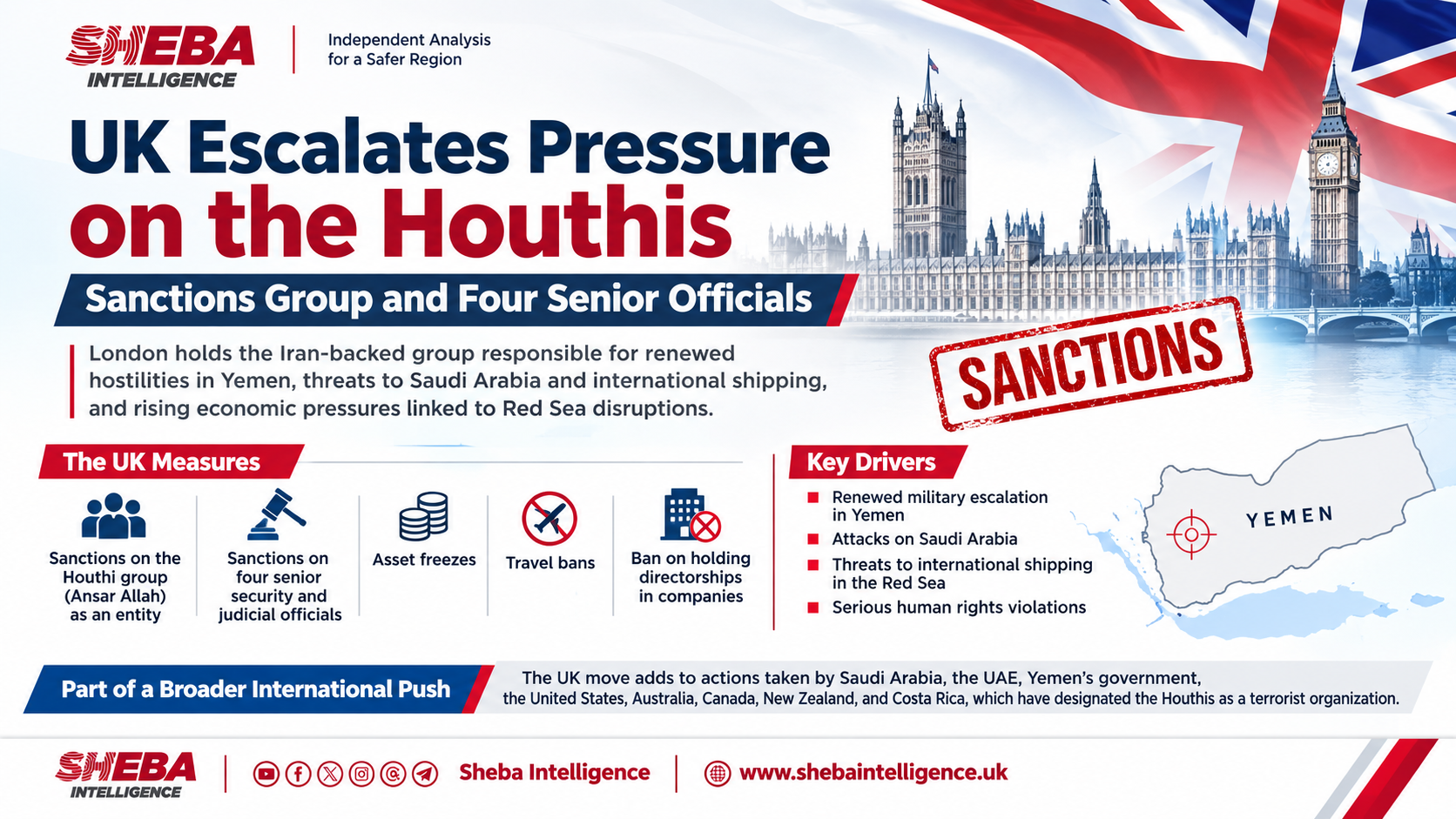
London holds the Iran-backed group responsible for renewed hostilities in Yemen, threats to Saudi Arabia and international shipping, and rising economic pressures linked to disruptions in Red Sea trade.
The United Kingdom announced on Tuesday sanctions against the Houthi group (Ansar Allah) as an entity and four senior officials within its security and judicial apparatus, marking a significant escalation in British policy toward the Iran-backed group.
The decision moves beyond the existing United Nations arms embargo to impose independent British financial restrictions directly targeting the group, increasing legal and financial risks for individuals, businesses and networks associated with its activities.
In an official statement, the British government said the measures were intended to hold the Houthis accountable for undermining regional stability and committing serious human rights violations in Yemen.
Holding the Houthis Responsible for Renewed Hostilities
In a written statement to the British Parliament, the British government said the Houthis had escalated their military activities since July 2026, including attacks against Saudi Arabia, offensives against Yemen’s internationally recognized government and threats to maritime navigation in the Red Sea.
London reaffirmed its support for Saudi Arabia and Yemen’s internationally recognized government, holding the Houthis responsible for renewed hostilities and the worsening humanitarian crisis.
The British position carries particular political significance amid the ongoing military campaign under Operation “Dawn of Yemen,” as it identifies Houthi aggression as a driver of the escalation preceding the current phase of the conflict.
Targeting the Security and Judicial Apparatus
The sanctions package extends beyond the group itself to four senior Houthi officials representing different levels of its security and judicial apparatus:
- Abdulkarim Amir al-Din Hussein Al-Houthi: Houthi interior minister, whose ministry oversees detention facilities where prisoners have reportedly been subjected to torture and sexual violence.
- Abdul Hakim Hashem Ali Al-Khaiwani: Head of the Houthi Security and Intelligence Service and former deputy interior minister.
- Mohammed Moufleh: A Houthi-appointed judge implicated in serious violations of individual liberty and personal security.
- Sarim Al-Din Muffadal: A senior Houthi prosecutor suspected of involvement in grave abuses against female detainees, including torture and rape.
The four officials are subject to asset freezes, travel restrictions and prohibitions on corporate directorships under Britain’s Global Human Rights and International Humanitarian Law Sanctions Regulations 2026.
The selection of these officials reflects a broader effort to hold accountable the institutions through which the Houthis exercise internal control, alongside measures addressing the group’s military activities.
From Red Sea Security to Britain’s Domestic Economy
British Foreign Secretary Ed Miliband linked Houthi attacks on commercial shipping in the Bab al-Mandab Strait to Britain’s domestic economic interests, highlighting the impact of disrupted international supply chains on household living costs.
The British position reflects an expanding perception of the Houthi threat, which is increasingly viewed not merely as a regional security challenge but as a source of disruption to international commerce and economic stability.
Growing International Pressure on the Houthis
The British decision follows a growing international trend toward restricting the Houthis’ financial activities, criminalizing support for the group and isolating its external networks.
Saudi Arabia and the United Arab Emirates designated the Houthis as a terrorist organization in 2014, followed by Yemen’s internationally recognized government in October 2022.
The United States reinstated the group’s Specially Designated Global Terrorist (SDGT) status in February 2024 before redesignating it as a Foreign Terrorist Organization (FTO) in March 2025.
Australia and Canada also added the Houthis to their respective terrorist organization lists in 2024, expanding international efforts to combat the group’s financing and activities. canada.ca +1
Unlike these countries, Britain has opted to impose direct financial sanctions on the Houthis without formally proscribing the group under its domestic terrorism legislation.
Nevertheless, London’s decision carries additional diplomatic weight given its position as a permanent member of the UN Security Council and its role as the Council’s penholder on Yemen.
New Zealand designated the Houthis as a terrorist entity on November 20, 2024, while Costa Rica officially announced its terrorist designation of the group on April 8, 2026.
More recently, on November 18, 2026, Yemen’s Presidential Leadership Council issued Law No. 1 of 2026, reinforcing the group’s terrorist designation and criminalizing its activities and financing.
Mounting Pressure on the European Union
The British decision comes amid growing diplomatic efforts to persuade the European Union to designate the Houthis as a terrorist organization.
On November 12, Reuters reported that Saudi Arabia was pressing the EU to adopt such a designation following renewed Houthi attacks against the Kingdom.
Although the European Parliament has called for a terrorist designation, a binding decision would require unanimous approval from all 27 EU member states.
Some European governments remain concerned about the potential implications for humanitarian operations, diplomatic engagement and maritime security.
Britain’s latest measures could provide further political momentum for European efforts to tighten restrictions on the group.
Tightening the Financial Noose
The British designation prohibits persons and businesses subject to UK jurisdiction from making funds or economic resources available to the Houthis, except where authorized or exempted.
These restrictions could increase compliance risks for financial institutions, commercial intermediaries and businesses connected to the group’s economic networks.
London has nevertheless maintained humanitarian exemptions, while the UK Treasury has issued a general licence intended to protect humanitarian operations and specified commercial activities supporting the essential needs of the Yemeni population.
The British government also reaffirmed its commitment to strengthening the UN sanctions regime on Yemen, potentially paving the way for broader international measures targeting Houthi financial and logistical networks.
Toward a New Phase of International Isolation
The British sanctions come at a time of mounting concern over the expansion of Houthi threats beyond Yemen’s borders, particularly across the southern Red Sea, the Gulf of Aden and the Horn of Africa.
The combination of terrorist designations, financial restrictions and human rights sanctions reflects an increasingly multidimensional international response to the group.
The significance of London’s decision lies in bringing together three dimensions of the Houthi threat: renewed warfare inside Yemen, regional and international security risks, and serious human rights violations.
Should additional European governments adopt similar measures, the Houthis could face a new phase of financial, legal and diplomatic isolation, alongside the military pressure they currently face inside Yemen.