
Exclusive | Intelligence Sources: Israel and the UAE Refused to Destroy Israeli Radar System Seized by Houthis in Mocha
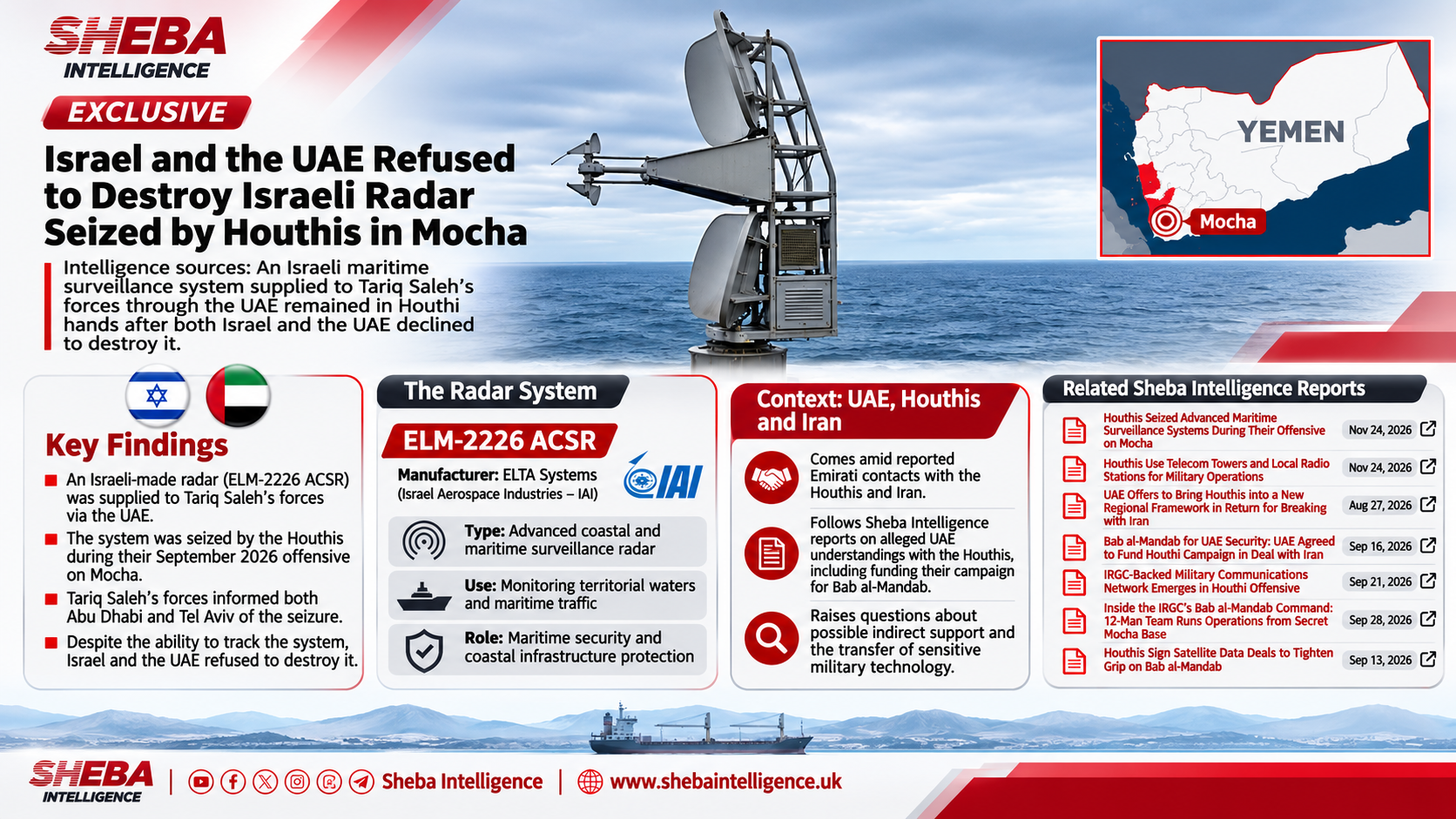
Intelligence obtained by Sheba Intelligence reveals that an advanced Israeli maritime surveillance radar supplied to Tariq Saleh’s forces through the UAE remained in Houthi hands after Israel and the UAE reportedly refused to destroy it, raising questions in light of previously reported Emirati understandings with the Houthis and Iran.
Intelligence obtained by Sheba Intelligence reveals that Israel and the United Arab Emirates refused to destroy an advanced Israeli-made coastal and maritime surveillance radar after the Houthis seized it during their September 2026 offensive on the western Yemeni coastal city of Mocha.
According to intelligence sources, the radar system, identified as the ELM-2226 ACSR, had been supplied through the UAE to forces led by Tariq Mohammed Abdullah Saleh as part of maritime surveillance equipment deployed along Yemen’s western coast.
Following the Houthi offensive on Mocha, Tariq Saleh’s forces informed both the Emirati and Israeli sides that the radar system had fallen into Houthi hands.
Despite reportedly retaining the ability to track the system, both Israel and the UAE refused to destroy it, leaving the equipment under Houthi control, according to the intelligence sources.
The reasons behind the reported refusal remain unclear, raising questions about whether the decision could have indirectly benefited the Houthis’ maritime surveillance capabilities.
An Advanced Israeli Maritime Surveillance System
The ELM-2226 ACSR is manufactured by ELTA Systems, a subsidiary of Israel Aerospace Industries (IAI).
According to the manufacturer’s official website, the system is a digital radar designed for coastal and maritime surveillance, the protection of maritime infrastructure and territorial waters monitoring.
The intelligence obtained by Sheba Intelligence identifies the UAE as the intermediary through which the Israeli-made system was supplied to Tariq Saleh’s forces.
Its current technical condition and whether it has entered operational service under Houthi control remain unclear.
The UAE’s Shifting Approach Toward the Houthis and Iran
The reported refusal by Israel and the UAE to destroy the radar takes on additional significance in light of earlier Sheba Intelligence investigations into undisclosed contacts between Abu Dhabi and the Houthis, as well as alleged understandings involving Iran.
On August 27, 2026, Sheba Intelligence published an exclusive investigation into an Emirati proposal to bring the Houthis into a new regional framework in exchange for breaking ties with Iran.
According to a source familiar with the meeting, Emirati intelligence officers held undisclosed talks with Houthi security officials in Abu Dhabi on August 20.
The Emirati side reportedly offered various forms of support in exchange for the Houthis severing their ties with Iran and coordinating with the Southern Transitional Council (STC) on Yemen’s future governance and security arrangements. The Houthi representatives said they would consider the proposal.
On September 16, Sheba Intelligence published another investigation titled “Bab al-Mandab for UAE Security: UAE Agreed to Fund Houthi Campaign in Deal with Iran, Source Says.”
An intelligence source alleged that Iran had negotiated an arrangement under which Abu Dhabi would finance the Houthi campaign to seize Bab al-Mandab in exchange for an end to missile attacks against the UAE.
According to the source, contacts that initially sought to distance the Houthis from Iran subsequently evolved into an alleged arrangement involving Tehran itself.
On September 12, Abu Dhabi Crown Prince Sheikh Khaled bin Mohamed bin Zayed Al Nahyan met Iranian President Masoud Pezeshkian on the sidelines of the BRICS summit in New Delhi. Official Emirati statements emphasized regional stability and de-escalation but made no reference to arrangements involving the Houthis or Bab al-Mandab.
The alleged financing agreement has not been independently verified.
These earlier findings provide a broader political and strategic context for examining the reported Emirati and Israeli refusal to destroy the radar. However, the available intelligence does not establish a direct connection between those alleged understandings and the decision concerning the Israeli-made system.
European and Israeli Surveillance Systems in Houthi Hands
On November 24, 2026, Sheba Intelligence published an exclusive investigation revealing that the Houthis had seized advanced maritime surveillance systems during their offensive on Mocha.
The equipment included French Thales CoastWatcher 100 coastal surveillance radars, British-origin Kelvin Hughes SharpEye radar systems, and advanced electro-optical and infrared surveillance equipment.
The new intelligence concerning the Israeli-made radar adds a significant dimension to the earlier investigation.
While the previous findings focused on the seizure of European-made surveillance equipment, the latest disclosure reveals the reported circumstances under which an Israeli-made system supplied through the UAE remained in Houthi possession despite both countries being informed of its seizure.
In a separate investigation published on November 24, Sheba Intelligence revealed the Houthis’ reported exploitation of telecommunications towers and local radio stations for military purposes, alongside the deployment of maritime radars to monitor international shipping.
Earlier, on September 21, the platform revealed the development of an IRGC-backed military communications network, which reportedly entered operational service during the Houthi offensive on Mocha and Bab al-Mandab.
On September 13, Sheba Intelligence also reported Houthi agreements with a Chinese company to obtain satellite imagery and maritime surveillance data through Iranian mediation, although the implementation of those agreements could not be independently verified.
A further investigation published on September 28 documented intelligence concerning the IRGC’s reported role in overseeing Houthi military operations around Bab al-Mandab and Yemen’s western coast.
Indirect Support or Strategic Calculations?
The reported refusal by Israel and the UAE to destroy the Israeli-made radar, despite being informed that it had fallen into Houthi hands, raises questions about their strategic calculations and their responsibilities regarding the transfer and end-use of sensitive military technology.
It also raises the question of whether leaving the radar under Houthi control effectively amounted to indirect support for the group’s maritime surveillance capabilities.
The case is particularly significant given the Houthis’ history of attacks against commercial vessels and the importance of the Red Sea and Bab al-Mandab Strait to international trade and regional security.
While previous Sheba Intelligence investigations have reported alleged Emirati understandings with the Houthis and Iran, the available intelligence does not establish direct coordination between Israel and the Houthis or demonstrate that the decision to leave the radar in Houthi possession formed part of a broader political or military agreement.
The reported decision, its underlying motives and the radar’s current operational status remain subjects requiring further investigation.