
Fragile Peace: Yemen's Struggle with Economic De-escalation and Political Tensions
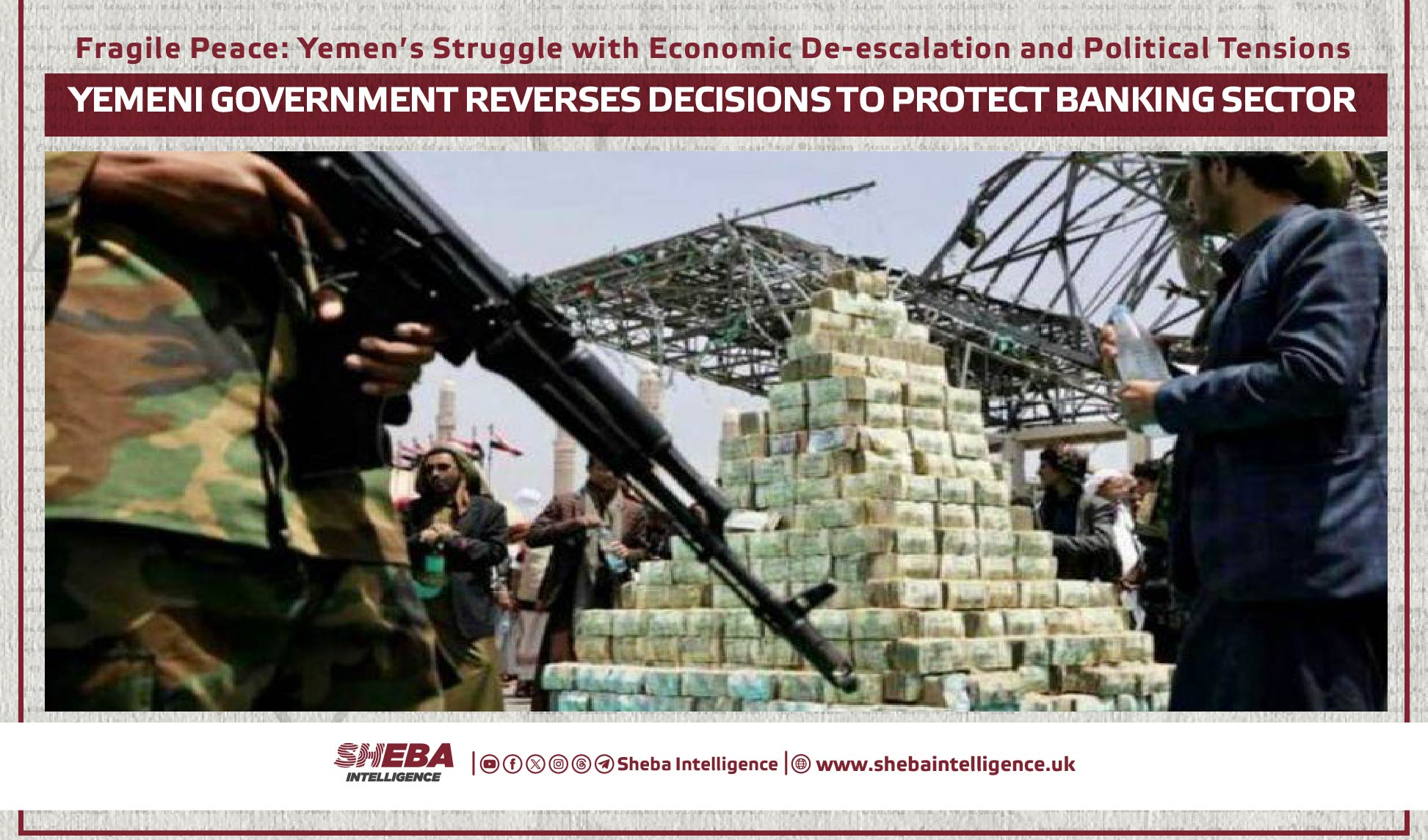
In response to ongoing threats from the Houthis targeting both the Yemeni government and Saudi Arabia, the internationally recognized Yemeni government has decided to reverse recent decisions made by the Central Bank of Yemen. These decisions, aimed at regaining control over the country’s banking sector, had prompted concerns of military escalation. Acting on the request of the UN Special Envoy for Yemen, the Yemeni government has agreed to rescind these measures and engage into negotiations with the Houthis.
Parallel War Led by the Central Bank
On May 30th, the Central Bank of Yemen in Aden, declared the temporary capital of the country, issued a decision to suspend transactions with six Yemeni banks and financial institutions located in areas under Houthi control, after the expiration of a 60-day deadline for them to relocate their headquarters to Aden. Additionally, the bank issued another directive urging all individuals, commercial establishments, companies, other entities, and financial institutions holding old paper currency, pre-2016 issue year of various denominations, to deposit it within 60 days from the announcement date. The Central Bank also revoked the licenses of 26 exchange companies and ordered the indefinite closure of their branches due to violations of the bank's regulations and instructions.
These decisions followed two previous resolutions mandating a unified internal remittance network, banning dealings with 12 unlicensed electronic payment entities, and permanently halting operations in local financial transfer networks owned by banks, financial institutions, or exchange companies operating in Yemen. All these measures constituted a parallel war on the economic front in Yemen, with the Yemeni government attempting to gain an advantage over the Ansar Allah Houthi group, who have been threatening to resume their military operations.
A Retreat Without a Price
In a surprising move, the Yemeni government announced its acceptance of the UN Secretary-General's envoy's call to reverse all recent decisions. In a statement, the government said it "welcomes the contents of the UN special envoy's announcement regarding the cancellation of recent decisions against several banks and the banking sector, the resumption of flights through Sana'a International Airport, and the facilitation of flights to other destinations including Amman, Cairo and Mumbai airports as needed."
This reversal appears to come without any conditions, not even the stipulation of resuming oil exports, which the Houthis have blocked by threatening ports with missiles. The legitimate government did not demand oil exportation in exchange for canceling its decisions. Instead, the reversal seems to be a prelude to dialogue sessions on economic and humanitarian issues. The Yemeni government hopes this will "create the atmosphere for a constructive dialogue to end all destructive practices against the banking sector, the economy, and the national currency as well."
The government's decision has sparked public outrage, particularly in areas under legitimate government control, as the currency continues to deteriorate and become more divided after the Houthis imposed a specific value on the old currency. The public was expecting a unification of the currency in exchange for the government's retreat on the pressure from its decisions. However, in its statement, the government claimed that its economic reforms were aimed at protecting the state's legal status, enabling the Central Bank of Yemen to exercise its exclusive rights in managing monetary policy, protecting the banking sector and depositors, and mitigating the catastrophic consequences of halted oil exports on the national currency and the most vulnerable groups across the country. The government's decision to reverse its policies was made "to avoid subjecting the Yemeni people in areas forcibly controlled by Houthi militias to further living burdens and to enable them to travel." The government did not respond to accusations that it reversed its decision due to external pressure, rendering it "devoid of decision-making power."
In a related incident, the political parties issued a statement in mid-month warning that "any reversal of the decisions made by the Central Bank and the Presidential Leadership Council will have severe consequences for the state's legal standing. It will not only deprive the state of its strategic sources of power but also strip the legitimate authority of its constitutional, legal, political, popular, and moral legitimacy. Such reversal will lead the country, its people, and its government towards uncertainty, perpetuate the coup and the war, and leave harmful effects that may be difficult to address in the future," the political elites added in their statement.
Economic Problems and Their Complications
The Houthis issued a statement summarizing the agreement, which includes several key provisions. According to Houthi spokesperson Mohammed Abdul Salam, the agreement entails: "the cancellation of recent decisions and measures against banks by both parties, with a commitment to refrain from similar actions in the future; resuming Yemenia Airways flights between Sana’a and Jordan, increasing the number of flights to three daily, and operating flights to Cairo and India daily or as needed; conducting meetings to address the administrative, technical, and financial challenges faced by the company; and initiating discussions on all economic and humanitarian issues based on the roadmap."
Despite this, the majority of Yemenis remain skeptical about the agreement's potential to resolve pressing economic issues, such as currency re-unification, resuming oil exports, and addressing salary payments. The persistent economic divide and ongoing military mobilization indicate that the possibility of further collapse in the banking sector and Yemeni currency, as well as deteriorating living conditions for citizens, remains high. According to the office of UN Special Envoy for Yemen Hans Grundberg, on Tuesday, July 23, 2024, the agreement between the internationally recognized Yemeni government and the Houthi group is part of measures to de-escalate tensions concerning the banking sector and Yemenia Airways.
However, in a statement to the UN Security Council during the open session on the situation in the Middle East (Yemen), Yemen's ambassador, Abdullah Al-Sa’adi, stated, "Since June 25, 2024, the Houthi militias have been holding four Yemenia Airways aircraft and their crews and freezing the company's accounts, which exceed $100 million, since March 2023." He expressed the government's regret over the stalled negotiations on the file of prisoners and detainees, which recently took place in the neighboring Sultanate of Oman, and the missed opportunities for any exchange during this round.
Al-Saa’di further accused the Houthis of "bringing in external interventions, continuing their destructive approach, various forms of violence, military escalation, and their insistence on thwarting peace efforts, prolonging the war in Yemen and the region, and endangering regional and international security and peace." He warned against resorting to a full-scale escalation and reverting the situation to square one, which would exacerbate the prolonged humanitarian suffering, destroy what remains of the inadequate living resources for the Yemeni people, and squander regional and international efforts to end the war and restore the path of peace, stability, and development.
While the agreement between the legitimate Yemeni government and the Houthis marks a step towards de-escalation, the challenges ahead remain significant. The deep-rooted economic divisions, ongoing military mobilization, and lack of durable and sustainable solutions to economic problems, all highlight the fragile nature of this progress.