
Popular Movements in Aden and Hadramout May Alter the Political Landscape in Southern Yemen
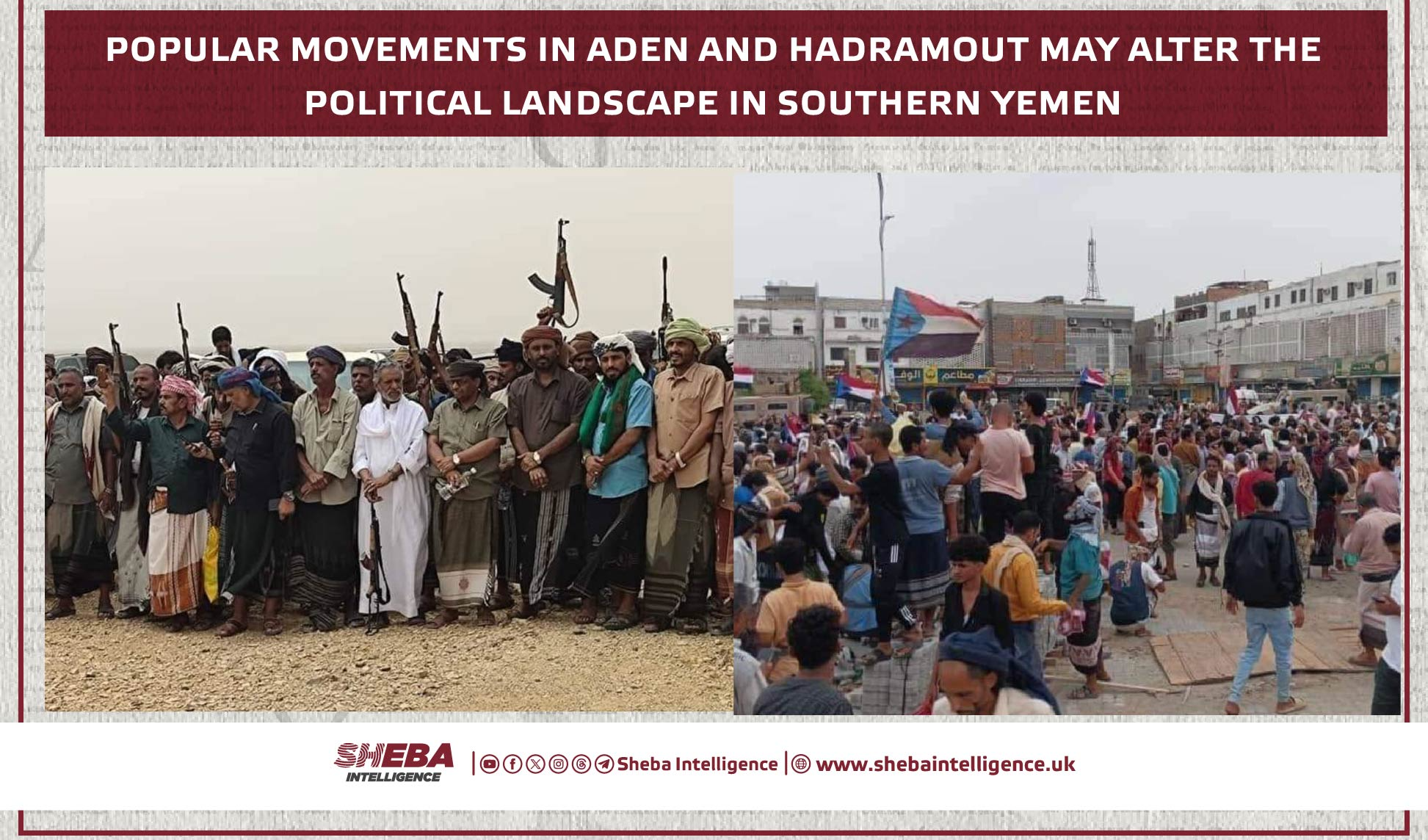
Recent popular protests in the provinces of Aden and Hadramout indicate escalating tensions in these critical southern and eastern regions, which are currently entangled in a political conflict over control of power and resources.
Aden: Abduction of Officer Sparks Potential Uprising
In Aden, demonstrators from various provinces protested against the abduction of army officer and tribal leader Ali Ashal Al-Ja’dani from Abyan province. The incident allegedly involved counterterrorism forces in Aden. Protesters demanded information on the whereabouts of Al-Ja’dani and other activists, journalists, and individuals reportedly detained in prisons controlled by the UAE-backed Southern Transitional Council (STC). The STC has governed Aden, designated as the temporary capital by the Yemeni government, since August 2019.
Reports on social media and video footage depict protesters breaking through barriers established by STC forces, who had been deployed to reinforce military checkpoints and prevent demonstrations. In response, the forces fired live ammunition, causing injuries. Despite this, protesters succeeded in reaching the Parades Square in Aden.
Aidarous Al-Zubaidi, leader of the STC and Vice President of the Presidential Leadership Council, instructed security authorities in Aden to allow the protests to proceed peacefully, ensuring the protection and safety of demonstrators while maintaining stability in the capital. Conversely, Mohammed Haidara Massdous, a founder of the Southern Movement advocating for secession, criticized the politicization of Al-Ja’dani's abduction, asserting that regional incitement could lead to the division of the south. Masdous emphasized that the case of Ali Ashal Al-Ja’dani should be considered a criminal matter.
However, southern leader Azal Omar Al-Jawi, an opponent of secession, considered the suppression of the popular event condemning the abduction of the Yemeni officer as potentially sparking a youthful revolution that could change the face of Aden in the coming days. Al-Jawi added in a post on his X account, "The STC's suppression of the Ashal event reveals that it supports the crime, exposing its true nature. He emphasized that this is a political assassination and enforced disappearance, not an isolated, spontaneous criminal act."
Meanwhile, the head of the Supreme Security and Military Committee, Defense Minister Mohsen Al-Da’iri, disclosed that security agencies in Aden had obtained important information about the circumstances surrounding the abduction of the military officer, Lieutenant Colonel Ali Ashal Al-Ja’dani. In a briefing to the Cabinet during its meeting yesterday, he discussed the actions taken by security agencies to identify and apprehend the perpetrators and to free the abducted officer. He confirmed that "important information has been obtained and will be disclosed to the public in a press conference in the coming days."
Lieutenant Colonel Ali Ashal Al-Ja’dani was abducted on June 12 from the Technical District in Aden. The security committee in Aden issued statements confirming the involvement of Yasran Al-Maqtari, the leader of the so-called Counterterrorism Forces affiliated with the Southern Transitional Council, in the crime. The committee called for his arrest and requested Interpol to apprehend him as he has left Yemen.
Hadramout: Tribes Threaten Control Over Oil Resources
In Hadramout, a significant gathering of armed members of the Hadramout Tribal Alliance took place on Friday, in front of the region's oil companies. This demonstration followed the expiration of a deadline set by the alliance, demanding political and economic concessions for the residents of Hadramout.
The Hadramout Tribal Alliance, in a brief statement on Facebook, announced that its leader, Sheikh Omar bin Habrish, had initiated the first assembly of the alliance's members. He issued a warning that the alliance might take control of the province's oil resources if their demands were not met. The tribes are seeking what they describe as a "genuine and effective partnership," alongside the recognition of the Hadramout Inclusive Conference, in line with other parties involved in the anticipated political settlement. The alliance cautioned against any actions related to Hadramout oil, such as its export or marketing, without first securing the region's status and ensuring the rights of its people. They stressed the importance of implementing the decisions made by the Hadramout Inclusive Conference, dated July 13, 2024.
The alliance asserts that the current oil stock in the storage tanks at Dabba and Masila ports is a rightful asset of Hadramout. They demand that it be entirely used to fund electricity for the region. Hadramout produces approximately 100,000 barrels of oil per day from the Masila field, managed by the state-owned company PetroMasila. This production currently represents Yemen's total crude oil output, following the suspension of exports from several other sectors. The Hadramout tribes’ threats coincide with reports that the internationally recognized Yemeni government is preparing to resume crude oil exports from Hadramout in the coming days. This resumption follows nearly two years of suspension, which resulted in an estimated $2 billion loss to the public treasury, due to Houthi attacks on the oil export port in Dabba, Hadramout.