
Sudan 2025: From Battlefield Gains to the Risk of State Fragmentation
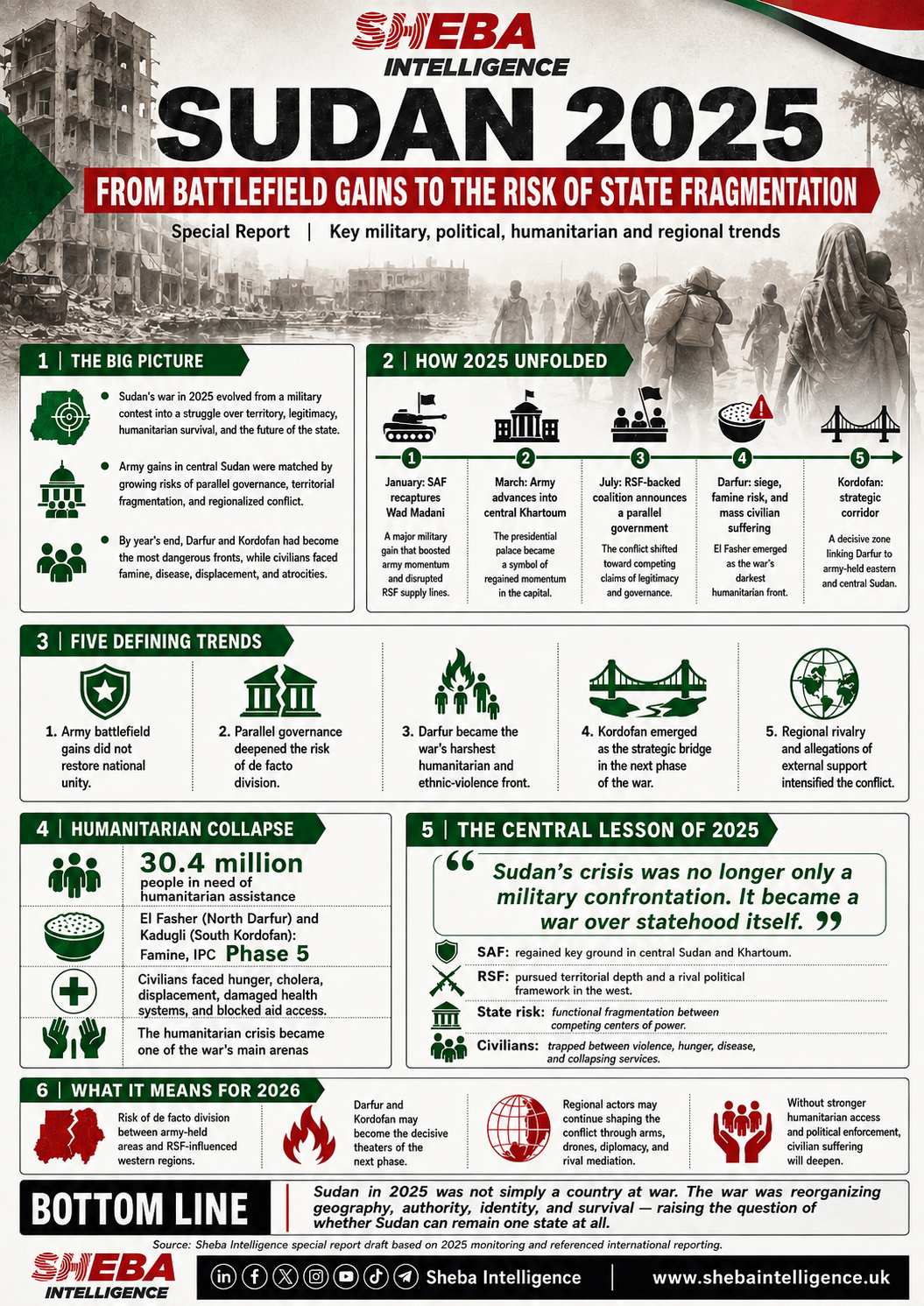
Sudan’s war in 2025 moved beyond a contest for military control. It became a struggle over territory, legitimacy, humanitarian survival, regional influence, and the future shape of the Sudanese state.
At the beginning of the year, the Sudanese Armed Forces appeared to regain momentum, recapturing Wad Madani and later advancing into central Khartoum. By mid-year, however, the Rapid Support Forces and allied factions had moved toward formalizing a rival political authority, raising the prospect of two competing centers of power. By the final months of the year, Darfur and Kordofan had become the war’s most dangerous theaters, while famine, cholera, displacement, and atrocities against civilians turned Sudan into one of the world’s gravest emergencies.
The central lesson of 2025 was clear: Sudan’s crisis was no longer only a military confrontation between two armed camps. It had become a war over statehood itself.
The First Quarter: The Army Regains Ground
The year opened with a major battlefield shift. In January 2025, the Sudanese army recaptured Wad Madani, the capital of Gezira state, from the Rapid Support Forces. The city’s recovery boosted army morale, disrupted RSF supply lines, and marked one of the SAF’s most important gains since the war began in April 2023. (Reuters)
The momentum continued in March. The army said it had regained control of the presidential palace in central Khartoum, a symbolic and strategic victory after nearly two years of war. The advance suggested that the SAF had reasserted itself in the political heart of the country, even as the conflict remained far from resolved. (Reuters)
Yet the army’s gains did not restore Sudan’s unity or stability. While the SAF recovered key positions in central Sudan, the RSF retained influence in large parts of Darfur and continued to operate as a powerful military and political actor. The result was a paradox: the army regained ground in the center, but the war was already moving toward a broader territorial and institutional split.
Parallel Governance: Legitimacy Becomes a Battlefield
As the army advanced in central Sudan, the RSF and allied political and armed groups sought to create an alternative political framework.
In July 2025, a coalition led by the RSF announced a parallel government, a move Reuters reported could push Sudan further toward de facto division. The step transformed the conflict from a battle over military sites into a contest over who had the right to claim legitimacy and speak for Sudan. (Reuters)
This development marked one of the most dangerous political shifts of the year. Sudan was no longer facing only two rival armed forces. It was facing the emergence of competing governing claims: one based around the army-held center and east, and another linked to RSF-controlled or RSF-influenced areas, especially in the west.
The creation of a rival authority did not necessarily mean immediate formal partition. But it deepened the risk of functional fragmentation: separate chains of command, competing institutions, rival diplomatic narratives, and different zones of military and administrative control.
Darfur: The War’s Darkest Front
Darfur remained the most dangerous theater of Sudan’s war in 2025.
El Fasher, the capital of North Darfur and one of the last major army-aligned strongholds in the region, became a focal point of siege, famine risk, and mass civilian suffering. The struggle for Darfur was not only military. It combined ethnic violence, displacement, hunger, blocked aid, and competing claims over the future of western Sudan.
The humanitarian situation in Darfur deteriorated sharply. IPC reporting showed that El Fasher was among the areas facing the most severe food insecurity conditions, with famine-level risks linked to siege, conflict, and restricted humanitarian access. (ipcinfo.org)
Darfur also carried broader political significance. The RSF’s western strongholds gave it territorial depth, while the conflict’s ethnic and humanitarian dimensions made the region central to international concern. By the end of the year, Darfur had become not only a battlefield, but a possible foundation for a rival political geography.
Kordofan: The War’s Strategic Corridor
As the year progressed, Kordofan emerged as one of the most important fronts in Sudan’s war.
The region sits between Darfur, where the RSF holds major influence, and the army-held east and center. This geography makes Kordofan a strategic corridor: whoever controls it can shape the connection between Sudan’s western battlefields and the rest of the country.
Kordofan also gained political importance because of its links to armed movements and local power structures. The involvement of Abdelaziz al-Hilu’s SPLM-N in the wider anti-army alignment gave the region added weight in the conflict’s political trajectory. A December 2025 country report noted that, in July, RSF leader Mohamed Hamdan Dagalo was named chairman of the parallel government, while Abdelaziz al-Hilu was named vice-chairman. (Government.nl)
By late 2025, Kordofan was no longer a secondary front. It had become a bridge between military geography and political fragmentation — a zone where the next phase of the war could determine whether Sudan remains a unified state or slides further into territorial division.
Humanitarian Collapse: Hunger, Disease, and Displacement
Sudan’s humanitarian crisis in 2025 reached catastrophic levels.
The UN’s 2025 humanitarian plan estimated that 30.4 million people — more than half of Sudan’s population — needed assistance during the year. (ReliefWeb)
Food insecurity became one of the defining features of the crisis. IPC analysis reported that, as of September 2025, El Fasher in North Darfur and Kadugli in South Kordofan were classified in Famine, IPC Phase 5, with conditions expected to persist into early 2026. (ipcinfo.org)
The crisis was not limited to hunger. Conflict, displacement, damaged health systems, poor water access, and collapsing public services created conditions for disease outbreaks and rising mortality. For millions of Sudanese, survival depended on informal networks, displacement routes, limited aid, and the ability to escape besieged or contested areas.
Sudan’s humanitarian emergency therefore became more than a consequence of war. It became one of the war’s main arenas: access to food, aid, medicine, roads, and safe zones became part of the struggle over civilian survival.
The Regional Dimension: Allegations, Arms, and Diplomatic Rivalries
Sudan’s war in 2025 became increasingly regionalized.
One of the most sensitive issues was the accusation by Sudanese authorities that the United Arab Emirates had supported the RSF — allegations Abu Dhabi has denied. Sudan brought a case against the UAE at the International Court of Justice, but in May 2025 the court said it lacked jurisdiction and removed the case from its docket. The ruling did not decide the merits of Sudan’s allegations; it dismissed the case on jurisdictional grounds. (Reuters)
Regional involvement also appeared through allegations of arms flows, drone warfare, diplomatic pressure, and competing mediation efforts. For Sudan, this meant the war was no longer only an internal struggle between the army and the RSF. It had become part of a broader regional contest over influence in the Red Sea, the Horn of Africa, the Sahel, and the Nile Valley.
This regionalization complicated any path to settlement. As long as external actors influence the calculations of local forces, ceasefire proposals remain vulnerable to battlefield ambitions, diplomatic rivalry, and the belief among the parties that military gains can still improve their negotiating position.
Diplomacy Without Enforcement
Despite repeated diplomatic initiatives, 2025 did not produce a durable ceasefire.
The problem was not the absence of proposals. Sudan had multiple diplomatic tracks and repeated calls for humanitarian pauses. The problem was the absence of enforcement, trust, and a political framework strong enough to force both sides into meaningful compromise.
Each side continued to calculate that the battlefield could improve its political position. The army’s gains in central Sudan strengthened its belief that it could recover more territory. The RSF’s move toward parallel governance suggested that it was preparing for long-term political leverage, not merely military survival.
In this environment, diplomacy remained reactive. It responded to battlefield developments, humanitarian shocks, and international pressure, but it did not yet define the course of the war.
The Central Lesson of 2025
The most important conclusion from Sudan’s 2025 trajectory is that the war moved from a contest over control to a contest over statehood.
The army regained important ground in central Sudan and Khartoum. The RSF and its allies deepened their political project in the west. Darfur became the war’s darkest humanitarian front. Kordofan emerged as a strategic corridor. The humanitarian system struggled to match the scale of need. Regional involvement became more visible and more contested.
Sudan therefore entered the end of 2025 not as a country moving toward resolution, but as a state at risk of functional fragmentation.
One authority claimed legitimacy from the army-held center and east. Another sought legitimacy through territory, armed control, and parallel governance in the west. Between them stood millions of civilians facing hunger, disease, displacement, violence, and the collapse of public services.
What 2025 Means for 2026
Sudan enters 2026 with four major risks.
First, the war may harden into a de facto division between army-held areas and RSF-controlled or RSF-influenced western regions.
Second, Darfur and Kordofan may become the decisive theaters of the next phase, with famine, siege tactics, displacement, and atrocities worsening as military pressure grows.
Third, regional actors may continue to shape the conflict through arms, drones, diplomatic protection, financial networks, and competing mediation channels.
Fourth, the humanitarian system may remain unable to meet needs at the required scale, especially if access remains blocked, funding remains insufficient, and civilians continue to be trapped between rival military zones.
For Sheba Intelligence readers, the essential picture is this: Sudan in 2025 was not simply a country at war. It was a country whose war was reorganizing geography, authority, identity, and survival.
The question for 2026 is therefore not only who wins the battlefield. It is whether Sudan can remain one state at all.