
Yemen’s Digital Revolt Against the Houthis Revives the Battle Over Identity and the State
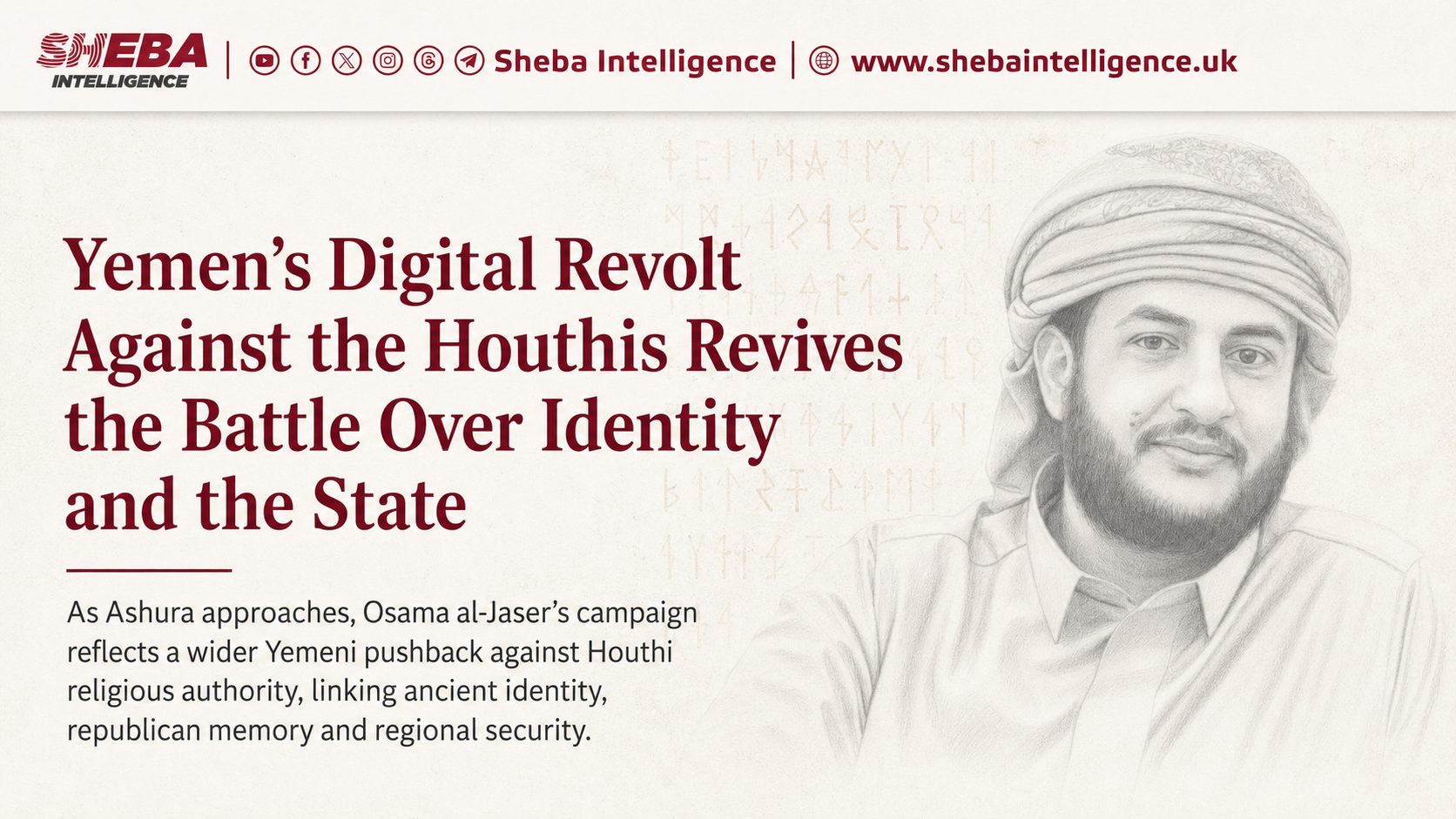
A social media campaign led by Yemeni writer and activist Osama al-Jaser has moved beyond a personal online dispute. It has become part of a wider Yemeni debate over religion, memory, Houthi rule and the meaning of the state after more than a decade of war.
The campaign comes as Ashura approaches, a moment the Houthis regularly use to reinforce their political and religious narrative. For the group, Ashura is not only a religious occasion. It is also a platform for mobilization, ideological discipline and alignment with Iran’s regional axis through the language of martyrdom, grievance and resistance.
Al-Jaser’s campaign challenges that narrative in a direct and popular style. His language is often sharp and confrontational, but the response around it shows that the issue is larger than one writer’s tone. Many Yemenis see the campaign as a symbolic rejection of the Houthi attempt to reshape Yemen’s identity around lineage, sectarian authority and revolutionary mythology.
At the center of this debate is memory. For many Yemenis, the defining political reference is not Karbala, but September 26, 1962 — the republican revolution that ended the Imamate in North Yemen and became a symbol of liberation from hereditary rule. In this reading, the Houthis are not viewed only as an armed movement born from the current war, but as a modern expression of an older struggle over power, legitimacy and the state.
This republican memory is now merging with a broader cultural revival. Many Yemenis are increasingly returning to the symbols of ancient South Arabia — Saba, Himyar and the Musnad script — as signs of national pride and historical continuity. Ancient Yemeni letters are now seen on clothing, home decorations, jewelry, social media profiles and cultural products. The trend reflects more than aesthetics. It shows a growing desire to reconnect with a Yemeni identity older than the Imamate, older than today’s factions and wider than the sectarian narratives produced by war.
For many, Saba and Himyar represent a lost civilizational memory: kingdoms, inscriptions, trade networks and political traditions that once made Yemen a major center in the ancient world. Their revival today carries a political message: Yemen’s identity cannot be reduced to dynastic claims, religious grievance or militia power.
This shift has also been reinforced by intellectual voices such as Yemeni researcher Abdulmalik al-Hadhouri, who has focused on the historical and doctrinal roots of the Imamate, the Rassid legacy and the ideological foundations that later shaped Houthi political thought. His discourse places the current conflict within a longer historical frame, while al-Jaser’s campaign translates that rejection into popular digital language. Together, they point to a new phase in Yemeni public awareness: a move from rejecting Houthi rule politically to questioning the historical narratives that justify it.
The campaign has also gained weight because signs of frustration are not limited to Yemenis outside Houthi-controlled areas. A message attributed to a young man from Sana’a suggested that some youth had been influenced by Houthi narratives around Ahl al-Bayt and the revolution of Hussein before reconsidering those ideas. The message indicates a quiet struggle inside Houthi-held society over religion, identity and historical interpretation.
Another striking signal came from Dr. Ibrahim Ismail al-Kibsi, a figure associated with the Hashemite social environment and previously seen by some as close to Houthi circles. In a recent post, he criticized Houthi leaders for living in comfort while most people sink into poverty and debt. The importance of this criticism lies in its source. Anger at the Houthis is no longer confined to their traditional opponents. It is increasingly emerging from social spaces the group has long tried to claim as part of its natural base.
These signals do not mean a popular uprising is imminent. But they suggest that the moral and social shield built by the Houthis through religion, fear and claims of historic grievance is facing growing pressure.
The wider context remains Yemen’s unresolved war. The Houthis control large parts of northern Yemen and continue to present themselves as a regional force capable of threatening Saudi Arabia, Gulf states, Israel and international shipping in the Red Sea and Bab al-Mandab. This makes the battle over identity and symbols more than a cultural debate. The group’s ability to mobilize society at home strengthens its ability to project power beyond Yemen.
Al-Jaser’s campaign should therefore be understood as part of a wider digital pushback against Houthi ideological control. It seeks to strip the movement of sacred language and return the Yemeni debate to questions of citizenship, poverty, power and the state. Its strength lies in its ability to touch a deep emotional layer among Yemenis exhausted by war, inequality and religious manipulation.
In the end, the campaign reveals a country still fighting over the meaning of itself. The Houthis are trying to anchor Yemen in a narrative of divine right, martyrdom and regional resistance. Their opponents are reviving ancient Yemeni pride, republican memory and the dream of a national state. Between these two visions lies one of the central questions of Yemen’s war: will the country remain trapped in the politics of lineage and armed ideology, or will it rebuild a state that belongs to all Yemenis and contributes to regional stability?