
Exclusive: IRGC-Linked Technical Cell Reviews Relocation of Houthi Missile and Drone Sites
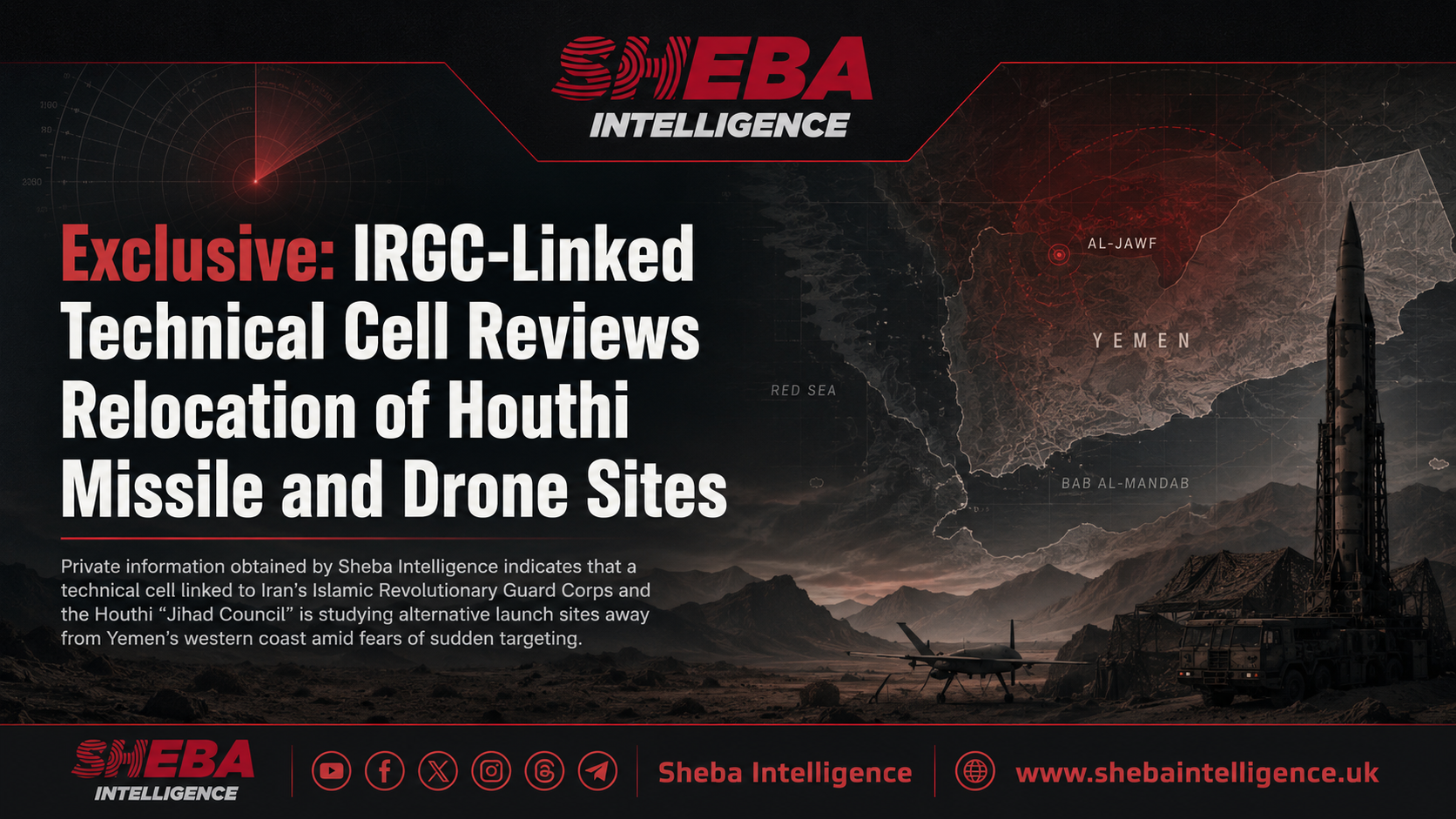
Exclusive information obtained by Sheba Intelligence indicates that a technical cell linked to Iran’s Islamic Revolutionary Guard Corps and the Houthi “Jihad Council” is studying alternative launch sites away from Yemen’s western coast amid fears of sudden targeting.
Sheba Intelligence has obtained private information indicating that a so-called “technical cell” linked to Iran’s Islamic Revolutionary Guard Corps and the Houthi “Jihad Council” has been operating in Al-Jawf governorate to study the relocation or redistribution of some Houthi missile and drone centers from the western coast and Hodeidah.
According to information received on June 20, the cell is reviewing alternative mountainous and desert locations in Al-Jawf and other areas, with the aim of preparing hardened underground operations rooms that could serve as alternative launch platforms in the event of future long-range strikes.
The reported task of the team includes assessing potential sites, verifying the technical readiness of ballistic missile systems, inspecting navigation and guidance systems, and evaluating whether alternative launch locations can provide greater flexibility and protection against sudden targeting.
The review appears to reflect Houthi concern that missile and drone infrastructure near the western coast and Hodeidah could become vulnerable in the event of renewed regional or maritime escalation.
This development is significant because it suggests that the Houthi movement is not only mobilizing manpower, but also reviewing the survivability of its strategic weapons infrastructure. The relocation review points to an attempt to preserve long-range strike capabilities even if coastal positions come under pressure.
The timing is also important. Yemen’s western coast, the Red Sea and the Bab al-Mandab Strait remain central to regional security calculations. Even when direct attacks decline, Houthi missile and drone capabilities continue to shape the risk environment for commercial shipping, regional security forces and Yemen’s internationally recognized government.
Sheba Intelligence assesses that the reported technical review may indicate preparation for multiple scenarios: avoiding sudden strikes, expanding launch flexibility, reducing dependence on coastal locations, and preserving the group’s ability to influence maritime and border security.
The reported presence of an IRGC-linked technical track also reinforces the regional dimension of the Houthi file. The group’s missile and drone capabilities cannot be separated from Iran’s wider network of allied armed actors, especially as U.S.-Iran negotiations and regional de-escalation efforts continue to shape the broader Middle East security environment.
Any limited understanding between Washington and Tehran may reduce some direct confrontation risks, but it may not fully address the role of Iran-aligned armed groups or their missile, drone and maritime pressure tools.
For Yemen, this means that the Houthi military file remains connected to the regional equation. The group’s location along the Red Sea, its missile and drone capabilities, and its ability to affect the Bab al-Mandab Strait and the Gulf of Aden make it a central actor in any future escalation or de-escalation involving Iran, the United States and regional powers.
The reported relocation review does not necessarily mean that a major attack is imminent. However, it does suggest that the Houthis are preparing for a more complex security environment in which missile and drone infrastructure must be protected, redistributed and kept operational under pressure.
For the internationally recognized Yemeni government and its allies, the development raises concerns that Houthi military preparations are moving beyond frontline mobilization into strategic repositioning. The risk extends from Yemen’s internal frontlines to border areas, maritime approaches and the Red Sea security equation.
In this context, the reported technical cell represents a sensitive warning indicator. It points to a possible effort to build alternative strike infrastructure away from exposed coastal areas, while preserving the group’s ability to threaten long-range targets and influence maritime security around Bab al-Mandab and the Gulf of Aden.