
Iran Flight to Sana’a Triggers Regional Escalation as Coalition Warns Houthis
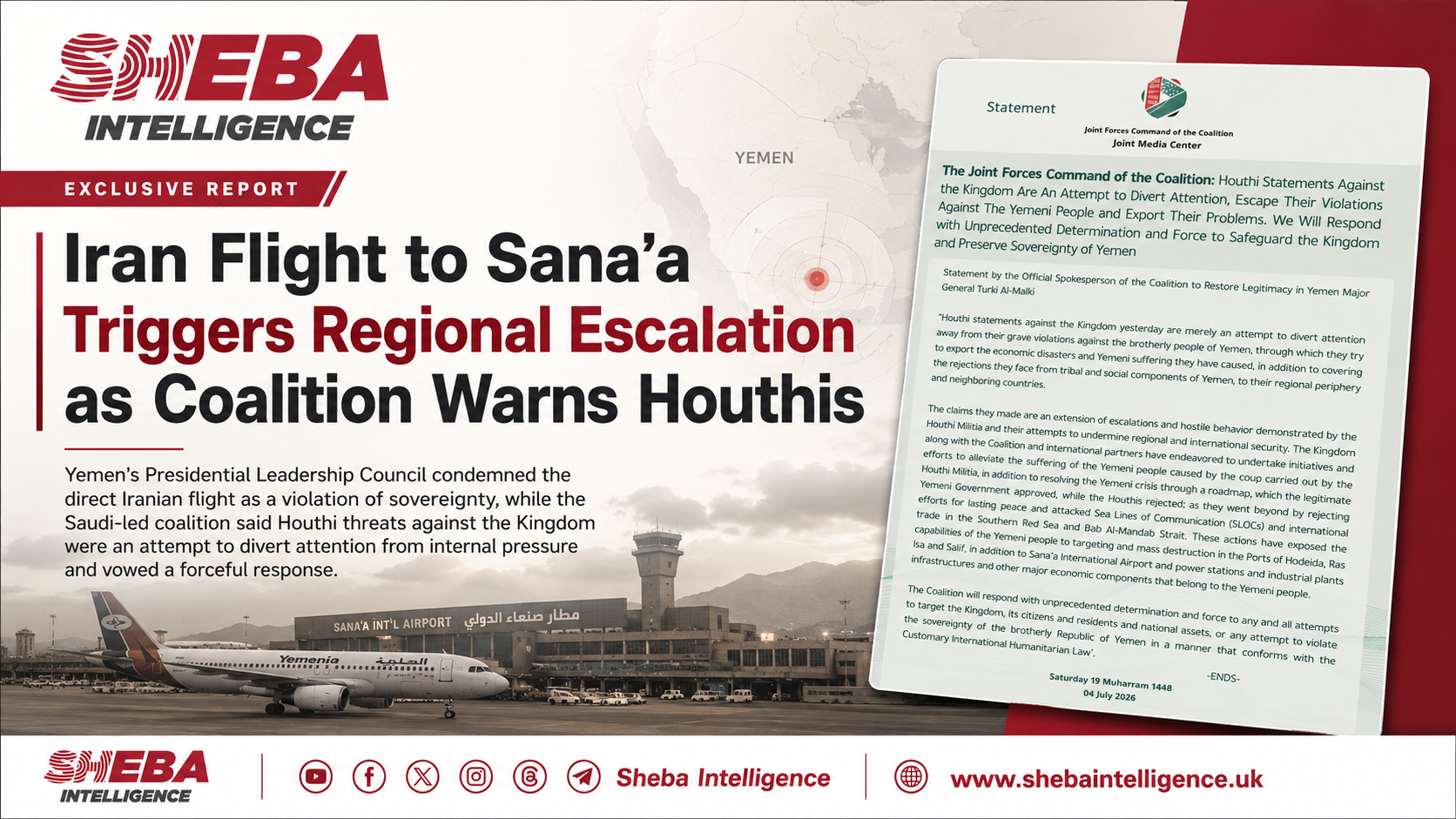
Yemen’s Presidential Leadership Council condemned the direct Iranian flight as a violation of sovereignty, while the Saudi-led coalition said Houthi threats against the Kingdom were an attempt to divert attention from the group’s internal pressures and violations in Yemen.
The direct Iranian flight to Houthi-held Sana’a Airport has triggered a new round of political and military escalation, after Yemen’s Presidential Leadership Council condemned the move as a violation of national sovereignty and the Saudi-led coalition warned the Houthis against targeting the Kingdom or undermining Yemen’s sovereignty.
The escalation began after an Iranian aircraft landed at Sana’a International Airport, which remains under Houthi control and outside the authority of Yemen’s internationally recognized government. The Houthis said the aircraft carried stranded civilians, wounded people, patients and a delegation returning from Iran. However, Yemeni political and security sources view the flight as a highly sensitive development because of the strategic role of the airport and the absence of independent government or international inspection.
Yemen’s Presidential Leadership Council held an emergency meeting in Riyadh, chaired by President Rashad Mohammed al-Alimi and attended by all council members, to discuss what it described as a flagrant Iranian violation of Yemen’s sovereignty. The council said the direct flight represented a serious challenge to international law and relevant UN Security Council resolutions, warning that using Yemeni airports outside state authority threatens Yemen’s sovereignty as well as regional and international security.
The council said the incident confirmed, once again, the Houthis’ full alignment with Iran’s regional project and their use of state institutions and entry points to serve an external agenda that undermines Yemen’s security and stability. It also called on the United Nations, the Security Council and regional and international partners to move beyond condemnation and take deterrent measures to stop Iranian violations and tighten oversight of channels used to support, arm and finance the Houthis.
The Houthis responded by escalating their rhetoric against Saudi Arabia. In a military statement, the group claimed that Saudi warplanes had attempted to prevent the Iranian aircraft from landing in Sana’a and said Houthi air defenses forced them to leave Yemeni airspace. The group threatened what it called a “comprehensive response” targeting Saudi airports and vital land and maritime interests if similar actions are repeated.
The first public response from the Saudi-led coalition came through a statement issued by the Joint Forces Command of the Coalition to Restore Legitimacy in Yemen. Coalition spokesperson Major General Turki al-Maliki said Houthi statements against the Kingdom were an attempt to divert attention from what he described as the group’s grave violations against the Yemeni people, and an effort to export the economic disasters and suffering caused by the Houthis to Yemen’s regional surroundings and neighboring countries.
The coalition statement said the Houthi claims were part of a broader pattern of escalation and hostile behavior aimed at undermining regional and international security. It said the Kingdom, the coalition and international partners had worked to support initiatives aimed at easing the suffering of Yemenis and resolving the crisis through a roadmap approved by the legitimate Yemeni government, but rejected by the Houthis.
The statement also linked Houthi behavior to attacks on sea lines of communication and international trade in the southern Red Sea and Bab al-Mandab Strait. It said such actions exposed Yemeni national assets to targeting and destruction, including ports, Sana’a International Airport, power stations, industrial facilities and other economic infrastructure belonging to the Yemeni people.
The coalition said it would respond with “unprecedented determination and force” to any attempt to target the Kingdom, its citizens, residents or national assets, or to violate the sovereignty of Yemen, in accordance with international humanitarian law.
The significance of the coalition’s response lies in the way it connects Houthi threats against Saudi Arabia with the group’s internal pressures inside Yemen. The statement referred to tribal and social rejection inside Yemen, a point that intersects with the current crisis in Al-Rayyan, Al-Jawf, where tribal mobilization has become one of the most sensitive domestic challenges facing the Houthis.
Direct Iran–Sana’a flights carry a special sensitivity in Yemen’s war memory. In March 2015, the first direct Iranian flight landed in Houthi-held Sana’a after an aviation agreement between Tehran and the authorities then controlling the capital. At the time, the flight was presented as carrying medical aid and an Iranian Red Crescent team, while reports spoke of arrangements for regular flights between the two countries.
Only weeks later, on March 26, 2015, the Saudi-led coalition launched Operation Decisive Storm after the Houthi takeover of Sana’a and the collapse of the political transition. This sequence gives renewed Iran–Sana’a flights particular security weight in Yemeni and Gulf calculations, especially because political and humanitarian cover has long been viewed by the Yemeni government and regional actors as a possible gateway for deeper Iranian military, technical and advisory involvement.
The legal and security context is equally important. UN Security Council Resolution 2216 imposed a targeted arms embargo related to Yemen, and the sanctions framework has remained a central reference point in debates over arms flows to the Houthis. Any direct flight to an airport outside the control of the recognized government therefore raises concerns that go beyond the declared humanitarian purpose.
Sheba Intelligence previously reported that information surrounding the Iranian flight raised concerns over the possible transfer of experts and sensitive equipment to the Houthis. According to those concerns, equipment was reportedly unloaded after the aircraft arrived in Sana’a, while dozens of specialists were believed to have arrived and other experts reportedly departed with the delegation.
These concerns include the possible movement of experts, sensitive equipment, dual-use components, or military-related technology linked to drones and missiles. Some sources have also raised unverified concerns about more sensitive materials, including possible biological-related items or equipment. Sheba Intelligence treats these claims strictly as unconfirmed security concerns, not established facts, in the absence of physical evidence or independent inspection of the aircraft, cargo and passengers.
The aviation dispute also comes as the Houthis face an internal tribal crisis in Al-Rayyan, Al-Jawf, over the case of Mira Saddam. Tribal groups gathered in Al-Rayyan have demanded that the Houthis reveal her fate and hand her over. This internal pressure gives the current escalation a broader meaning: the Houthis appear to be facing both an external confrontation track with Saudi Arabia and the coalition, and an internal tribal challenge that could expand if not contained.
The next phase will depend on whether Iran–Sana’a flights continue, whether the coalition’s warning leads to additional security measures, and whether the Houthis use the regional escalation to cover internal military moves in Al-Jawf and Marib. If these tracks escalate at the same time, Yemen may face a new confrontation linking aviation sovereignty, Iranian influence, Red Sea security and internal tribal unrest.