
Yemeni Government Steps Up Political and Military Response After Iranian Flight to Sanaa and Houthi Escalation in Al-Jawf
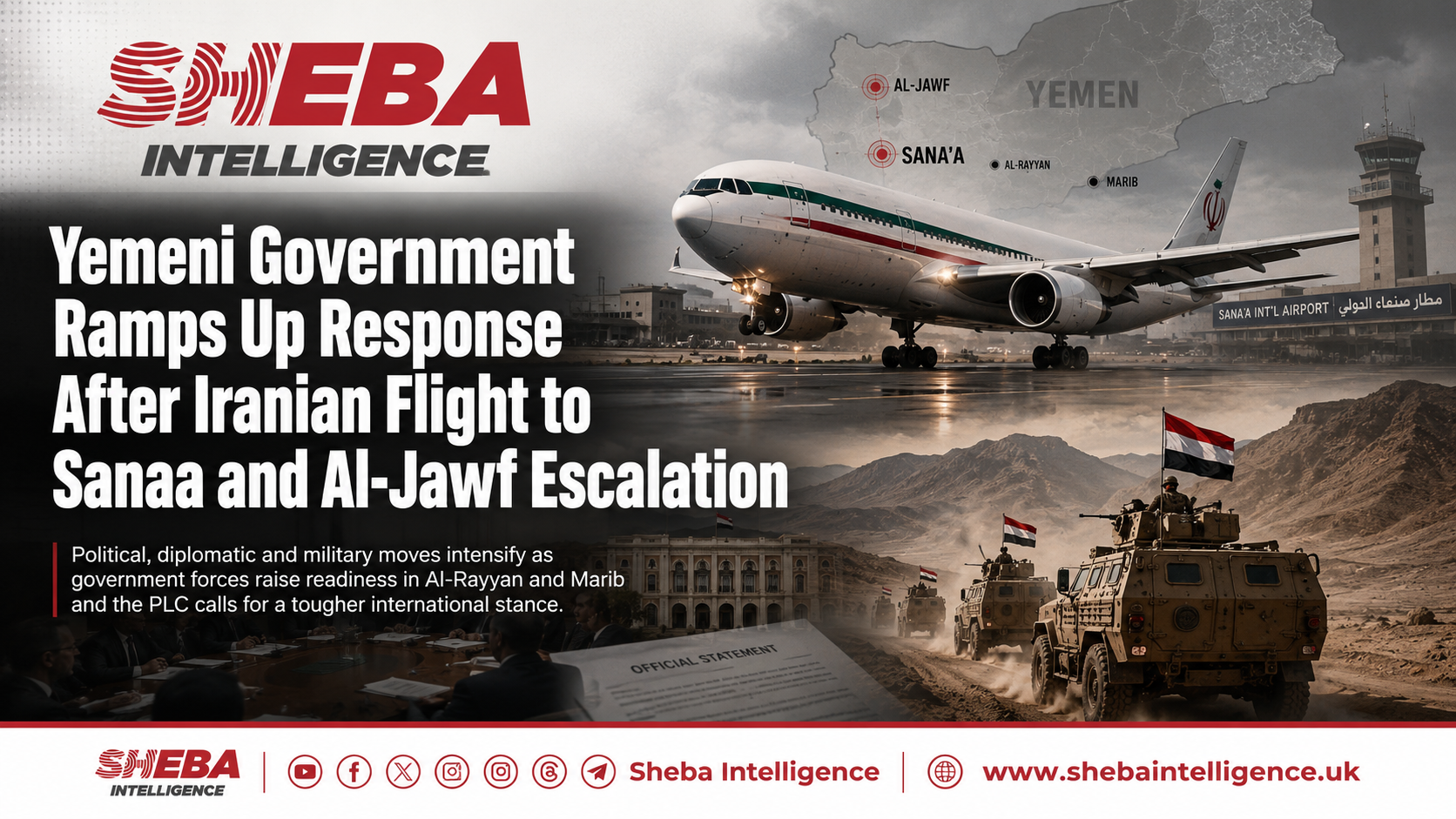
The Yemeni government and the Presidential Leadership Council have intensified political, diplomatic and military activity over the past 48 hours following the arrival of an Iranian flight at Houthi-controlled Sanaa airport and new field developments in Al-Jawf governorate.
According to informed sources, the Houthi group has deployed two brigades and a special force to areas linked to the Al-Jawf front, while the internationally recognized government has sent a brigade from the Emergency Forces to Al-Rayyan. The move was accompanied by high-level coordination with government forces in Marib, amid concerns that the Houthis may be preparing for wider military pressure on tribal and military fronts.
The developments come as Al-Rayyan has turned into a sensitive flashpoint after growing tribal mobilization in the area. Government-aligned forces appear to be seeking to prevent any Houthi move that could expand the confrontation toward Marib or deepen tensions with tribes in Al-Jawf.
Politically, Presidential Leadership Council Chairman Rashad Al-Alimi met on Monday with ambassadors of countries sponsoring the peace process in Yemen. He called for a firmer international position toward what he described as Iran’s direct intervention in Yemen, saying the Iranian Revolutionary Guard-linked flight to Sanaa represented a blatant violation of Yemeni sovereignty and a direct challenge to international law and relevant UN Security Council resolutions.
Al-Alimi urged an international investigation into the flight, including its cargo and the reported disruption of its tracking signal while crossing Yemeni airspace. He said preliminary information contradicted Houthi claims that the flight was humanitarian in nature, pointing instead to indications that it carried military and security personnel, Iranian experts, and equipment with potential use in communications and command-and-control systems.
In Aden, the Council of Ministers, chaired by Prime Minister and Foreign Minister Shaya Al-Zindani, discussed the latest political, military, security and economic developments, including what it called Houthi escalation and Iranian violations of Yemeni sovereignty. The cabinet backed the position of the Presidential Leadership Council and called for practical international measures to stop Iranian support to the Houthis, dry up funding and smuggling networks, and hold those responsible for the violations accountable.
The cabinet also reviewed a report from the defense minister on the military situation across several fronts. It praised the readiness of the armed forces and security units, and called for raising combat preparedness, improving operational coordination, and strengthening logistical readiness to deal with any possible field developments.
Separately, Defense Minister Lt. Gen. Taher Al-Aqili chaired a meeting of the Supreme Security Committee in Aden. The meeting focused on military and security developments and the implications of the Iranian flight to Sanaa. It stressed the need to activate a joint security and military operations room to unify efforts and improve response capacity.
The committee said the armed forces were ready to respond firmly to any hostile Houthi activity, while warning that international inaction toward Iran’s violations would increase risks for Yemen and the wider region.
In a message addressed to Yemenis living under Houthi control, Prime Minister Al-Zindani accused the group of returning to escalation whenever peace efforts advance. He said the government and the Saudi-led coalition had supported efforts to reopen Sanaa airport for civilian travel and allowed the flow of goods through Hodeidah port, but that the Houthis responded by targeting oil exports, holding Yemenia aircraft in Sanaa, and refusing proposals that would allow flights to resume without Houthi interference in the airline’s management or revenues.
Al-Zindani said the government had accepted peace efforts and the proposed roadmap, while the Houthis stalled, rejected implementation, and later dragged Yemen into a regional confrontation serving external agendas. He warned that any new Houthi attack would face a firm response aimed at imposing peace, security and stability.
The diplomatic track also expanded on Tuesday, when Al-Alimi received Egypt’s ambassador to Yemen, Ihab Abu Srie. The meeting came after developments linked to Somaliland and threats involving Socotra and the Red Sea. Al-Alimi praised Egypt’s role in supporting regional security and Arab interests, and stressed continued Yemeni-Egyptian coordination on regional and international challenges.
Taken together, the latest moves show that the Yemeni government is trying to frame the Iranian flight and Houthi military activity not as separate incidents, but as part of a broader challenge to Yemeni sovereignty, regional security, and international deterrence. The Al-Jawf front, especially the Al-Rayyan area, now appears to be one of the key pressure points where political escalation and military readiness are converging.