
Exclusive: Yemen Threatens Military Response After Iranian Flight Enters Houthi-Controlled Airspace
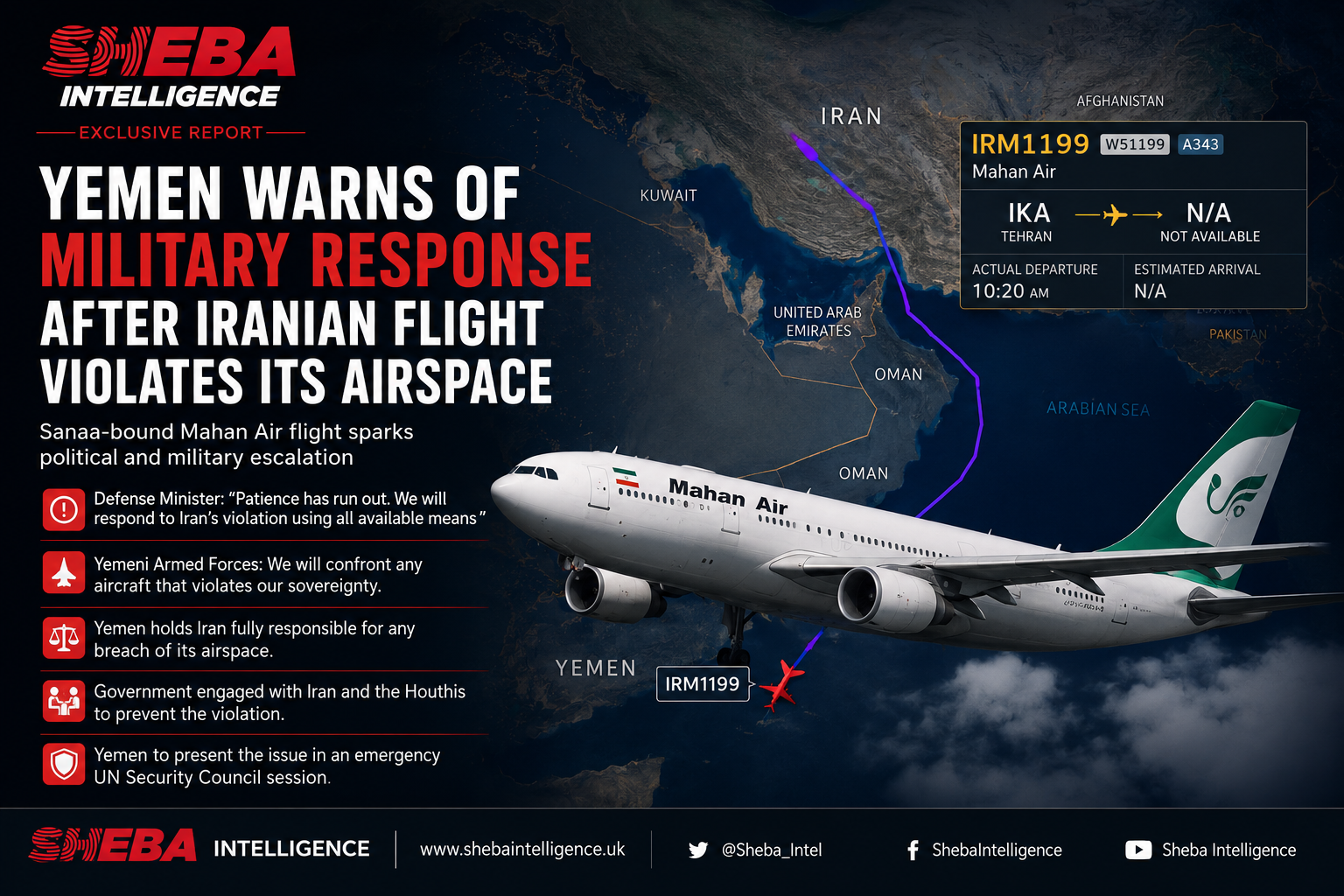
Government says "patience has run out" as emergency UN Security Council session looms over Tehran's direct flight to Sana'a
Yemen's internationally recognized government has sharply escalated its response to Iran's direct flight to Houthi-controlled Sana'a, with the Ministry of Defense issuing its strongest warning yet that any future violation of Yemen's airspace will be met with military action.
In an extraordinary statement, Defense Minister Lt. Gen. Taher Al-Aqili declared that "patience has run out,"announcing that the Yemeni Armed Forces would respond to any further Iranian violations "using all available means."The military said it would confront any aircraft violating Yemen's sovereignty and held Iran fully responsible for the legal and political consequences of any future incursions.
The statement marks the first official military threat by Yemen's government since Mahan Air resumed direct flights from Tehran to Sana'a without authorization from the internationally recognized authorities.
The latest flight, identified as Mahan Air Flight IRM1199 (W51199), departed Tehran's Imam Khomeini International Airport (IKA) and flew south across Iranian airspace before passing over the Gulf of Oman and approaching Yemen, according to publicly available flight-tracking data. The route has become the centerpiece of Yemen's argument that Tehran deliberately bypassed the government's exclusive authority over international civil aviation.
The military statement comes as President Rashad Al-Alimi intensifies diplomatic efforts ahead of an emergency UN Security Council session requested by Yemen to discuss what the government describes as an Iranian violation of its sovereignty.
During separate meetings with the Chinese and Russian ambassadors, Al-Alimi argued that authorizing international flights, managing national airspace, and coordinating civil aviation are sovereign powers reserved exclusively for the internationally recognized Yemeni government. He warned that any direct engagement with the Houthis on these matters undermines UN Security Council Resolutions 2140 and 2216 and risks creating a dangerous international precedent by allowing an armed non-state actor to exercise sovereign state functions.
The president also rejected claims that the dispute concerns humanitarian access, revealing that the government had proposed allowing flights to Sana'a through Yemenia Airways under internationally recognized legal procedures, including arrangements that could facilitate travel from Tehran. According to Al-Alimi, the rejection of that proposal demonstrated that the objective was not humanitarian relief but the establishment of an alternative Iranian-controlled air corridor outside the authority of the Yemeni state.
The combination of an unprecedented military warning, diplomatic consultations with permanent Security Council members, and the emergency UN meeting signals that the dispute has evolved beyond a single commercial flight. Yemen is framing the issue as a test of whether the international community will uphold state sovereignty over national airspace—or tolerate direct international engagement with an armed group controlling part of a UN member state's territory.