
Saudi Arabia’s Drug War: Border Seizures Point to a Changing Smuggling Market
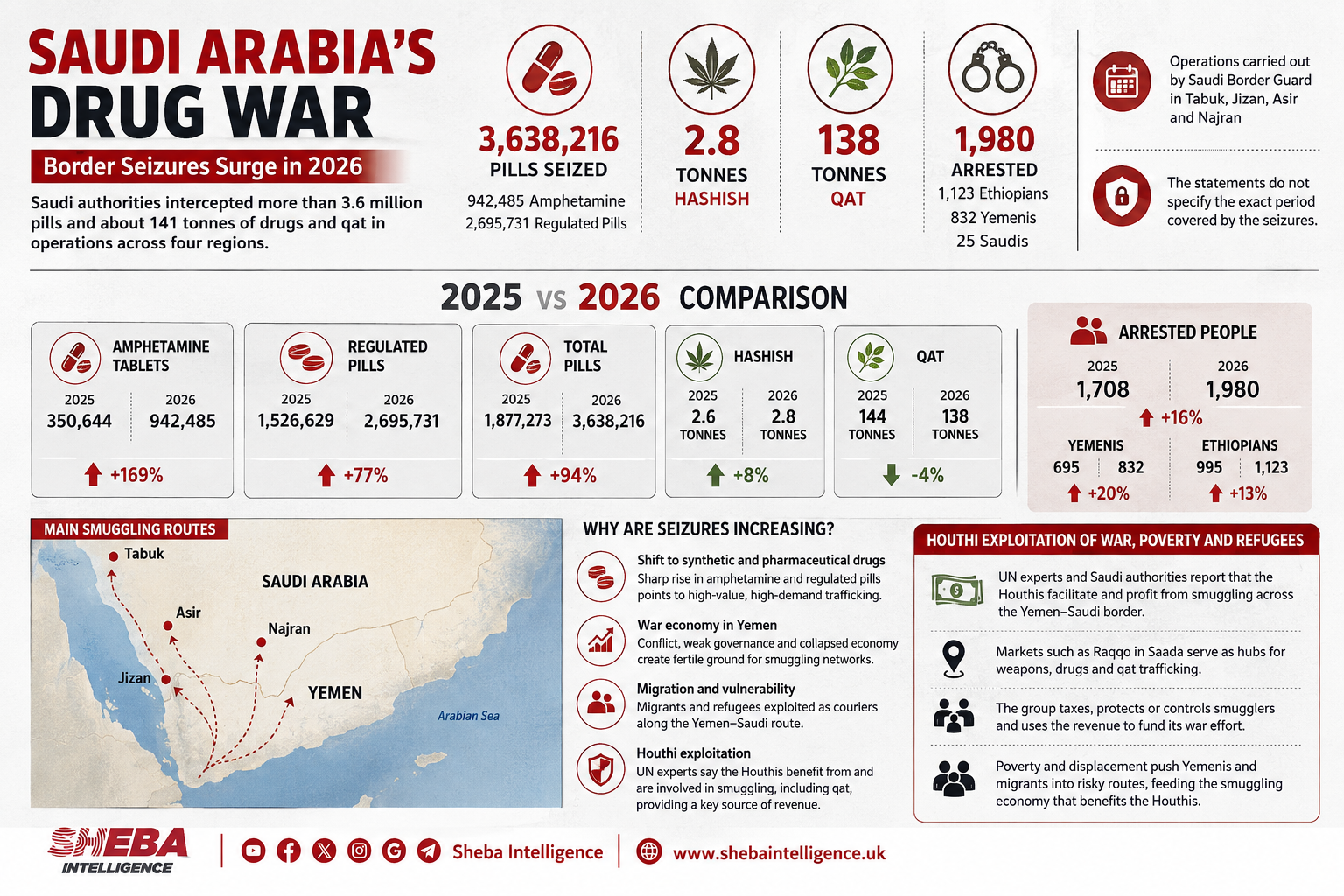
Amphetamine seizures nearly tripled in a year as Saudi authorities intercepted 3.6 million pills and 141 tonnes of drugs and qat. The figures also expose the growing intersection between narcotics, Yemen’s war economy and migrant-smuggling routes.
Saudi Arabia’s latest border seizures point to a significant change in the drug trade surrounding the Kingdom: pills are rising sharply, while the long-established traffic in qat and hashish remains stubbornly high.
On August 22, Saudi authorities said Border Guard operations in Tabuk, Jizan, Asir and Najran had intercepted 942,485 amphetamine tablets, 2.69 million medically regulated pills, 2.8 tonnes of hashish and 138 tonnes of qat.
Authorities arrested 1,980 people — 1,123 Ethiopians, 832 Yemenis and 25 Saudis.
The announcement closely mirrors one issued on August 18, 2025, covering the same four regions. That operation tally included 350,644 amphetamine tablets, 1.52 million regulated pills, 2.6 tonnes of hashish and 144 tonnes of qat, with 1,708 people arrested.
The two statements do not specify the exact period covered by the seizures, so they should not be treated as full-year national statistics. But their timing, format and geographical coverage make them useful snapshots of how the smuggling picture has changed.
Pills Are Driving the Increase
The most striking shift is in synthetic and pharmaceutical drugs.
Amphetamine seizures rose from 350,644 tablets in the 2025 announcement to 942,485 in 2026 — an increase of about 169 percent.
Regulated pharmaceutical pills climbed by roughly 77 percent, from 1.53 million to almost 2.7 million.
Combined pill seizures therefore increased from 1.88 million to 3.64 million, almost doubling within the two comparable announcements.
Hashish changed little, rising from 2.6 to 2.8 tonnes. Qat actually declined slightly, from 144 tonnes to 138 tonnes.
The figures suggest that the pressure on Saudi Arabia is no longer defined primarily by traditional cross-border commodities such as qat and cannabis. High-volume pill trafficking is becoming increasingly prominent.
The number of people arrested also rose by 16 percent. Yemeni detainees increased from 695 to 832, while Ethiopians rose from 995 to 1,123.
Seizures alone cannot show how much contraband successfully crossed the border. Higher figures can reflect more trafficking, better interdiction, or both. What they do show is the scale at which the Saudi border authorities are now confronting the trade.
Yemen’s War Changed the Smuggling Environment
Smuggling across the Saudi-Yemeni frontier predates the current war by decades. The conflict, however, transformed the environment in which those networks operate.
More than a decade of fighting has fragmented state authority, damaged legitimate trade and pushed large parts of Yemen deeper into an informal wartime economy. The United Nations says Yemen’s economy has contracted by more than half since the conflict began, while more than 21 million people are expected to require humanitarian assistance in 2026.
For smuggling networks, that creates a large pool of vulnerable people, poorly governed territory and established informal routes connecting the Arabian Sea, Gulf of Aden, Red Sea and Saudi border.
The maritime side is also important. In June 2026, the UN Office on Drugs and Crime highlighted the interception of 432 kilograms of methamphetamine aboard a dhow off Yemen’s Red Sea coast. UNODC said traffickers use dhows, fishing boats and small vessels to conceal narcotics within normal maritime traffic.
That seizure illustrates how Yemen can function not only as a source of locally produced qat but also as a transit corridor for higher-value narcotics moving through regional maritime networks.
Houthis, Smuggling and War Finance
The Houthi-controlled northwest adds another layer.
A UN Panel of Experts investigation has examined drug trafficking as a potential source of Houthi war financing. In its 2023 report, the Panel said Saudi authorities had provided information that narcotics and other contraband moving across the Yemen-Saudi border were being “aided and abetted” by the Houthis as a means of generating funds for their war activities.
The Panel identified Raqqo market in Munabbih district of Saada as a major smuggling hub near the Saudi frontier. According to information supplied to the investigators, weapons and drugs were traded there and networks involving Yemenis and Ethiopian migrants operated around the market.
A subsequent UN investigation went further. The 2024 Panel of Experts reviewed the case of drugs discovered inside sugar containers at Aden port and said its examination of court records and interviews with counterterrorism officials revealed Houthi involvement in the smuggling operation.
The latest UN Panel report also describes smuggling more broadly as providing the Houthis with economic benefits and says the group maintains extensive relationships with trafficking networks connecting Yemen and Somalia.
This does not establish that the 3.6 million pills announced by Saudi Arabia this week originated in Houthi areas. The Saudi statement provides no route or source for individual consignments.
It does, however, place the latest seizures inside a wider documented smuggling economy that has developed around Yemen’s war.
Qat is particularly suited to this economy. It is produced extensively in Yemen, has established local trading networks and can be moved in relatively small loads across mountainous terrain. Drugs, cigarettes, weapons and other contraband can use many of the same routes and brokers.
Poverty and Migrants as Part of the Smuggling Chain
The nationality breakdown in the Saudi figures is also significant.
Yemenis and Ethiopians accounted for almost all those arrested in the latest announcement. That closely reflects one of the busiest irregular migration corridors in the region: from Ethiopia and the Horn of Africa, across the Gulf of Aden into Yemen, north through Houthi-controlled Saada and towards Saudi Arabia.
It would be misleading to treat every migrant caught with contraband as a member of an organized trafficking network.
Research into the route instead shows how vulnerable migrants can be absorbed into the smuggling economy.
Human Rights Watch has documented migrants being detained, beaten and forced to make payments to smugglers along the Yemen route. Migrants interviewed by the organization also described Houthi forces working with smugglers in Saada, keeping records of payments and detaining people unable to pay.
Some migrants arrive already fleeing poverty, conflict or repression in the Horn of Africa. Once in Yemen, debt and extortion can leave them dependent on smugglers for food, transport and access to the Saudi border.
A July 2026 case documented by Human Rights Watch illustrates the vulnerability: an Ethiopian migrant convicted in Saudi Arabia of drug smuggling was reported to have been forced by a smuggler to carry qat from Yemen as the price for continuing his journey.
This gives the trafficking economy a readily available source of couriers.
For armed actors and established smugglers, the economics are attractive: poverty supplies recruits, migration creates human transport networks, war weakens oversight, and Saudi Arabia provides a wealthy destination market.
In Houthi-controlled areas, the evidence indicates that this economy can produce revenue through direct trafficking, fees, protection, taxation or control over the routes used by smugglers. The available evidence is stronger for Houthi involvement in and benefit from smuggling networks than for any claim that the group controls every narcotics shipment entering Saudi Arabia.
A Drug War With Several Fronts
Saudi Arabia therefore faces more than one trafficking problem.
Qat remains a mass-volume border trade. Hashish continues to move through established land and maritime routes. Synthetic drugs and regulated pharmaceutical tablets are expanding much faster. At the same time, irregular migration, human trafficking and narcotics increasingly overlap along the southern frontier.
The 2025–2026 comparison captures that change.
Amphetamine seizures: +169%
Regulated pills: +77%
All pills combined: +94%
Yemeni suspects: +20%
Ethiopian suspects: +13%
Behind those numbers lies a larger regional problem. Yemen’s war has not created the drug trade, but it has produced many of the conditions in which it thrives: fragmented authority, poverty, armed networks, uncontrolled coastlines and a generation of people dependent on informal economies.
For Saudi Arabia, this means the southern border is no longer simply a line to be defended against individual smugglers. It has become one end of a trafficking system extending from the Horn of Africa and Yemen’s coastline through areas controlled by competing armed actors and into one of the region’s largest consumer markets.