Sheba Intelligence Returns After Nearly Two Years with Expanded Coverage of Yemen, Sudan and Somalia

Sheba Intelligence has resumed publication after a pause of nearly two years, returning with a broader editorial focus on information-led journalism, investigations, and analytical coverage from Yemen, Sudan and Somalia.
The relaunch marks a new chapter for the English-language platform, which had previously built its identity around exclusive reporting, investigative files, and close monitoring of Yemen’s political, security, economic and humanitarian developments. Some of its earlier reporting was later cited in external research and monitoring outputs, including work on corruption, public-sector governance in Yemen’s electricity sector, and economic tracking initiatives that referenced Sheba Intelligence as a source.
In its new phase, Sheba Intelligence is moving beyond single-country coverage to position itself as a specialized platform following three interconnected crisis arenas around the Red Sea, the Gulf of Aden, Bab al-Mandab and the Horn of Africa. Its editorial agenda will focus on special reports, investigations, security and political analysis, humanitarian trends, regional influence, maritime security, and the role of armed actors operating outside full state control.
The platform’s return coincided with the publication of three country reports examining the broader landscape in Yemen, Sudan and Somalia during 2025. The reports seek to help fill the information gap left by the platform’s absence and provide readers with a wider picture of the major shifts that shaped each country over the past year.
The Yemen report, titled “Yemen 2025: From Houthi Escalation to the Crisis of State Authority,” examines how the Yemeni crisis moved from Houthi escalation and Red Sea tensions into a deeper crisis involving sovereignty, governance, economic survival, and divisions within the anti-Houthi camp. The report argues that Yemen in 2025 was not static; it was changing beneath the surface, with the conflict shifting from open frontlines to deeper contests over authority, legitimacy, the economy and identity.
The Sudan report, “Sudan 2025: From Battlefield Gains to the Risk of State Fragmentation,” traces the war’s evolution from a military confrontation between the Sudanese Armed Forces and the Rapid Support Forces into a wider struggle over territory, legitimacy, humanitarian survival and the future of the Sudanese state. It highlights the army’s gains in central Sudan, the emergence of competing claims to governance, the deepening humanitarian catastrophe in Darfur and Kordofan, and the growing risk of de facto state fragmentation.
The Somalia report, “Somalia 2025: Al-Shabaab’s Renewed Rise and the Battle to Build a Federal State,” focuses on the intersection of renewed Al-Shabaab pressure, the security transition from ATMIS to AUSSOM, tensions between Mogadishu and federal member states, constitutional disputes, and regional competition around the Gulf of Aden and Bab al-Mandab. The report concludes that Somalia’s challenge is not only to defeat Al-Shabaab militarily, but also to build the political consensus and state presence needed to make any security gains sustainable.
Taken together, the three reports reflect the platform’s renewed editorial approach: combining field-oriented information, investigative interest and strategic analysis to explain how local conflicts are increasingly tied to regional rivalries, maritime routes, humanitarian crises and international security concerns.
The return of Sheba Intelligence comes at a time when the crises in Yemen, Sudan and Somalia are becoming more interconnected. All three countries face fragile state institutions, armed actors operating beyond full state authority, mounting humanitarian pressures, and growing regional and international competition. Their geography also places them at the heart of some of the world’s most sensitive maritime and security corridors.
By relaunching with comprehensive 2025 country reports, Sheba Intelligence is seeking to reconnect with its readers and reintroduce itself as a platform focused on depth, not speed alone. Its new phase appears to be built around a clear editorial proposition: to provide international readers with credible, information-rich reporting from countries too often reduced to crisis headlines.
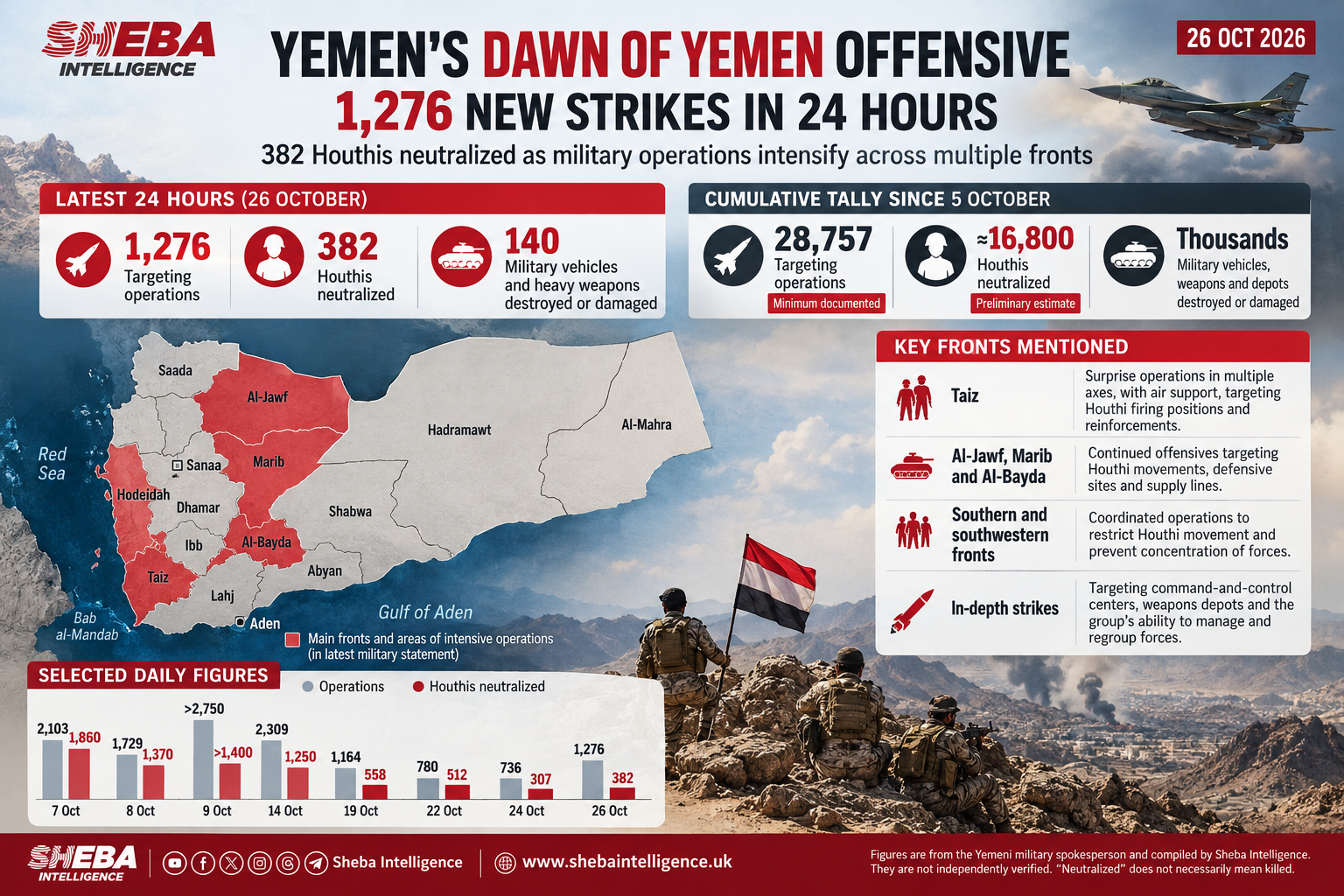
The platform is expected to continue publishing special reports, investigative stories, infographics and analytical briefs on Yemen, Sudan and Somalia, with particular attention to armed groups, state fragmentation, maritime security, humanitarian access, regional influence and governance failures.
For readers returning after the platform’s pause, the message is clear: Sheba Intelligence is back with a wider geographic scope, a sharper investigative focus, and an ambition to cover three crisis arenas that are increasingly shaping the future of the Red Sea and the Horn of Africa.