Three Senior Houthi Brigade Commanders Killed in Taiz as Internal Purge and Security Breach Fears Trigger Investigation
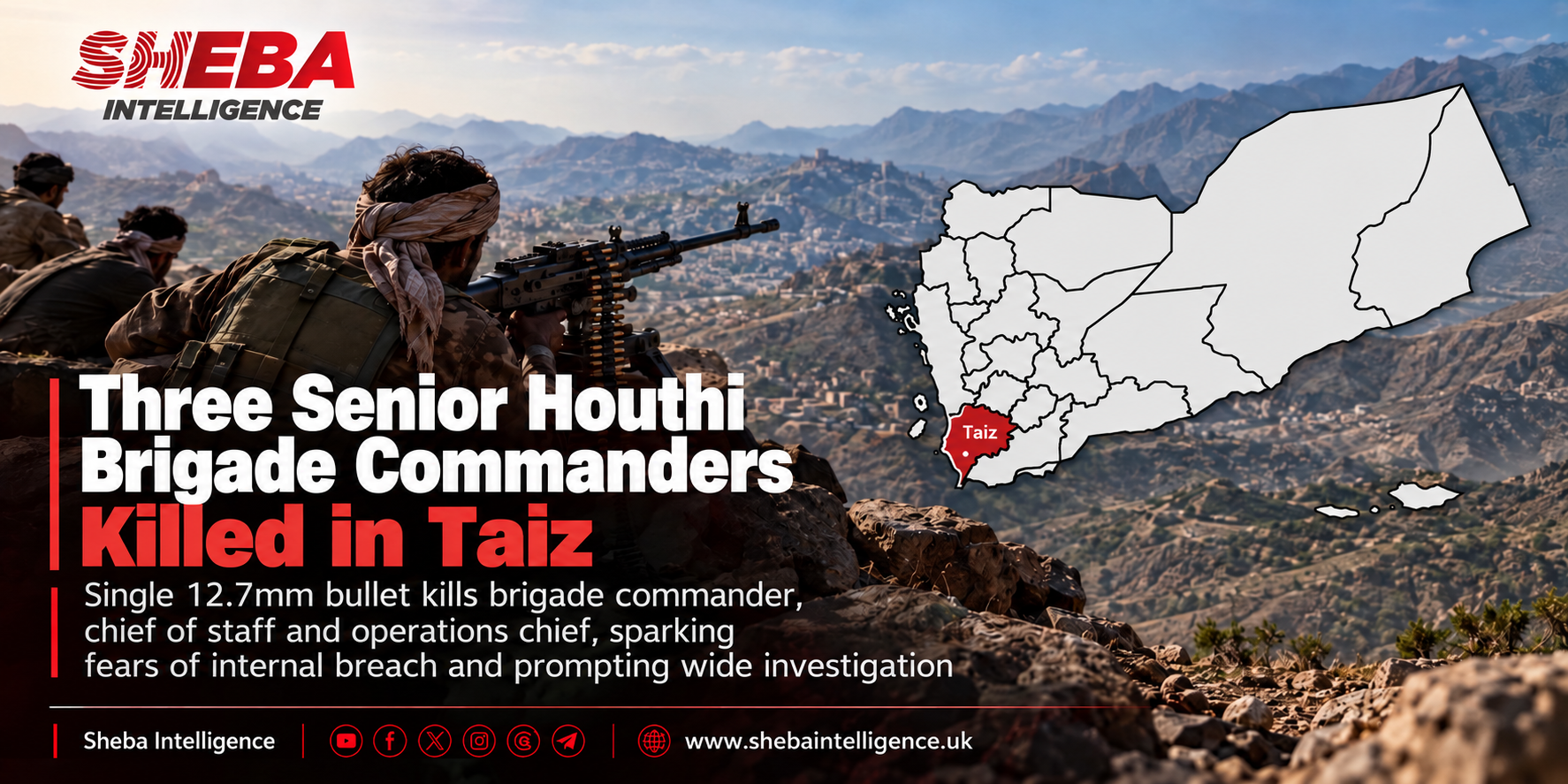
Exclusive military sources say the brigade commander, chief of staff and operations commander were killed in a single shooting incident involving a 12.7mm heavy machine gun, raising questions over possible deliberate targeting, infiltration or friendly fire.
Three senior commanders of a Houthi military brigade have been killed under suspicious circumstances in rural Taiz, southwestern Yemen, triggering a broad internal investigation amid fears of a possible security breach or deliberate elimination from within the group, exclusive military sources told Sheba Intelligence.
The sources said the casualties included the brigade commander, his chief of staff and the brigade's operations commander, all of whom were killed at the same location and at approximately the same time.
According to the sources, preliminary Houthi investigations indicated that the three commanders were struck by fire from a 12.7mm heavy machine gun, with initial accounts suggesting they may have been hit by a single round.
The unusual circumstances surrounding the deaths have reportedly raised serious concerns within the group over whether the commanders were deliberately targeted by individuals with prior knowledge of their movements.
The sources revealed that the three officers had entered forward positions to conduct a battlefield reconnaissance mission without submitting prior operational notification or coordinating their movements through the established command structure.
Their unannounced presence near the front lines has complicated efforts to establish whether the incident resulted from a planned operation, an internal security breach, mistaken identification by friendly forces, or an accidental encounter with hostile fire.
According to the sources, Houthi investigators are examining the circumstances of the commanders' movements, the origin of the gunfire and whether their deaths were intentional or accidental.
No conclusive findings identifying those responsible have been disclosed, and the allegations of internal elimination or infiltration remain unverified.
Intensified Airstrikes and Ground Operations Weaken Houthi Positions in Taiz
The incident comes amid sustained military pressure on Houthi forces in Taiz, where Yemeni government troops, supported by fighter aircraft, drones and artillery, have conducted repeated attacks against the group's defensive positions, reinforcements, command structures and supply routes since the launch of Operation Dawn of Yemen in early October.
On October 12, Yemeni military spokesperson Colonel Majed al-Nuzaili reported that airstrikes had hit Houthi reinforcements and military convoys heading toward the Taiz fronts, disrupting troop concentrations and efforts to reinforce forward positions.
Subsequent military statements described further attacks against Houthi heavy weapons, defensive fortifications and supply movements.
On October 18, government forces reported capturing additional positions and recovering heavy weapons and military equipment in Taiz while striking Houthi reinforcements.
The following days saw continued fighting, with government forces reporting the disruption of Houthi attempts to retake lost positions.
On October 23, the military announced further advances along the Al-Aqrud front, saying its forces had carried out raids and counterattacks that prevented Houthi units from regrouping or recovering previously lost positions.
These developments suggest sustained pressure on the group's personnel, logistics and command arrangements, although the precise extent of its battlefield losses in Taiz cannot be independently established from nationwide military figures.
More Than 26,700 Military Operations and Approximately 16,100 Houthi Fighters Neutralized
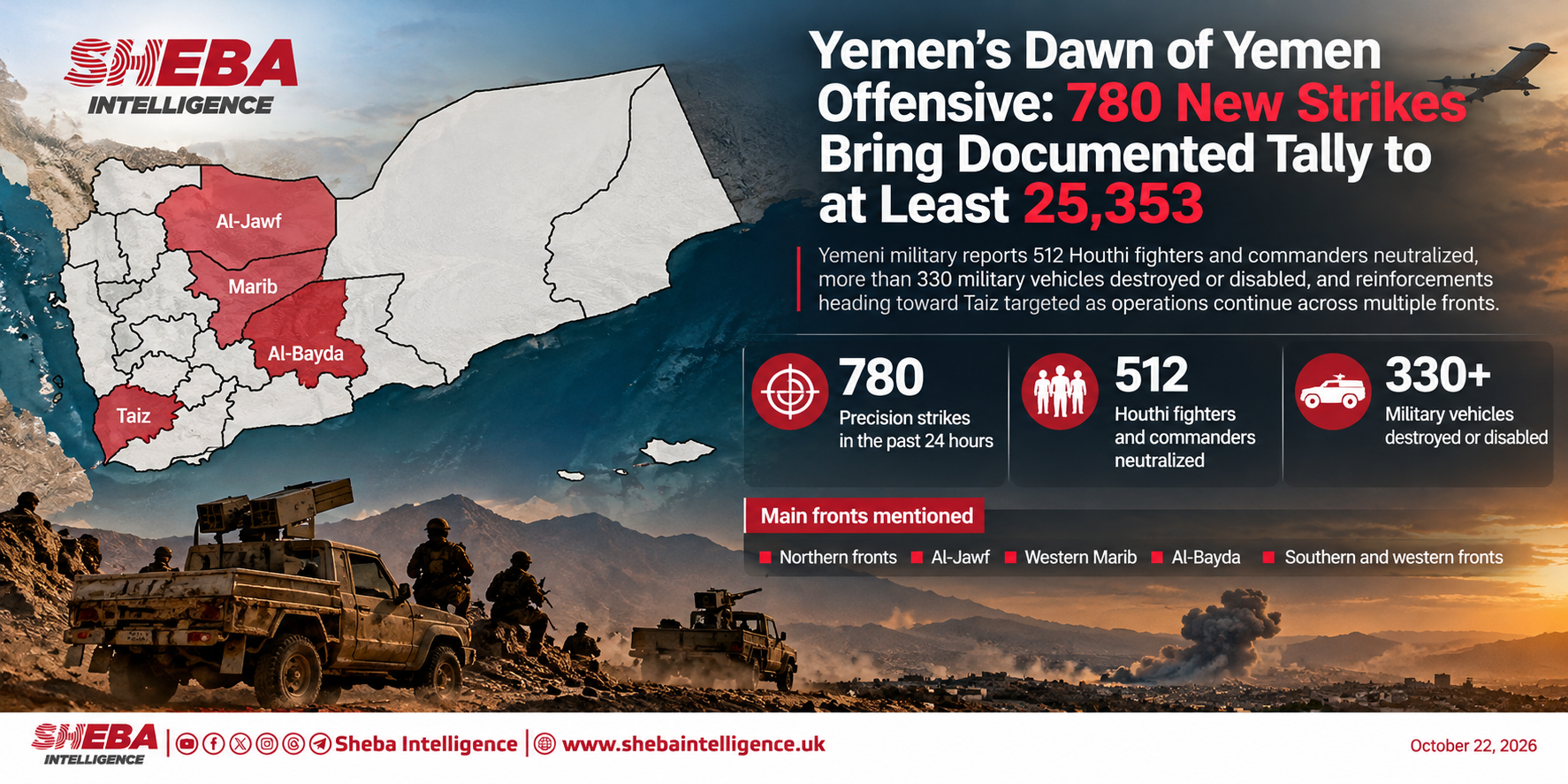
According to figures compiled by Sheba Intelligence from statements issued by the Yemeni Armed Forces, Operation Dawn of Yemen had recorded at least 26,745 targeting operations by October 23, 2026.
The cumulative figures indicate that approximately 16,100 Houthi fighters had been neutralized across the various fronts since the operation began, including field commanders and specialized military personnel.
The figures remain preliminary and are based on military statements rather than independently verified casualty records.
The cumulative number of targeting operations includes fighter aircraft, drones, artillery, rocket launchers and ground units. It should not be interpreted as the number of airstrikes alone.
Similarly, the military term neutralized does not necessarily mean killed. Available reports do not provide a verified breakdown distinguishing fatalities from injuries, captures or other forms of removal from combat.
The figures cover multiple Yemeni fronts and cannot be attributed exclusively to Taiz.
Nearly 3,000 Unburied Bodies Reported in Dhamar
The reported killing of the three commanders follows earlier Sheba Intelligence findings concerning the scale of Houthi battlefield losses and growing difficulties in replacing military personnel.
In an investigation published on October 15, Sheba Intelligence cited medical and tribal sources reporting that nearly 3,000 bodies of Houthi fighters remained unburied at a hospital in Dhamar governorate.
A medical student assigned to the hospital's morgue told the network that the bodies were being held in refrigerated facilities awaiting burial. The reported figure did not include fighters whose bodies had previously been received and buried.
Sources also reported that bodies had been transferred to Dhamar after morgue facilities in Taiz and Ibb reached capacity, while others were transported to Sanaa.
The investigation further revealed that the Houthis had expanded recruitment efforts to include university and high school students, while deploying security personnel to reinforce combat units facing mounting losses.
Sheba Intelligence was unable to independently verify the reported number of bodies through hospital records.
Houthi Losses Extend to Ideological and Hashemite Families
Another indication of the mounting human toll is the emergence of public mourning announcements in Sanaa by families identifying as Hashemite, commemorating members reportedly killed in the fighting. The development suggests that battlefield losses may be extending beyond ordinary recruits and field commanders to the ideological and hereditary networks traditionally regarded as part of the Houthi movement's core support base, raising questions about the depth of attrition within the group's inner circles.
Command Losses Raise New Security Questions
The killing of the brigade commander and his two senior officers adds a potentially significant command-level incident to the broader military pressure facing Houthi forces in Taiz.
While the group has been confronting repeated airstrikes, ground assaults and reported personnel losses, the circumstances of this incident have raised a separate question concerning the security of its senior field commanders.
The investigation is particularly sensitive because the three officers reportedly moved together into forward positions without prior operational coordination.
Whether their deaths resulted from deliberate targeting, an internal breach, friendly fire or an accidental battlefield encounter remains unresolved.
The incident illustrates how the loss of senior officers under unexplained circumstances can create additional uncertainty within military command structures already operating under sustained battlefield pressure.