Yemen Accuses Houthis of Turning Civilian Telecom Networks into Tools for Espionage and Military Operations
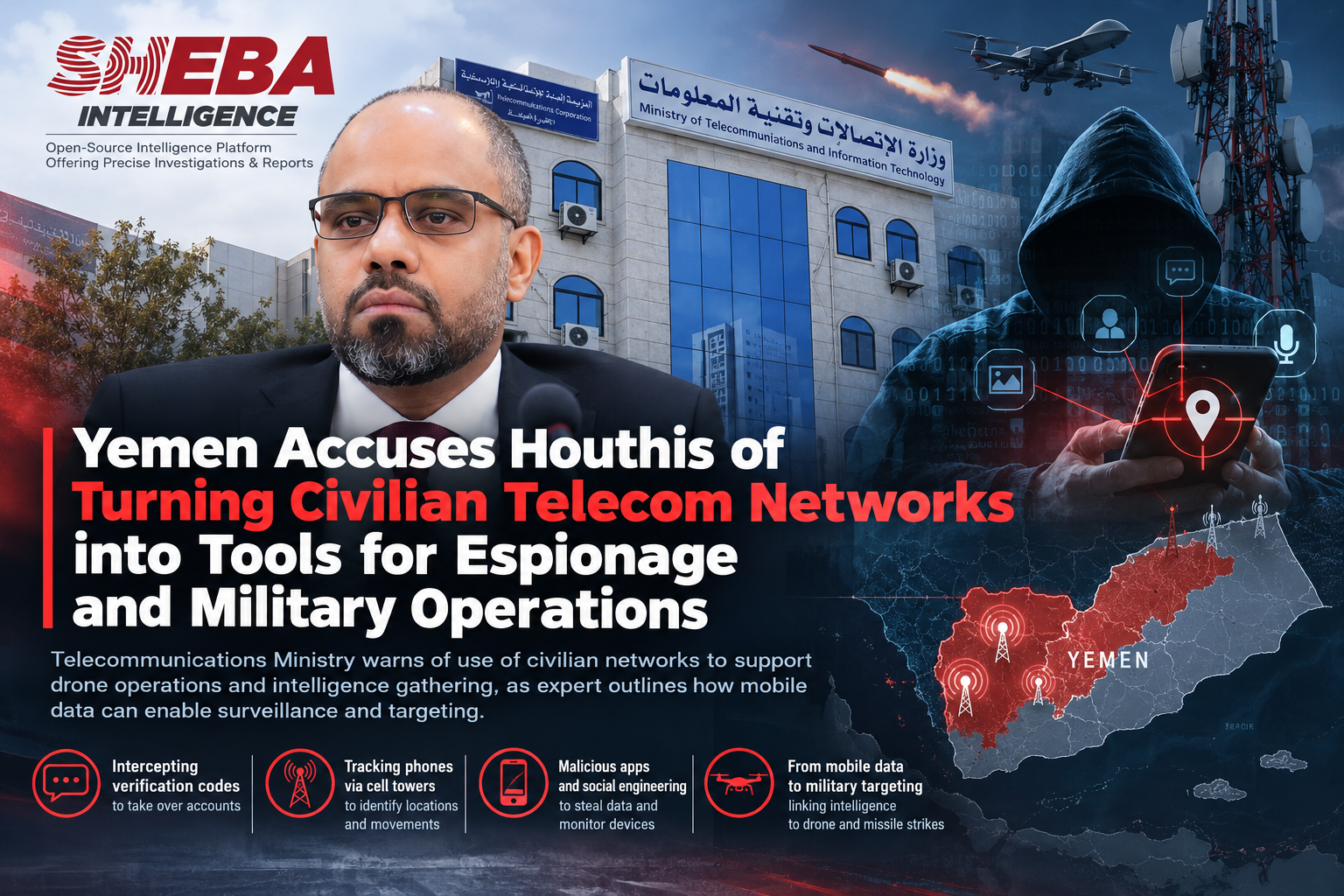
Yemen’s Telecommunications Ministry warns that civilian networks are being used to support drone operations and intelligence gathering, while a technical expert outlines how mobile data could facilitate surveillance, account compromise and military targeting.
Yemen’s Ministry of Telecommunications and Information Technology has accused the Houthis of exploiting civilian telecommunications networks and internet infrastructure to support military and intelligence operations, including drone and missile activities, surveillance and the collection of sensitive information.
In a statement issued on October 13, the ministry warned that the use of civilian communications infrastructure for military purposes poses serious risks to civilians and vital public services.
The ministry said the Houthis have used telecommunications networks under their control to monitor citizens, collect personal information, spread disinformation and support security operations.
It also accused the group of deliberately disrupting telecommunications and internet services in Taiz governorate, describing the shutdowns as part of practices that deprive civilians of essential services and could conceal abuses.
From Network Control to Digital Surveillance
The government's warning comes amid growing concerns over the security implications of Houthi control over major components of Yemen's telecommunications infrastructure.
In a technical article titled From Mobile Numbers to Missile Targeting, telecommunications specialist Raed Al-Thabeti explains how control over the international internet gateway, telephone exchanges and mobile networks could provide extensive capabilities for digital surveillance and intelligence collection.
Al-Thabeti identifies three principal risks: interception of SMS verification codes used to secure online accounts, analysis of call detail records (CDRs) and cell-site location information (CSLI) to track mobile devices, and the use of deep packet inspection (DPI) to monitor and control internet traffic.
According to his analysis, access to telecommunications infrastructure could enable the interception of one-time passwords (OTPs), potentially allowing attackers to compromise accounts linked to mobile numbers without directly breaking the encryption protecting messaging services such as WhatsApp and Telegram.
Mobile network records can also reveal approximate device locations and movement patterns, even when GPS location services are disabled.
However, location accuracy depends on network coverage, tower density and available technical capabilities, and cell-tower positioning does not necessarily provide GPS-level precision.
Malicious Applications and Social Engineering
Al-Thabeti also describes the risks posed by malicious applications disguised as civilian services, humanitarian assistance platforms, news applications or military information services.
Such applications may be designed to extract sensitive files, access messages, activate microphones or cameras, and collect location information through permissions granted by unsuspecting users.
His analysis also highlights social engineering operations involving fake social media accounts, impersonation of journalists or humanitarian organizations, and fraudulent links designed to steal login credentials or distribute malicious software.
These techniques present particular risks to military personnel, journalists, political figures and humanitarian workers whose devices may contain sensitive contacts, operational information or confidential sources.
The specific applications and campaigns described in the technical article would require independent digital forensic evidence to establish their connection to particular Houthi operations.
Military Risks: From Mobile Data to Targeting Intelligence
A central concern raised in Al-Thabeti's analysis is the potential use of mobile phone data to support battlefield surveillance and targeting.
Information obtained through telecommunications networks or compromised devices could reveal movement patterns, identify the presence of individuals in particular areas and provide intelligence relevant to military operations.
Such information becomes particularly sensitive in conflict zones, including Marib, Taiz and Yemen's western coast, where the movements of military personnel and commanders may carry operational significance.
Al-Thabeti also discusses the potential deployment of mobile surveillance equipment, including IMSI catchers, which can imitate cellular base stations to collect device identifiers and, depending on network conditions and technical capabilities, obtain additional communications or location information.
The integration of telecommunications intelligence with other reconnaissance sources could contribute to military targeting. However, converting mobile location data into an accurate missile or drone strike requires additional verification, targeting capabilities and timely intelligence.
The ministry's statement did not provide technical evidence establishing a specific instance in which intercepted mobile data directly resulted in a missile strike.
Government Calls for International Intervention
The Ministry of Telecommunications held the Houthis responsible for the consequences of using civilian communications networks for military and intelligence purposes, warning that such practices endanger civilians and essential infrastructure.
It called on the United Nations, the International Telecommunication Union (ITU) and the international community to intervene and pressure the group to stop using civilian telecommunications infrastructure for military operations and surveillance.
The ministry also warned residents in Houthi-controlled areas about potential monitoring and privacy violations, urging telecommunications engineers and technical personnel not to cooperate with efforts to redirect civilian networks toward military or intelligence activities.
The Yemeni government said it is working to establish secure and independent telecommunications and internet alternatives in government-controlled areas to ensure service continuity and protect civilian users.
The latest warning highlights how Yemen's telecommunications infrastructure has become a significant security concern beyond the provision of civilian services.
Control over digital networks can provide access to sensitive communications metadata, facilitate surveillance and potentially support military intelligence operations, raising questions about data protection, civilian safety and the use of essential infrastructure during armed conflict.
Make the report more news-firstSeparate ministry claims from analysis